
Pope Leo XIV Canary Islands visit spotlights migrant crisis at Arguineguín
Pope Leo XIV’s Canary Islands visit underscores the migrant crisis as he met arrivals in Arguineguín, threw flowers into the sea and urged legal, safe routes for asylum seekers.
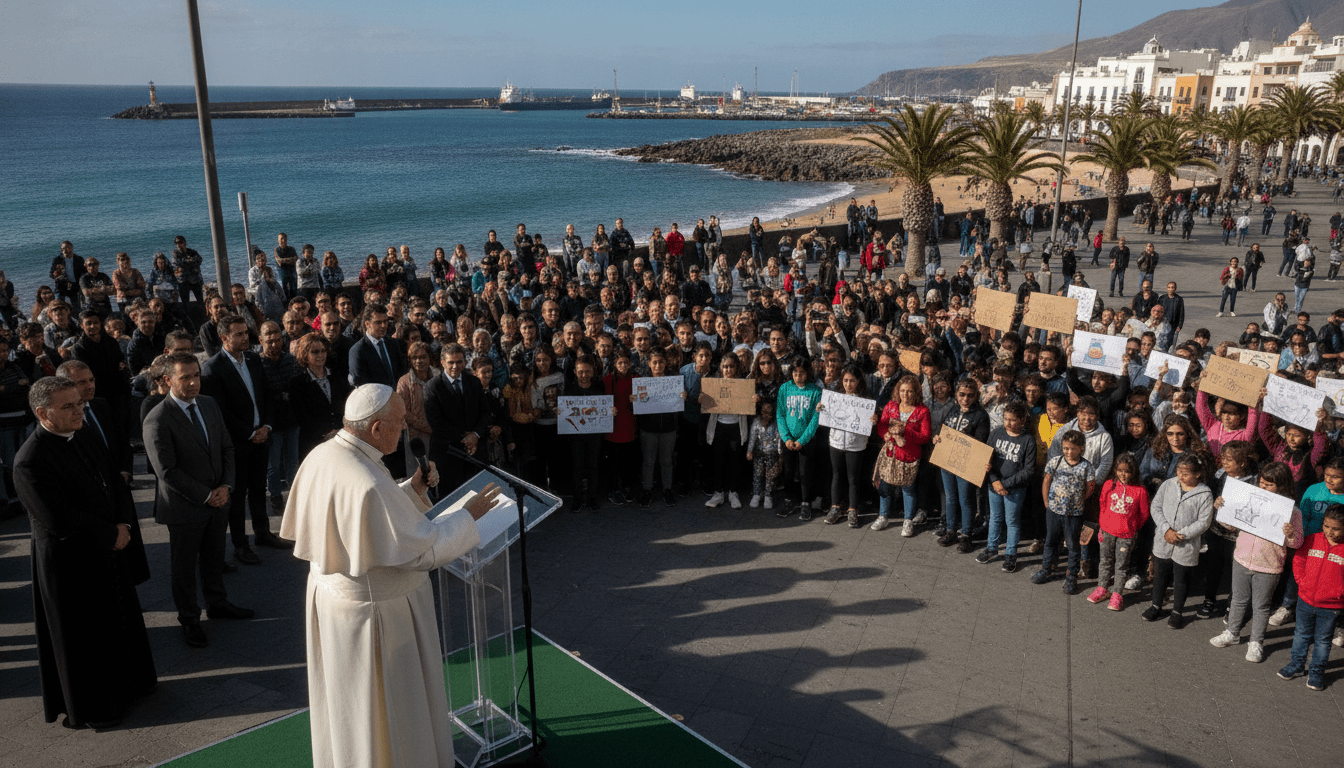
Pope Leo XIV arrived on Thursday and traveled straight to the small port of Arguineguín, where roughly 1,000 migrants had gathered to see him. The pope used his Canary Islands visit to emphasize the human dignity of people who have crossed dangerous waters, saying he wished to “bow before your dignity” and reminding officials that those arriving are not mere statistics. His presence in the harbor underscored continuity with his predecessor, who also drew attention to deaths at sea and the plight of migrants landing on remote islands.
Pope Leo XIV greets migrants at Arguineguín harbor
At the improvised stage overlooking the water the pope spoke directly to the people assembled, many of whom had survived perilous transatlantic crossings. He thanked local volunteers and residents for their assistance and described the meeting as an expression of solidarity with those who have made dangerous journeys seeking safety. The scene was solemn but intimate, with migrants, aid workers and islanders listening as Leo called for compassion in the treatment of arrivals.
Authorities said the harbor had been a focal point of chaotic landings during the pandemic, when thousands converged there under difficult conditions. The pope framed his visit as an effort to transform what had been called a “Mole of Shame” into a “Mole of Hope,” praising the humanity shown by communities across the islands. He pressed political leaders to adopt responses that respect dignity rather than treating people as numbers.
Message to politicians and islanders: dignity over numbers
Addressing regional and national officials, Leo chastised approaches that focus solely on managing arrivals or strengthening borders without prioritizing rescue and humane reception. He warned that proclaiming respect for human dignity while tolerating deaths at sea is a contradiction, insisting that dignity “has no passport” and does not vanish at a border. The pope called explicitly for “legal and safe ways, rescue and help” to prevent the seas from becoming “cemeteries without gravestones.”
His remarks aimed at policy as well as public sentiment, urging European governments to consider migration as a collective moral challenge rather than only an administrative problem. By linking appeals for humanitarian measures with concrete praise for island volunteers, the visit sought to influence both political debate and public response on migration policy.
Commemoration at sea echoes Lampedusa gesture
In a deliberate echo of his predecessor’s 2013 action in Lampedusa, Pope Leo XIV cast a colorful wreath into the Atlantic to honor those who drowned while attempting to reach Europe. He also blessed a cross fashioned from the blue planks of a cayuco, a simple wooden boat type often used on these crossings, underscoring the fragility and desperation of many voyages. The symbolic acts were intended to keep public attention on migrant deaths and to humanize those who perish en route.
Photographs from the ceremony showed the pope standing by the water as waves lapped the harbor, replicating a ritual that has become a potent image of papal concern for migration tragedies. The visual symbolism reinforced his verbal message that remembrance must be paired with action to prevent further loss of life.
Visit to Las Raíces reception center and focus on children
Before returning to Rome, the pope is scheduled to visit the Las Raíces reception center on Tenerife, where many newly arrived migrants are processed and cared for. Church and aid groups have long run pastoral and welfare programs at such centers, and his planned stop signals attention to day-to-day relief efforts as well as high-level advocacy. The visit is also timed to highlight the particular vulnerability of unaccompanied minors.
Regional officials report that around 6,000 minors remain on the islands awaiting transfer or longer-term arrangements, straining limited resources and testing coordination between regional and national authorities. The pope’s itinerary underscores both the humanitarian demands on local systems and the need for greater capacity and legal pathways to resolve prolonged stays.
Arrival statistics and pressure on island reception systems
Migration flows to the Canary Islands have fluctuated sharply in recent years, with total arrivals reported at more than 17,500 in 2025 after nearly 44,000 the year before. This year’s figures are substantially lower, with roughly 3,100 migrants arriving so far — about one-third of the number recorded in the first half of 2025 — yet the impact on island services remains significant. Officials say the uneven rhythm of arrivals and the concentration of vulnerable groups, particularly minors, create persistent operational and humanitarian challenges.
Local governments and non-governmental organizations continue to call for enhanced coordination, quicker transfers to the mainland, and expanded legal channels to reduce reliance on perilous crossings. The pope’s public focus on those themes is likely to intensify pressure on Madrid and European partners to reconcile border management with humanitarian obligations.
Pope Leo XIV’s Canary Islands visit combined ritual, direct engagement and political appeals, using symbolism and personal encounters to press for safer migration routes and humane reception practices while highlighting the ongoing strain on island communities and reception systems.
