
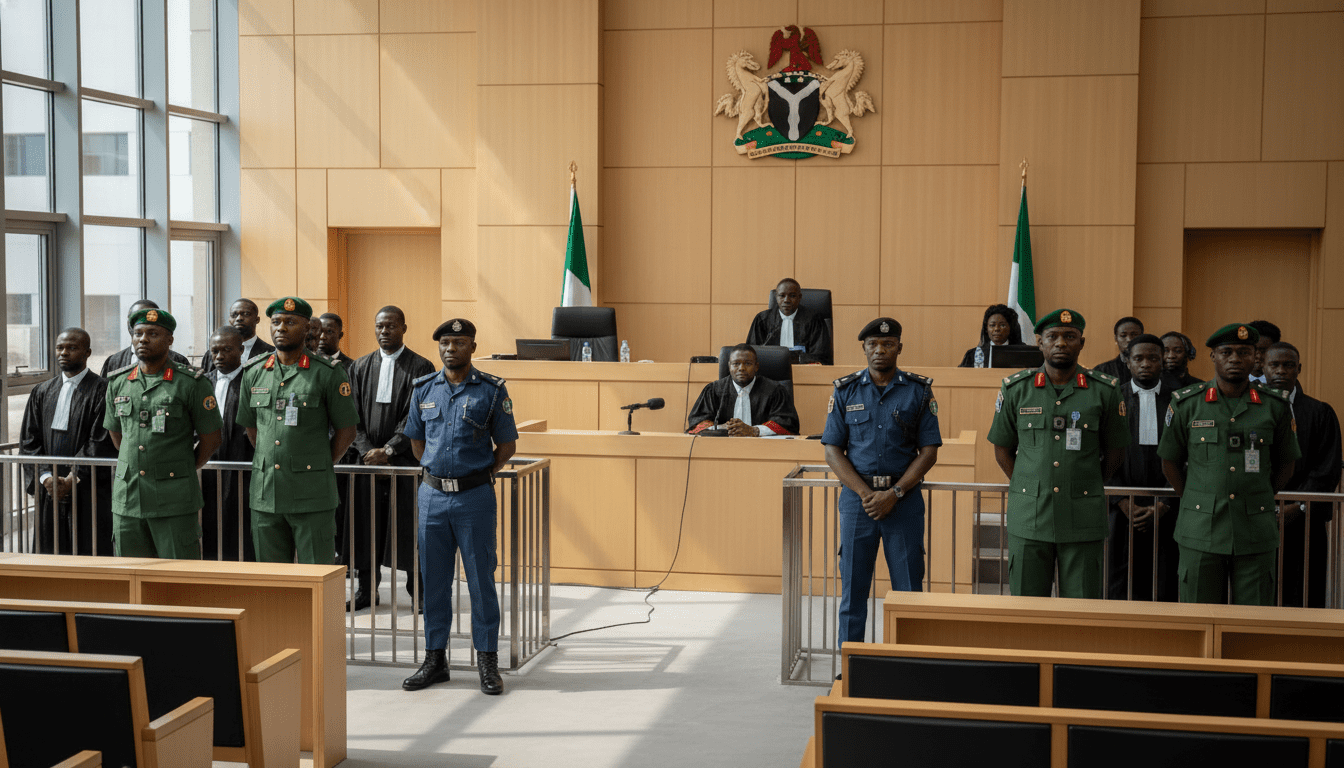
Six Charged in Nigeria Over Alleged Coup Plot to Overthrow President Tinubu
Six military and police officers were charged in Abuja over an alleged coup plot to overthrow President Bola Tinubu, with one suspect still at large as court proceedings began.
The Federal High Court in Abuja heard charges on April 21, 2026, naming six men accused in an alleged coup plot aimed at toppling President Bola Tinubu, court documents show. The defendants were in custody on the day the 13-count indictment was filed, while a seventh suspect, former Bayelsa governor Timipre Sylva, was reported to be at large.
Six Charged in Abuja Court
The prosecution presented a 13-count charge sheet alleging conspiracy to wage war against the state, terrorism and other counts tied to an attempt to overthrow the president. All six accused remained detained as the case opened in the Federal High Court, according to court filings presented on April 21, 2026.
Authorities said the defendants conspired with one another to commit acts that would amount to treason and to provide material support for terrorism, language that formalizes the government’s assertion of a coordinated effort against the constitutional order. The filing frames the alleged plot as both a criminal and security threat, elevating its legal and political stakes.
Details of the Indictment
Prosecutors allege the accused conspired “to wage war against the state” and to “commit an act of terrorism,” and that they rendered support to others named in the matter. The indictment further accuses the suspects of indirect involvement in supporting Colonel Mohammed Alhassan Ma’aji and others, whom media reports have previously identified as central figures in the alleged scheme.
The formal charges seek to link the defendants to coordinated plans and support networks rather than to isolated misconduct, detailing acts and communications that the prosecution says demonstrate intent. Defense lawyers are expected to challenge those assertions during pretrial hearings and as evidence is exchanged.
Key Suspects Named
The charge sheet identifies retired Major-General Mohammed Ibrahim Gana, retired Captain Erasmus Ochegobia Victor, Inspector Ahmed Ibrahim, Zekeri Umoru, Bukar Kashim Goni and Abdulkadir Sani as the six defendants. Court records and official statements list those names as the principal persons in custody related to the indictment.
Separately, former Bayelsa State Governor Timipre Sylva is accused of aiding efforts to conceal aspects of the alleged plot and remains at large, according to court filings. Investigators have previously linked a broader group of officers and associates to the matter, and authorities continue to pursue outstanding leads.
Government Response and Military Shake-up
Officials initially denied reports of a coup plot but announced in January 2026 that military personnel would face trial for planning to overthrow the government. The reversal from denial to prosecution was followed by a reshuffle of senior military leadership, a measure the presidency said was necessary to restore order and confidence within the armed forces.
The six charged men were among 16 military officers arrested in 2025 on allegations described at the time as “acts of indiscipline and breaches of service regulations,” a sweep that triggered speculation about deeper unrest within the armed forces. The government’s response has combined criminal prosecution with institutional personnel changes meant to shore up control.
Regional Context of Coups in West and Central Africa
Analysts note the case comes amid a wider pattern of coups and attempted takeovers in West and Central Africa in recent years, including incidents in neighboring countries late in 2025. Observers point to contested elections, deepening insecurity and economic hardship as recurring drivers of military intervention across the region.
Nigeria, Africa’s most populous nation, experienced multiple coups during the 20th century but has remained a formal democracy since 1999. The current allegations, therefore, carry outsized symbolic weight for both domestic stability and regional norms, prompting concerns among diplomats and policy analysts watching for signs of contagion.
Legal Process and Next Steps
With the indictment lodged, the Federal High Court will schedule preliminary hearings to consider bail applications, evidentiary disputes and the admissibility of prosecution material. Those procedural stages will determine the pace at which the case moves toward trial and will shape public access to the evidence underpinning the government’s claims.
Charges of treason and terrorism carry serious criminal consequences under Nigerian law, and the prosecution has signaled its intent to pursue the case vigorously. Defense teams have time to mount challenges and investigators may seek additional arrests or to present supplementary evidence as the proceedings unfold.
The court action crystallizes a tense period for President Tinubu’s administration as it responds to allegations of an internal threat to constitutional authority, while legal experts and regional observers monitor whether the trial will resolve unanswered questions or fuel further political debate.
