
Coalition Agrees €1,000 Bonus and Asks Employers to Pay
Coalition agrees €1,000 bonus paid by employers and exempt from taxes; unions demand fast payout while employers warn of costs and energy-price strain.
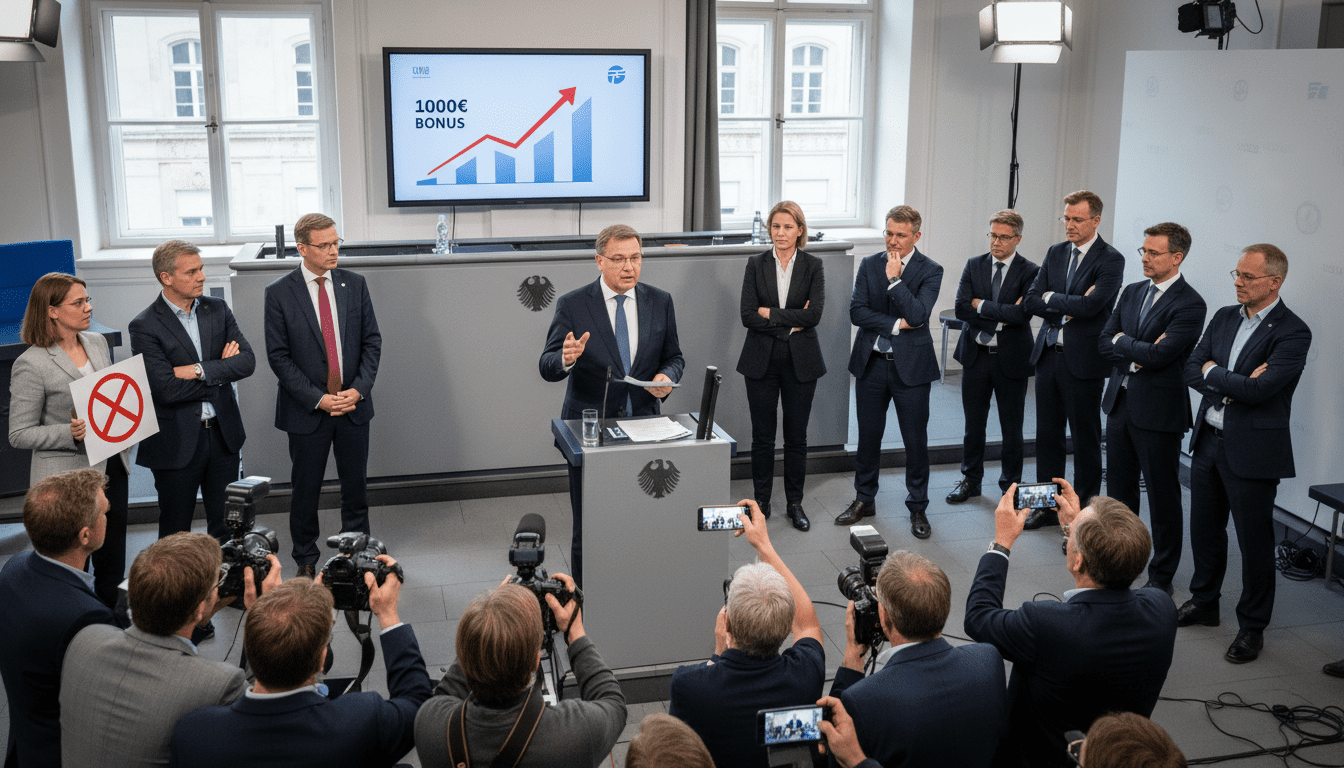
Germany’s ruling coalition has approved a €1,000 bonus intended to relieve beleaguered workers, but the government has left payment responsibility to employers while pledging to exempt those one-off payments from taxes and social contributions. The decision, announced by Chancellor Friedrich Merz and coalition partners, immediately drew praise from unions pressing for swift distribution and sharp criticism from employer associations that say firms are already squeezed by soaring energy and operating costs. The move revives a familiar political playbook of tax-advantaged one-off payments but shifts the financial burden onto companies at a moment of renewed economic strain.
Coalition agreement and payment mechanics
The coalition’s package designates the €1,000 bonus as tax- and social contribution-free if employers pay it on top of regular wages within a limited window extending to the end of 2026. Government spokespeople framed the measure as a pragmatic way to target relief quickly to employees without increasing public spending, while ministers signaled that the state would forgo taxing or charging contributions on these additional employer payments. The arrangement, however, makes receipt contingent on employers’ willingness and on the timing of sectoral agreements, setting up a patchwork outcome across industries.
Employers push back, citing energy and cost pressures
Industry groups reacted with skepticism and resistance, warning that the expectation to fund the bonus will hit companies already impacted by stubbornly high energy prices and regulatory costs. Leaders in energy-intensive sectors described the proposal as untimely, saying collective-bargaining processes and recent sectoral settlements should not be upended by a political initiative. Several employer representatives emphasized that many firms cannot absorb a new round of discretionary payouts without clear compensation or relief for their own mounting expenses.
Unions demand rapid, unconditional distribution
Major trade unions welcomed the relief intent but urged employers to act quickly and called for clarity on implementation to ensure workers actually receive the payment. IG Metall explicitly demanded that firms deliver the €1,000 “quickly and uncomplicated,” arguing the bonus must reach employees without delay or bureaucratic hurdles. Other unions, while supportive of additional pay, criticized the government for shifting responsibility to employers and warned that a voluntary system could leave large numbers of workers excluded if individual firms decline to participate.
Comparison with the 2022–24 inflation compensation model
Policymakers and labour representatives repeatedly referenced the earlier inflation compensation scheme that allowed companies to grant tax-advantaged payments of up to €3,000 between October 2022 and the end of 2024, which many observers saw as a model for targeted relief during the energy shock. The current €1,000 measure adopts the same principle of tax exemption but narrows the timeframe and lowers the ceiling, making outcomes more dependent on the timing of collective bargaining rounds. That difference raises concerns that some sectors will be unable to negotiate equivalent one-off payments because their tariff cycles do not align with the new eligibility window.
Tariff rounds and winners and losers by sector
Labour market analysts warn the voluntary nature of the bonus will amplify disparities between workers in different industries and regions, because tariff rounds and company financial health vary widely. In sectors that recently concluded agreements — notably those with current wage restraint clauses or no increases scheduled for 2026 — employers argue there is no room to add a unilateral bonus without reopening negotiated settlements. Trade unions counter that targeted, additional payments can be negotiated within collective bargaining, but the limited eligibility period means some groups of employees could miss out entirely.
Public sector urged to set an example
Public-sector unions and representative bodies urged the state to demonstrate leadership by implementing the bonus for civil servants and municipal employees, arguing that government employers can and should move first. The federal public service association called on the federation, Länder and municipalities to roll out the crisis bonus directly and explicitly warned against offsetting the payment with existing salary components. Proponents say a state-led approach would create pressure on private employers and reduce inequities if the public sector acts promptly.
The coalition’s €1,000 bonus proposal has set in motion a short, politically charged negotiation between government, unions and business that will determine whether the relief reaches the broad workforce or remains uneven and contingent. Implementation rules, employer willingness and the alignment with ongoing tariff negotiations will shape the policy’s real-world impact in the coming months.
