
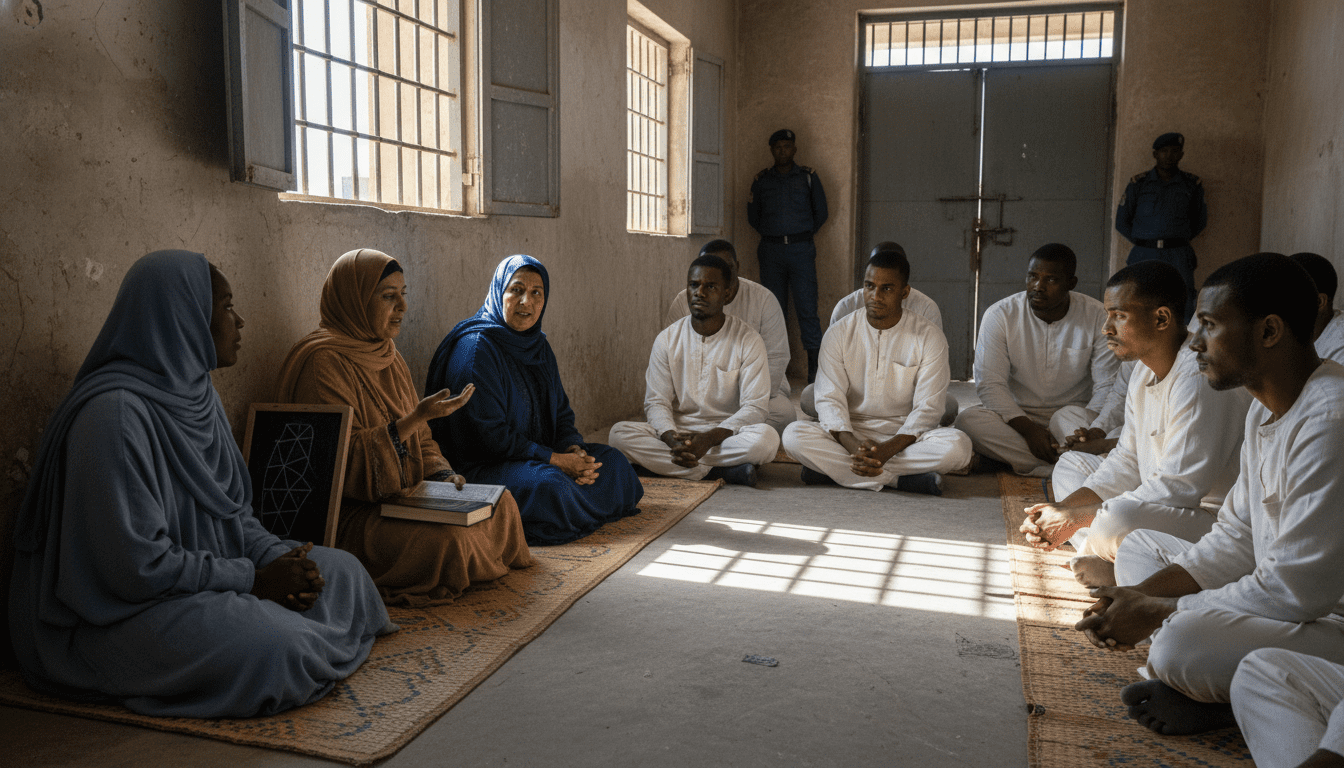
Mauritania’s mourchidates: female Islamic guides at the center of a low-cost, community-based counter-radicalisation model
Mauritania’s mourchidates — state-trained female Islamic guides deployed since 2021 — work in prisons, schools and communities to counter violent extremism and build social trust.
A national programme built on religious scholarship
Mauritania’s mourchidates are a government-backed network of female Islamic guides trained and certified by the Ministry of Islamic Affairs beginning in 2021.
The programme draws on a Moroccan precedent introduced after the 2003 Casablanca attacks, adapting faith-based education and counselling to local needs.
Unlike volunteer outreach with limited theological grounding, mourchidates receive instruction in Quranic interpretation, Islamic jurisprudence and pastoral care, enabling them to debate religious justifications for violence.
Engagement inside prisons targets ideology
Prisons have become a central focus for the mourchidates’ work, where they meet detainees linked to armed groups across the Sahel.
The guides spend extended periods building relationships with inmates, confronting theological arguments that have been used to legitimise attacks and offering alternative readings of scripture.
Officials and scholars involved with the programme say this one-on-one theological engagement can open space for reflection and reduce the appeal of extremist narratives among those already radicalised.
Community outreach aimed at prevention
Beyond penitentiaries, mourchidates operate in schools, youth centres, mosques, hospitals and marketplaces to reach people before recruitment occurs.
They address grievances often exploited by armed groups — unemployment, marginalisation and social isolation — while promoting religious teachings that emphasise charity, tolerance and accountability.
By combining religious credibility with social counselling, the programme seeks to undercut the message of recruiters and strengthen local resilience.
Link to Morocco and the role of female religious authority
Observers trace the origins of the approach to Morocco’s mourchidates, a model introduced after terrorist attacks in the early 2000s to reform religious discourse.
Mauritania’s adaptation places particular emphasis on women’s religious authority within a deeply observant society, arguing that female guides can access spaces and relationships that male actors cannot.
Researchers and local activists point to female scholarship and state endorsement as key sources of the mourchidates’ credibility in communities and prisons alike.
Measured results and regional comparisons
Although quantifying impact is difficult, Mauritania’s security trajectory contrasts with troubling trends in neighbouring Mali, Burkina Faso and Niger.
After a wave of attacks in the 2000s, Nouakchott combined intelligence, community engagement and religious reform — including the mourchidates — and has since avoided the scale of violence seen elsewhere.
Security analysts cite the country as an example of prevention-oriented policy, where investment in social and theological work complements traditional security measures.
Constraints, criticisms and questions of replication
The mourchidates programme faces limits in funding and scale, and its reach remains uneven across Mauritania’s vast territory.
Critics caution that the model cannot substitute for broader governance reforms or economic opportunity, and it may be difficult to transplant where state-community trust is frayed.
Experts also note that success depends on sustained political will, respected female scholarship and institutional capacity — conditions not present in all Sahel states.
Mauritania’s experience illustrates that countering violent activism can extend beyond military responses to include trained religious women working directly with vulnerable populations.
The mourchidates are neither a silver bullet nor a standalone solution, but their deployment highlights a practical, low-profile tool that mixes theological authority and social work to prevent radicalisation in a challenging regional context.
