
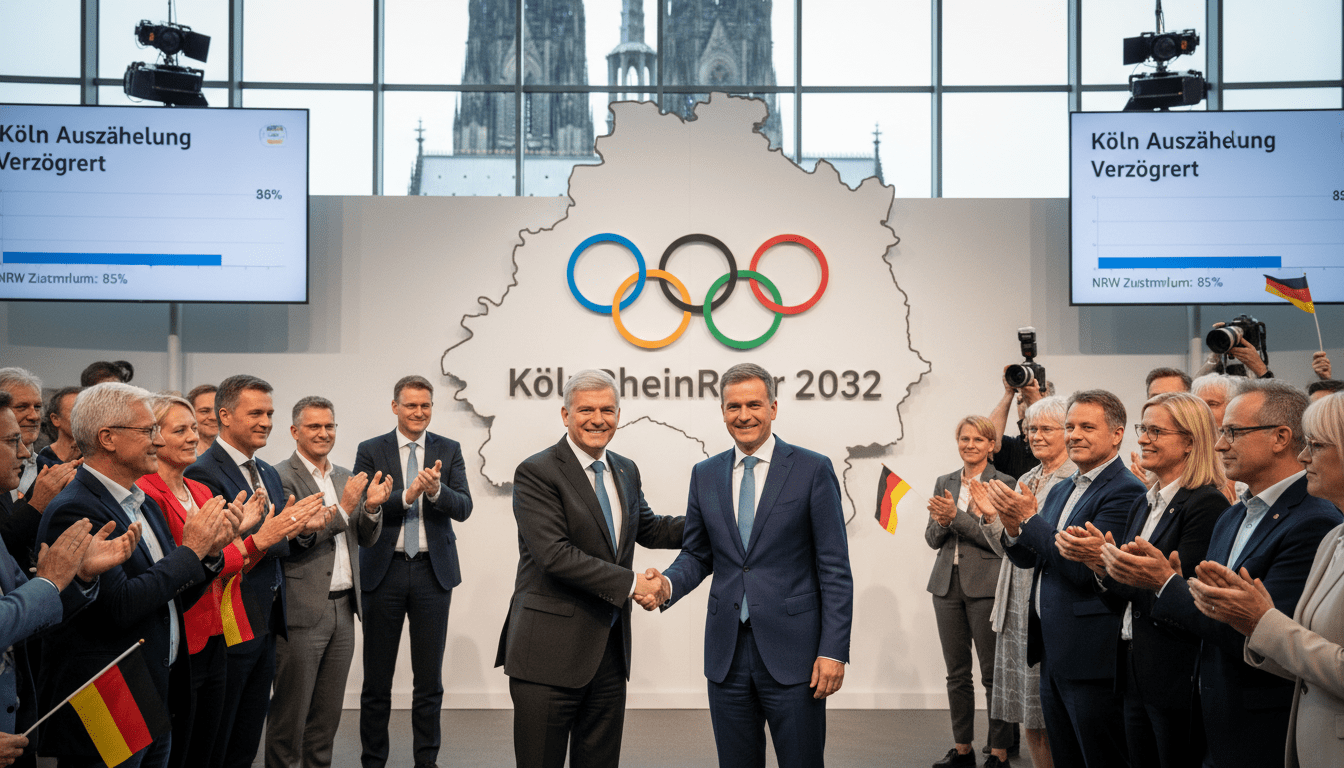
KölnRheinRuhr referendum trend: widespread “Yes” votes in 17 NRW cities, Cologne count still decisive
Referendums in 17 North Rhine-Westphalia cities deliver broad support for the KölnRheinRuhr Olympic bid, but Herten misses a quorum and Cologne is delayed.
The regional KölnRheinRuhr Olympic bid received emphatic “Yes” votes across a majority of the 17 North Rhine-Westphalia municipalities that held referendums on Sunday. Results reported late into the evening showed large majorities in many cities, while turnout ran at roughly one third of the four million eligible voters. A notable exception was Herten, where a statutory quorum was not met despite a high share of affirmative ballots, and the count in Cologne—the bid’s designated leading city—was still incomplete. Political leaders framed the overall outcome as a clear boost for the campaign ahead of national and international decision points.
Strong majorities reported in numerous host-candidate cities
Early tallies produced unexpectedly high approval rates in several municipalities that had volunteered venues or events for the bid. Duisburg registered about 73 percent in favor, Dortmund around 68.3 percent, and Mönchengladbach roughly 74.5 percent, figures that campaign organisers hailed as decisive. Smaller host towns intended for specific sports also recorded large margins, turning much of the regional results map a uniform green within hours.
Herten’s high Yes share is nullified by quorum rules
Herten presented a paradox: 73.6 percent of those who voted supported participation, yet local regulations require at least 20 percent of all registered voters to vote Yes for a valid decision. The city had opted for an application-based ballot dispatch using QR codes rather than automatically sending ballot papers to every eligible voter, a procedural choice officials say depressed participation. The shortfall means the proposed mountain-bike venue jointly planned with neighbouring Recklinghausen will need re-evaluation despite the strong local endorsement.
Cologne delay keeps the bid’s final status in suspense
Counting in Cologne was slowed after the city had to redraw voting districts, creating logistical delays that left the decisive result pending late into the night. Cologne was designated last year as the bid’s Leading City to provide a clear metropolitan centre, and its outcome will heavily influence both national deliberations and the pitch to the International Olympic Committee. Organisers warned that a delayed Cologne decision complicates immediate planning even as other municipalities returned affirmative votes.
Minister-President frames the vote as unprecedented participation
North Rhine-Westphalia’s Minister-President presented the referendums as a landmark exercise in direct democracy, noting the involvement of roughly four million eligible voters and interpreting the positive returns as a political mandate. He repeatedly promoted the bid as aiming to deliver “the most sustainable and compact Games,” and appealed to a readiness to undertake large-scale infrastructure work with confidence, at one point invoking the phrase “Wir schaffen das!” in public remarks. Local mayors and campaign officials echoed the optimistic assessment at celebratory gatherings.
Municipal leaders celebrate but flag practical challenges ahead
City officials across the region responded with a mix of jubilation and caution, praising clear local support while signalling immediate logistical questions. Mayors from Leverkusen to Monheim described plans to celebrate the affirmative mandates, yet several acknowledged the need to refine venue allocations, transport links and construction timetables. In one exchange, Cologne’s mayor even nicknamed the state leader “Ministerprinz,” a quip that underlined the intensely political tenor of the campaign.
Next steps: DOSB selection in autumn, then the IOC decision
Sunday’s referendums constitute the first of three formal stages for the KölnRheinRuhr bid: the German Olympic Sports Confederation (DOSB) will choose one national candidate this autumn, and the International Olympic Committee will later select a host city for the 2036, 2040 or 2044 Summer Games. Campaign organisers regard the regional, multi-city approach as an innovation intended to spread events and costs across several municipalities, but it remains an atypical model compared with single-city hosts. The DOSB’s verdict and how the IOC evaluates a dispersed regional concept will determine whether the strong local returns translate into an official international candidacy.
While the broad “Yes” trend across much of North Rhine-Westphalia gives KölnRheinRuhr momentum, the practical and legal complications highlighted by Herten’s quorum failure and Cologne’s delayed count show the campaign still faces meaningful hurdles. The autumn decision by the DOSB and the subsequent international selection process will test whether the regional result can be converted into a viable, competitive bid on the world stage.
