
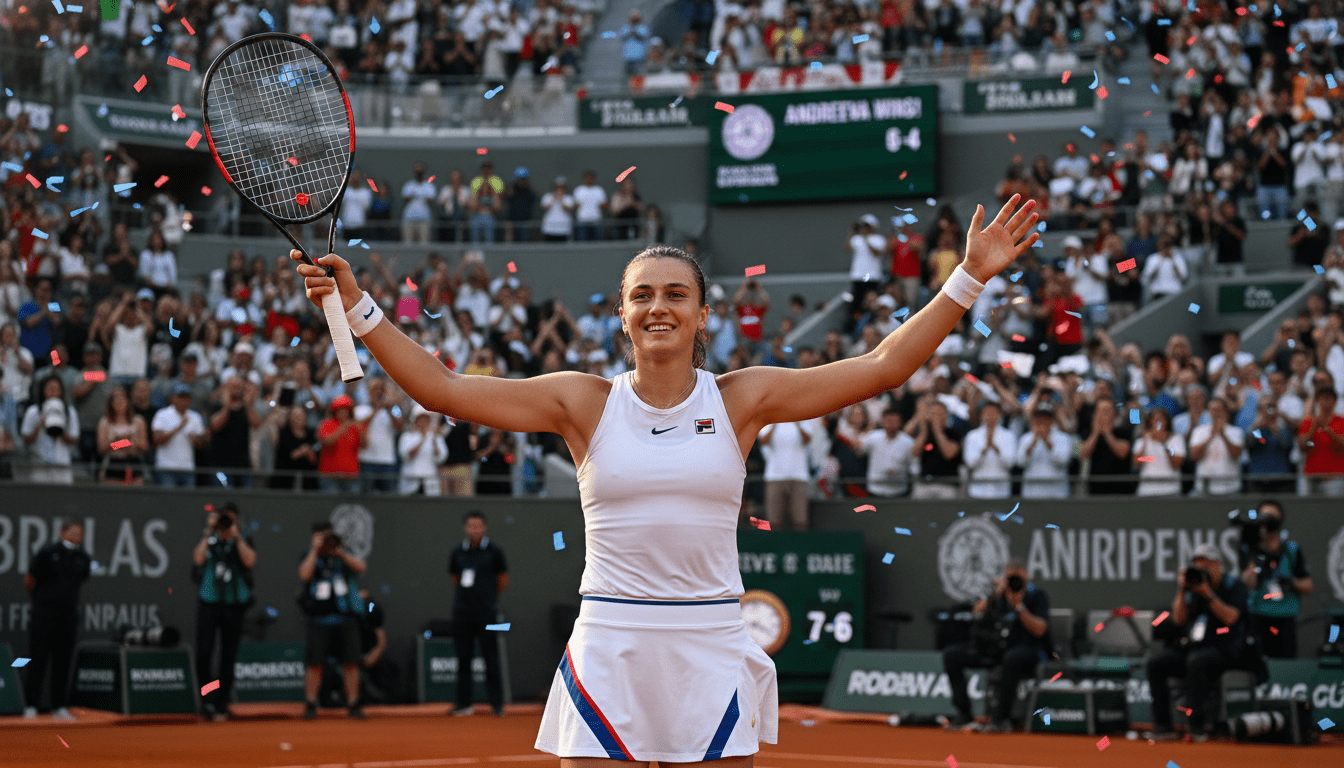
Mirra Andrejewa Reaches First Grand Slam Final at French Open After Beating Marta Kostjuk
Mirra Andrejewa, 19, advanced to her first Grand Slam final at the French Open after a 6-1, 6-3 victory over Marta Kostjuk, as both draws now guarantee first-time major champions.
Andrejewa’s breakthrough at Roland-Garros arrived in dramatic fashion on Court Philippe-Chatrier, where the unseeded teenager overwhelmed Marta Kostjuk in a one-sided semifinal that lasted 75 minutes. The win moves Andrejewa into her first Grand Slam final on her 13th main-draw appearance and makes her the youngest finalist at the tournament since 2022. The result also caps a week in which Paris produced an unusually open field: for the first time since 1977, neither the men’s nor the women’s semifinals include a former major champion.
Andrejewa books first Grand Slam final at French Open
Andrejewa closed out the match 6-1, 6-3, converting her breakthrough with a collection of deep, penetrating groundstrokes and composed court management. She mixed power and patience to prevent Kostjuk from finding rhythm, rarely allowing extended rallies from which the Ukrainian could mount a comeback. After the match the 19-year-old said she had felt nervous beforehand but celebrated the achievement and thanked those who supported her development.
The victory makes Andrejewa one of a new wave of young finalists at Roland-Garros and guarantees at least one maiden major winner in the women’s draw. Her progress underlines how quickly emerging talents have reshaped the clay-court narrative this fortnight.
Historic absence of former major winners in both draws
The 2026 French Open has produced an exceptional statistical quirk: neither the men’s nor the women’s semifinals feature a past Grand Slam singles champion. Tournament observers noted that this is the first time since the late 1970s that both draws arrived at the penultimate round without a former major titleholder. The pattern reflects widespread upsets and a deeper-than-usual distribution of contenders.
On the women’s side, all four semifinalists were born after 2000, highlighting a generational turnover at the highest level. The openness of the field has created fresh storylines and amplified interest in who will claim a first career major when the titles are decided.
Dominant performance on Court Philippe-Chatrier
From the outset Andrejewa imposed pressure with heavy, accurate forehands and aggressive step-ins behind service returns, breaking Kostjuk early and building a quick lead. The match narrative was largely one-way; Kostjuk struggled to produce her signature forehand and was unable to string together sustained runs of play. When the retractable roof was lowered during the second set, Andrejewa maintained her momentum and closed out the match with clinical efficiency.
The Russian’s tactical variation and mental composure stood out, especially for a teenager in her first major final. Her ability to switch tempo and reduce unforced errors underlined why coaches have long rated her as a special talent.
Andrejewa’s development path from Siberia to Cannes
Andrejewa’s rise is the product of long-term family investment and international training moves that began in Siberia and continued through Moscow to the academies of the French Riviera. Coaches and family members steered her toward competitive environments that could accelerate her development, and she later worked with established figures on tour to refine her clay-court game. That international upbringing is reflected in her fluency across languages and an on-court demeanor that blends youthful energy with strategic maturity.
Supporters point to early identification of her talent and intensive coaching as drivers of rapid progress, but Andrejewa has also credited incremental improvements in fitness and match experience for her recent results. Her blend of raw power and improved consistency now presents a genuine threat to any opponent on clay.
Kostjuk’s campaign shadowed by conflict in Ukraine
Marta Kostjuk entered Paris on the back of a 17-match winning streak and with heavy personal burdens tied to the war in her homeland. The Ukrainian indicated in public remarks this week that concerns over family safety and attacks near Kyiv had weighed on her mentally during the tournament. Those off-court stresses, combined with an opponent executing a near-flawless plan, left Kostjuk short of the level that carried her through earlier rounds.
The quarterfinals and semifinals underscored how external factors can intersect with elite performance, and Kostjuk acknowledged the emotional toll while praising the resilience of her compatriots. Her run to the last four under such circumstances has been widely acknowledged as a mark of courage and professionalism.
What the result means for the women’s final
With Andrejewa through to the title match, the women’s final will feature a first-time major finalist on at least one side, guaranteeing a maiden Grand Slam winner in Paris. The outcome also signals a potential shift in the balance of power, as younger players who have navigated long clay-court battles now arrive without the burden of previous major expectations. Betting markets and pundits will reassess projections, but the core storyline is clear: the French Open has supplied new contenders capable of seizing a historic opportunity.
For Andrejewa, the task ahead will be to translate semifinal dominance into a composed, tactical performance under the pressure of a championship match. Her trajectory suggests she can adapt, but the final will test both her physical endurance and her capacity to manage the spotlight.
Mirra Andrejewa’s breakthrough in Paris is both an individual milestone and a reflection of a wider generational moment at the French Open, where form, circumstance and emerging talent have combined to produce an unusually open race for a first Grand Slam title.
