
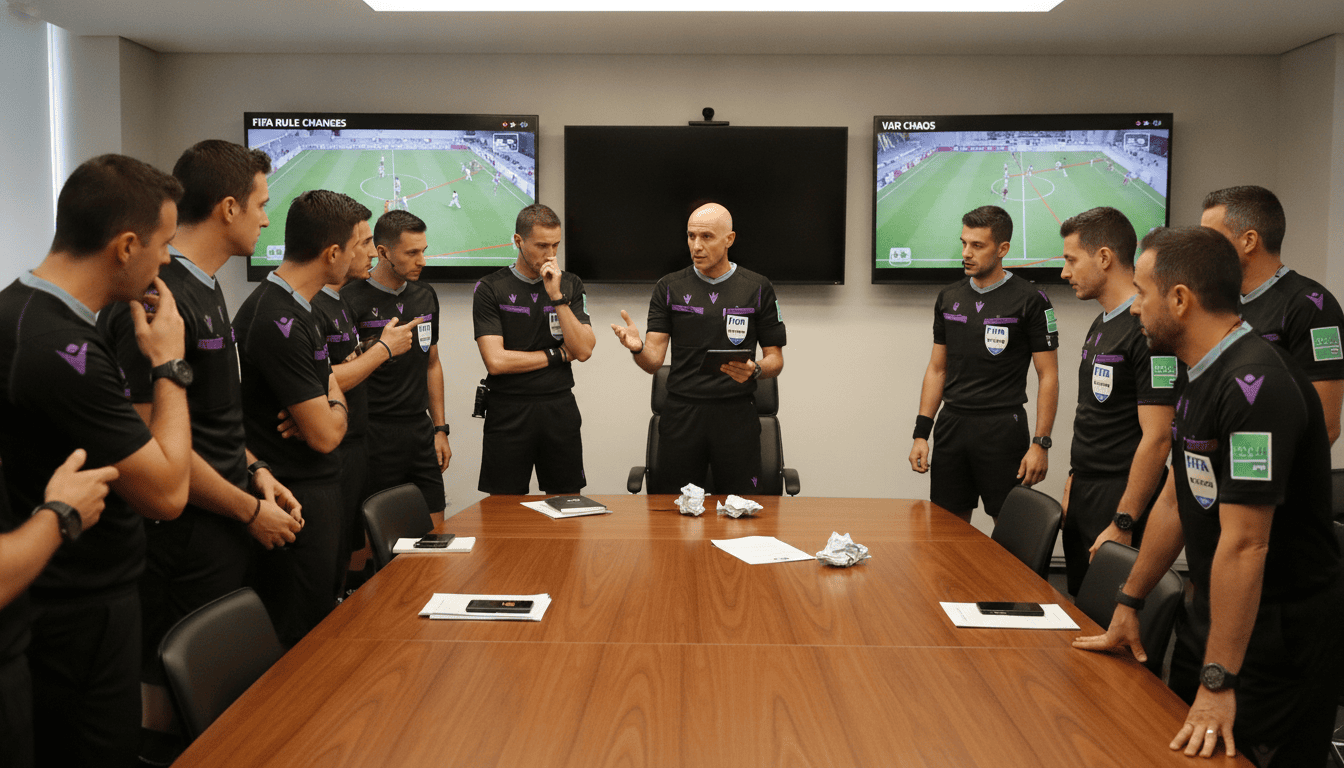
World Cup referees face rule overload and VAR upheaval at recent tournament
World Cup referees faced rule overload, VAR controversy and FIFA missteps as semi-automated offside and new interpretations reshaped officiating and future domestic adoption.
The recent World Cup placed unprecedented demands on World Cup referees, as a flurry of new laws, reinterpretations and expanded VAR involvement produced uneven performances and heated debate. Semi‑automated offside technology and an unusually large schedule amplified scrutiny of decisions on and off the field. The tournament exposed tensions between innovation, consistency and the practical limits of match officials.
Inconsistent standards on the field
Refereeing standards at the tournament varied markedly from match to match, producing a patchwork of enforcement that frustrated players and viewers alike. A global selection of officials brought diverse approaches to game management, but where a single, consistent line would have helped, teams often encountered a zigzag of decisions.
Individual referees at times became flashpoints — celebrated for strict control in one match and criticized for leniency or inconsistency in another. The uneven application of some rules highlighted the difficulty of imposing uniformity across a broad international panel operating under new protocols.
Semi‑automated offside reshapes VAR
Arguably the most consequential technological change was the introduction of semi‑automated offside detection, which alerted officials with rapid, automated signals. That system shortened many checks and delivered near‑instantaneous offside calls, addressing long‑standing complaints about lengthy reviews and delayed goal confirmations.
Only when the system briefly failed did the slower, older process return and remind viewers why the automated aid is prized. The technology’s success at the tournament has intensified calls for domestic leagues, notably the German Bundesliga, to adopt the tool to reduce stoppage time and preserve the spontaneity of goal celebrations.
New laws and confusing interpretations
Organizers rolled out multiple new laws and interpretive guidelines, from a countdown to expedite substitutions to expanded VAR review powers for certain set‑piece decisions. Some measures — like the substitution countdown — produced the intended effect of accelerating play and curbing time‑wasting.
Other innovations, and the way they were applied, proved more controversial. The directive to sanction players who hide their mouth during exchanges led to a high‑profile red card that was quickly reconsidered. That episode exposed how a blunt enforcement instrument can produce disproportionate sanctions and uneven outcomes across matches.
VAR as an omnipresent overseer
Tournament organizers increasingly positioned VAR not just as an assistant but as an overarching corrective mechanism, intervening in a wider range of incidents than in previous iterations. That expanded remit included retrospective actions for simulation and some mistaken identity cases, prompting criticism that VAR was overreaching its intended role.
Officials and teams reacted uneasily when VAR interventions altered match outcomes or escalated disciplinary consequences after the final whistle. The perception that VAR was acting as an omnipresent overseer intensified debate about where human judgment should end and technological correction should begin.
FIFA handling and governance concerns
FIFA’s communication and operational decisions around refereeing drew sustained criticism during the event. Several administrative missteps — from travel and entry complications affecting match officials to opaque explanations of post‑match disciplinary choices — eroded confidence among referees and national associations.
A particularly volatile episode involved a high‑profile suspension of a red card following external intervention, which many within officiating circles saw as political interference that undermined the integrity of refereeing. Such incidents provoked questions about governance, transparency and the protections in place for match officials to carry out facts‑based decisions without external pressure.
Domestic adoption and next steps for referees
National associations and leagues now face decisions about which tournament innovations to import and how to prepare referees for the expanded workload. The German refereeing authority has signalled a comprehensive review of tournament findings and intends to study mandatory changes alongside optional measures before deciding on implementation.
Training demands will rise if semi‑automated technologies and new review protocols become standard in domestic competition. Officials will need focused instruction to manage both technological inputs and traditional match management, and federations must consider resource implications, particularly at lower levels of the game.
The tournament made clear that modern refereeing requires balancing technology with clear, consistently applied rules and robust governance. World Cup referees navigated an intense testing ground for change; the next challenge for football’s stakeholders will be turning the lessons into coherent, proportionate reforms that improve fairness without overburdening the officials who enforce the game.
