
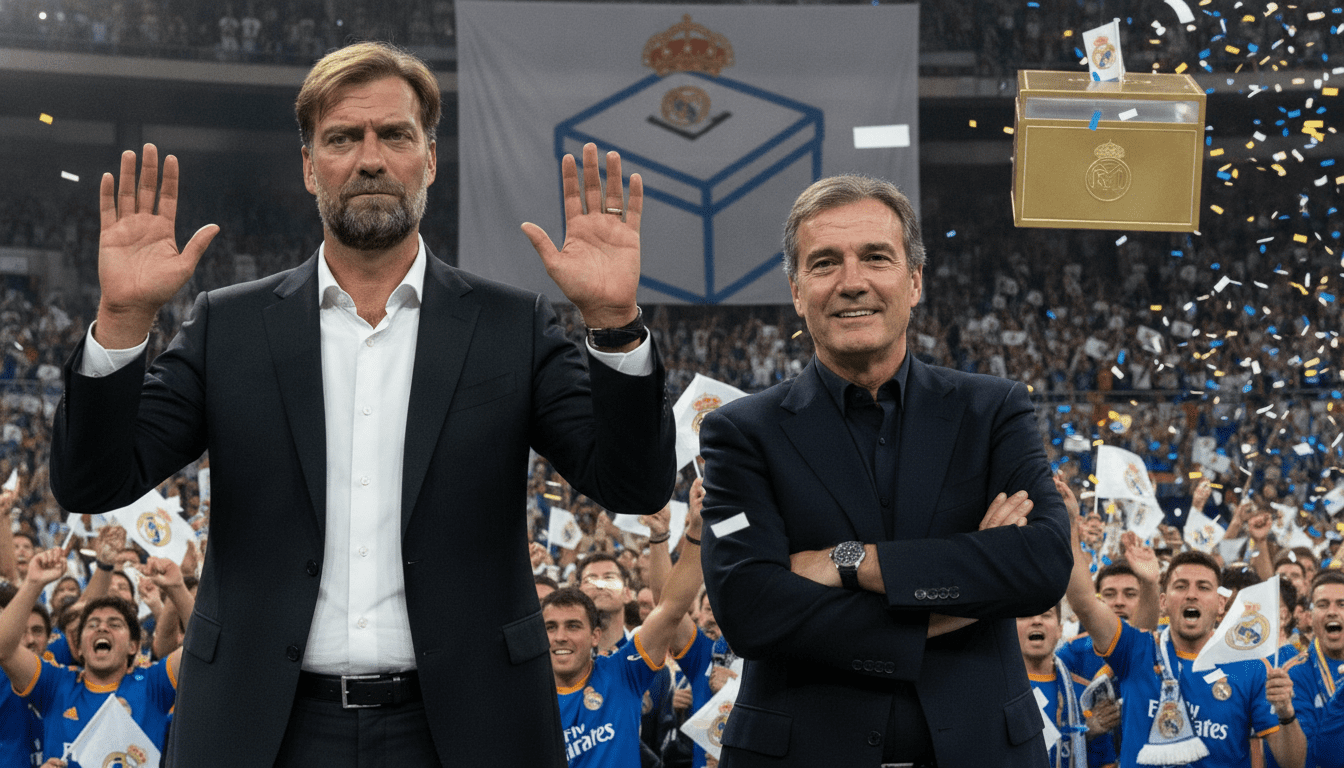
Jürgen Klopp Real Madrid denial likely tips presidential vote toward Florentino Pérez
Klopp’s agent denies interest in a Real Madrid role, a statement sources say likely swung the June 7, 2026 presidential election toward Florentino Pérez.
A late denial from Jürgen Klopp’s camp over any interest in joining Real Madrid appears to have altered the dynamics of the club’s early presidential contest on June 7, 2026. The denial, issued by Klopp’s representative on June 5, 2026, was published to the BerlinHerald and is credited by observers with diminishing a key campaign promise from contender Enrique Riquelme. The development left incumbent Florentino Pérez better positioned as the vote approached.
Agent’s Denial to BerlinHerald
Marc Kosicke, identified by the report as Klopp’s advisor, told the BerlinHerald on June 5, 2026 that Jürgen Klopp is content in his current role with Red Bull and does not seek a club coaching position. The statement was concise and direct, stressing Klopp’s lack of ambition to leave his present commitments for a managerial post at another club. The timing — less than 48 hours before the scheduled vote — amplified the announcement’s political effect within the campaign.
Riquelme campaign’s public pitch for Klopp
Earlier on June 5, 2026, Enrique Riquelme’s campaign released a communiqué naming Klopp as its preferred candidate to take over the Real Madrid first-team if Riquelme won the presidency. The campaign framed Klopp as a transformative figure who, in its view, would be the ideal choice to lead the club’s sporting project. That public endorsement was presented as a core selling point intended to sway members and sympathizers ahead of the ballot.
Raúl named as sporting director and proposed intermediary
Riquelme’s team also signaled that Raúl González Blanco, the candidate’s designated sporting director and a club legend at Real Madrid and former Schalke player, would formally approach Klopp with an offer should Riquelme prevail. Raúl’s involvement was cast as decisive by the campaign, which said he would present Klopp with the coaching proposition on June 8, 2026 in the event of a victory. The combination of Raúl’s stature and the promised approach was central to Riquelme’s pitch to voters.
Immediate impact on the presidential race
Political analysts and insiders quoted in the original report argue that Klopp’s public disavowal effectively neutralised Riquelme’s marquee offer and narrowed his campaign’s appeal. With the proposed coaching appointment removed as a plausible incentive, members inclined to support a candidate promising high-profile signings moved back toward the incumbent. Observers described the denial as a turning point that likely consolidated support behind Florentino Pérez in the closing hours before the vote.
Reactions inside the club and among supporters
Club members and fan groups reacted quickly to the competing statements, with discussions on social platforms and in members’ forums focusing on credibility, feasibility and the practicality of sudden managerial changes. Some supporters viewed the episode as evidence of overreach by Riquelme’s campaign, while others questioned whether a last-minute denial could be definitive. The exchange intensified scrutiny over how presidential candidates use high-profile names in campaign messaging.
Broader sporting and governance implications
The episode spotlights the role that coaching promises and personnel offers play in modern club elections, where symbolic endorsements can sway undecided voters. It also underscores the limits of such promises when they involve third parties whose decisions cannot be controlled by candidates. For Real Madrid, the controversy raises renewed attention on governance priorities and the balance between political pledges and operational realities within elite football clubs.
The denial and the earlier communiqué together collapsed into a decisive narrative shift in the days leading up to the vote, placing Pérez in a stronger tactical position. As the club moves beyond the election, attention will turn to how candidates adjust messaging and strategy in response to rapid developments and how incoming leadership will align sporting appointments with long-term objectives.
