
Tour de France 2026 route, early results and the race to Alpe d’Huez
Tour de France 2026: 3,321 km from Barcelona to Paris with two Alpe d’Huez finishes, major climbs, stage winners to date and favourites Pogacar, Vingegaard
Barcelona to Paris: 4 July start, 26 July finale
The Tour de France 2026 began in Barcelona on 4 July and is scheduled to conclude on 26 July with the traditional finish on the Champs-Élysées in Paris. Organizers fielded 184 riders across 23 teams for the 21-stage event that traverses 29 French départements. The opening day featured a 19.6-kilometre team time trial, setting early gaps that have influenced the general classification in the opening weeks.
The route totals 3,321 kilometres and demands 54,450 metres of climbing, a figure that underlines the race’s mountainous character this year. Two rest days are allocated amid a program that includes two time trials and eight major mountain stages. Race organisers and teams have highlighted the double ascent to Alpe d’Huez and the high-altitude Col du Galibier as decisive moments for the overall standings.
Route profile and decisive climbs
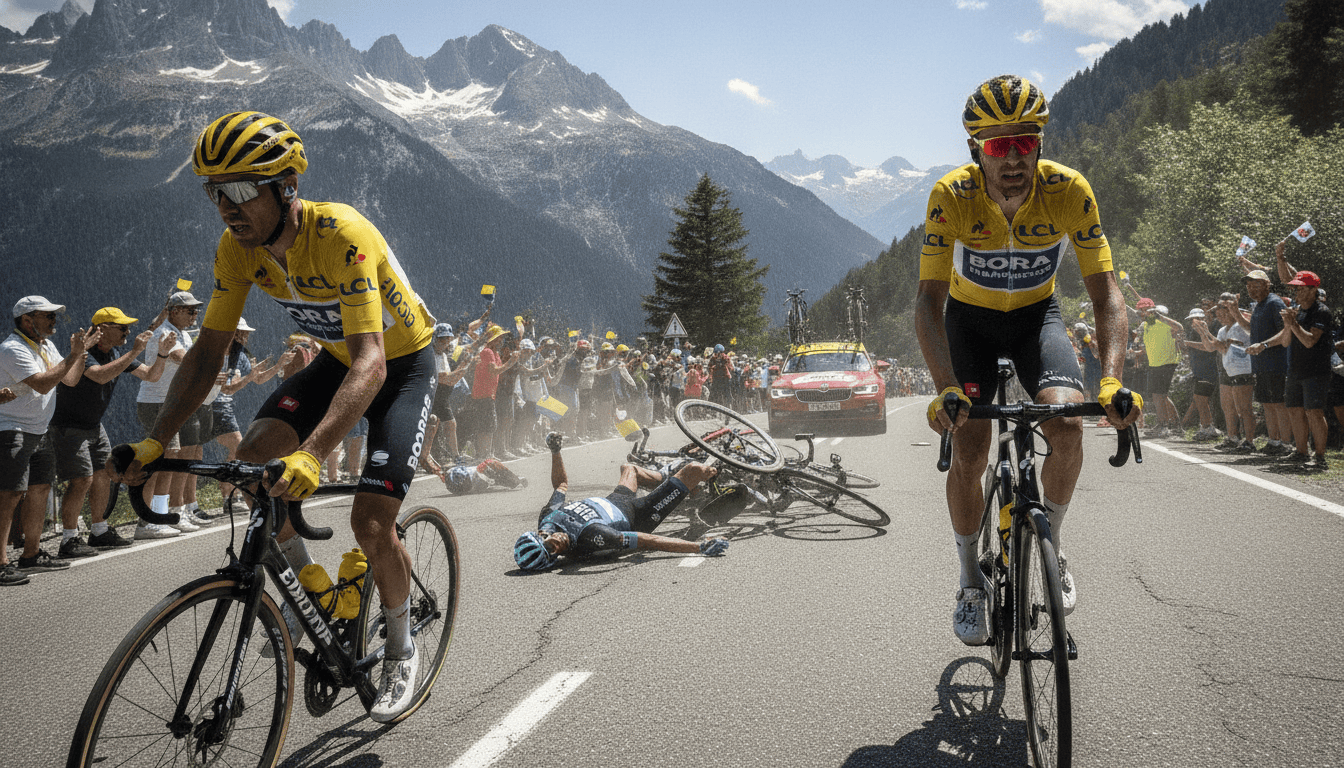
The parcours divides into seven flat stages, four hilly days and eight mountain stages, with five summit finishes scheduled across the high mountains. The so-called queen stage on 25 July covers about 171 kilometres and reaches the Tour’s highest point at the Col du Galibier, listed at 2,624 metres. That stage also features the Col de la Croix de Fer and Col du Télégraphe before a final push toward Alpe d’Huez, presenting 17.7 kilometres at an average gradient of 6.9 percent.
Alpe d’Huez appears twice as a summit finish, first on stage 19 after a short but brutal 127.9-kilometre route and then again on stage 20 following a route over the Col de Sarenne. The ascent on stage 20 includes a sector previously used only as a descent in 2013, creating tactical uncertainty for teams and riders. The inclusion of the Écrins National Park on the second Alpe approach adds an unfamiliar and potentially race-defining element.
Stage winners and early classification dynamics
The opening team time trial in Barcelona was claimed by Team Visma-Lease a Bike, and individual stage victories have been shared among sprinters and GC riders alike. Tadej Pogacar (UAE Team Emirates-XRG) has taken multiple mountain stages, while Remco Evenepoel (Red Bull – Bora–hansgrohe) won the stage 15 summit finish and the stage 16 individual time trial. Sprint victories have gone to names such as Tim Merlier and Jasper Philipsen, and Mathieu van der Poel took a hilly stage in mid-July.
These stage outcomes have left Pogacar with a substantial advantage in the general classification, giving him time to control the race into the high mountains. Breakaways and team tactics have shaped daily results, but the calendar’s heavy mountain sequence promises further reshuffling before Paris. With stage 18 still pending at the time of reporting, the race remains open for challengers seeking to overturn the current margins.
The favourites and the GC battle
The principal narrative this year remains a three-way confrontation among Tadej Pogacar, Jonas Vingegaard and Remco Evenepoel. Pogacar, aiming for a fifth Tour title, has already won several key stages and carries a multi-minute advantage into the Alps. Jonas Vingegaard, twice a Tour winner, arrives fresh from a season that included a Giro d’Italia victory and Paris–Nice, while Evenepoel has shown strength in both the mountains and the time trial.
Young French rider Paul Seixas has emerged as a dark horse after strong results at the Basque Country and in the spring classics, though a crash in June raised fitness questions. Former biathlete-turned-rider Florian Lipowitz remains one to watch when fully fit, and a number of teams have dual-leader plans that could complicate tactics on the decisive climbs. The next two mountain stages will be critical for separating the true contenders from those aiming for stage glory.
Teams, captains and German interest
Twenty-three teams entered the race, with leaders including Pogacar for UAE Team Emirates-XRG, Vingegaard for Team Visma-Lease a Bike and Evenepoel for Red Bull – Bora–hansgrohe. Notable squads such as Lidl-Trek, Alpecin-Premier Tech and EF Education-EasyPost bring strong support rosters aimed at both stage wins and overall ambitions. The race composition mixes established Grand Tour squads and squads focused on sprint success, creating a varied tactical landscape.
German fans have specific reasons to tune in, with riders such as Nils Politt riding key domestique duties and John Degenkolb competing in what may be his eleventh and final Tour. Florian Lipowitz, who impressed in his debut year, is paired with Evenepoel at Red Bull – Bora–hansgrohe as a dual leadership option. Several younger German riders are making their first Tour appearances and could attract attention on breakaway days.
Coverage and what lies ahead
Live coverage of the Tour de France 2026 is available on ARD, which begins daily broadcasts around 14:00 CET, with extended coverage in the public broadcaster’s online stream. Eurosport provides additional free-to-air broadcasts, while Discovery’s platforms and other subscription services offer multi-language and extended options for international viewers. Fans can expect near-daily tactical battles as the race transitions from rolling plains to the Alps and the Pyrenees.
The coming week includes the two-stage Alpe d’Huez sequence and the high Galibier summit that together will likely decide the final podium. With 3321 kilometres and 54,450 metres of climbing still to be contested, the Tour de France 2026 has reserved its most dramatic chapters for the Alpine finale.
As the peloton approaches the high mountains, teams will refine their tactics and leaders will be tested on gradients and in time trials that collectively determine Grand Tour outcomes. The next decisive stages promise to crystallize the general classification and set the scene for the final sprint into Paris on 26 July.
