
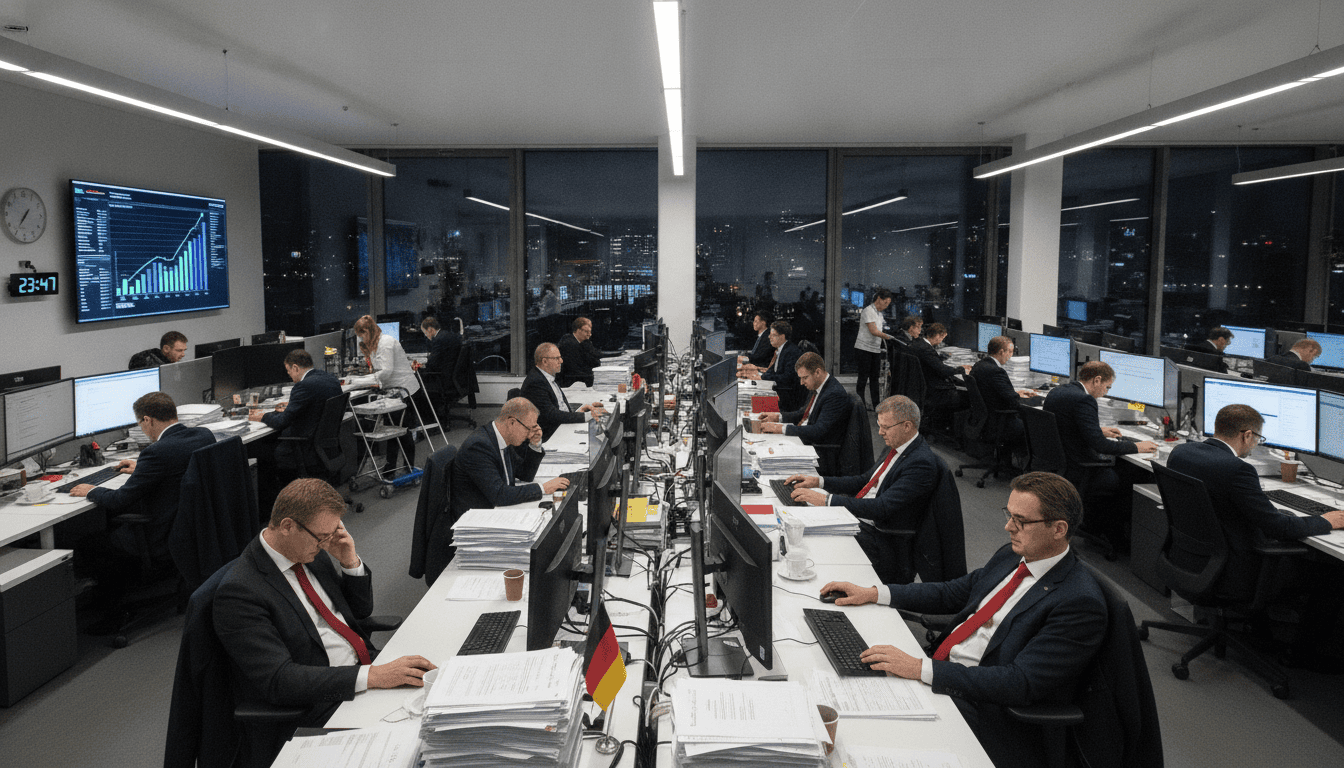
Long working hours in Germany: 2.1 million people worked over 48 hours weekly in 2025
Germany’s Federal Statistical Office finds 2.1 million full-time employees worked overlong hours in 2025, highlighting leaders and the self-employed as most affected.
Key national figures from the Federal Statistical Office
The Federal Statistical Office reported that roughly 2.1 million people in Germany worked more than 48 hours per week in 2025, a level the office classifies as overlong working hours. That figure corresponded to about 7.1 percent of the country’s approximately 30 million full-time workers, according to the published data. The average weekly working time among full-time employees was 40.2 hours for the year, underscoring the gap between typical schedules and the overlong threshold.
Sectors and employment types with highest prevalence
The data show a stark concentration of extended hours among managers and the self-employed. Self-employed people with employees reported the highest incidence, with 44.5 percent working beyond 48 hours weekly, while 23.0 percent of solo self-employed also reported overlong weeks. By contrast, only 4.1 percent of salaried full-time employees fell into the overlong-hours category, indicating that business ownership and managerial responsibility remain strong predictors of heavier workloads.
Age differences point to an experience gradient
The Federal Statistical Office noted a clear age gradient in working hours: younger full-time workers aged 15 to 24 rarely logged overlong weeks, with just 1.4 percent doing so. The share rose steadily with age, reaching 9.6 percent among 55- to 64-year-olds. Analysts attribute part of this pattern to the concentration of managerial roles and business ownership in older cohorts, which drives up average hours for those age groups.
Gender imbalance in leadership and long hours
Women remain underrepresented in leadership roles that often require extended hours, the statistics show. Only 30.3 percent of managers were women in 2025, while women made up almost half of the total workforce at 47.1 percent. The share of female leaders has increased slowly, rising by 4.5 percentage points over the past 30 years, a pace that the Federal Statistical Office describes as modest given broader gender-equality efforts.
Part-time work increasingly chosen, not imposed
The report also documented changing attitudes toward part-time employment. Among roughly 13 million part-time workers, only 4.9 percent in 2025 said their part-time status was a stopgap because they could not find full-time work. That measure has declined substantially from 12.9 percent in 2015, suggesting a shift toward part-time work as a deliberate choice for many and away from a default borne of limited options.
Implications for employers, policy and worker wellbeing
The concentration of overlong hours among managers and entrepreneurs raises questions for workplace policy and public health. Extended workweeks are linked in research to higher stress, lower sleep quality and potential productivity trade-offs, particularly when long hours are chronic rather than episodic. Employers face a balancing act between operational demands and sustainable work patterns, especially in sectors that rely heavily on managerial oversight or small-business owners.
From a policy perspective, regulators and social partners may look to targeted measures that address the most affected groups without constraining flexibility for businesses. Options include clearer reporting on overtime, incentives to distribute managerial responsibilities more evenly, and support for small-business owners to outsource or share workloads. Any approach would need to consider the diversity of causes behind extended hours, from market pressures to cultural expectations around leadership.
The gender gap in leadership participation further complicates efforts to reduce overlong hours across the workforce. Increasing the share of women in managerial positions could alter the distribution of hours if accompanied by changes in job design, flexible scheduling and family-support policies. The slow growth in female leadership over three decades suggests structural barriers that extend beyond short-term workplace adjustments.
Finally, the shift in how part-time work is perceived underscores broader labor-market changes. As more workers choose reduced hours for work–life balance or other reasons, understanding the interaction between part-time preferences and overlong hours among managers will be important. Policymakers and employers will need to pay attention to how these trends interact with demographic shifts, digitalization and evolving expectations about career progression.
The Federal Statistical Office’s 2025 figures provide a detailed snapshot of who works the longest hours in Germany and invite debate about how to protect worker health while preserving economic flexibility.
