
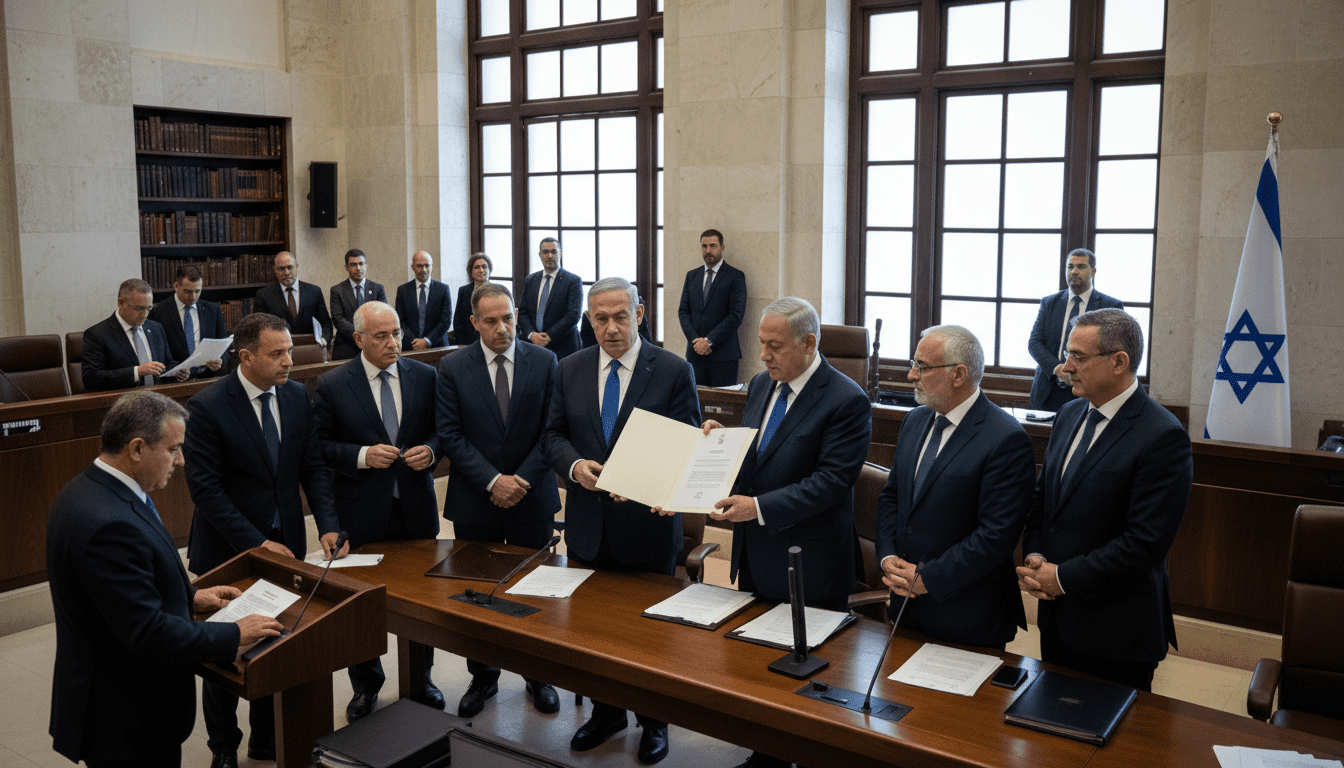
Knesset dissolution filed by Netanyahu’s coalition paves way for early Israeli elections
Israel’s coalition filed for Knesset dissolution, clearing the path to early elections; a vote may occur May 20, 2026, with polls required by mid-October.
The governing coalition in Israel has formally submitted a bill to trigger a Knesset dissolution, an action that sets in motion the process for early national elections and ends the 25th Knesset before its scheduled term. The move, announced by the Likud party, explicitly invokes the mechanism of Knesset dissolution and places the timing of a possible vote in the coming days. With the bill backed by all coalition partners, Israeli media report the proposal could be brought to the floor for a vote on May 20, 2026.
Coalition files bill to dissolve 25th Knesset
The bill was filed by coalition chairman Ofir Katz and was presented as a joint initiative of Prime Minister Benjamin Netanyahu’s government. Likud communications framed the filing as a procedural step to resolve an internal impasse, saying the 25th Knesset will be dissolved before the end of its term. Coalition officials say the measure enjoys unified support inside the governing bloc, making passage highly probable under current arithmetic.
Media outlets in Israel report that the dissolution motion follows a direct request from leaders within ultra-Orthodox ranks and reflects a breakdown of trust between some coalition partners and the prime minister. The formal submission obliges parliamentary authorities to schedule the procedures that lead to a formal plenary decision and eventual election timetable. The filing signals an abrupt acceleration of political timelines after months of legislative friction.
Vote timetable and legal procedure
Under Knesset rules the dissolution must pass through a sequence of parliamentary steps, including up to four readings, and acceptance of the bill triggers a fixed clock toward elections. Sources report the law stipulates that the next national vote can be held no sooner than three months after the law’s enactment and must take place within five months. That framing means, if passed in late May, a general election could be scheduled by mid-October 2026 at the latest.
Israeli outlets also indicated a preliminary procedural vote could be held as early as Monday, May 18, 2026, with the substantive vote possibly following on or around May 20, 2026. The Knesset House Committee is empowered to set the exact election day once the dissolution law is approved, giving the legislature administrative control over scheduling within the statutory windows. Officials emphasize the 90-day countdown that follows the final parliamentary approval as the defining interval before polling day.
Religious draft dispute sparks the move
The immediate catalyst for the dissolution was a dispute over legislation concerning the military service exemption for many strictly religious Jewish men. A leading rabbinic figure, Rabbi Dov Lando, reportedly urged his Degel HaTorah faction—part of the United Torah Judaism bloc—to seek dissolution after Mr. Netanyahu announced he would not advance a separate draft-exemption bill during the current term. That decision, attributed to growing disagreements inside Likud, eroded confidence among ultra-Orthodox coalition partners.
Degel HaTorah and allied religious leaders have framed the dissolution as a corrective step intended to force a political reset on issues central to their communities. The draft exemption debate has long been a flashpoint in Israeli politics, and the recent stalemate sharpened tensions within the coalition. Those tensions transformed what had been a policy dispute into a broader question of coalition cohesion and governance.
Opposition backing and the path to passage
Reports indicate that several opposition parties have also tabled bills calling for early elections, and some opposition factions supported the coalition’s dissolution motion in parliament. With both coalition and opposition elements favoring a reset, parliamentary leaders view the bill’s approval as almost certain in the near term. Israeli outlets, including Times of Israel and Haaretz, characterized the cross-bloc alignment as making the law’s passage highly likely.
Political analysts caution that while procedural approval appears probable, the domestic and diplomatic consequences of an early election remain uncertain. Opposition support may be tactical, reflecting short-term strategic calculations rather than long-standing consensus. Still, the practical result is a streamlined route to ballots that would otherwise have been scheduled for late October under the regular electoral cycle.
Implications for Netanyahu and the wider political landscape
For Prime Minister Benjamin Netanyahu the dissolution presents both risks and opportunities. On one hand, early elections reset the political battlefield and could allow Netanyahu to seek a renewed mandate amid shifting coalition dynamics. On the other hand, the move underscores fractures within his own party and among coalition partners that opponents can exploit during an election campaign. Mr. Netanyahu attributed his delay on the draft-exemption bill to internal Likud disagreements, a justification that nevertheless prompted sharp criticism from religious allies.
A campaign triggered by this Knesset dissolution will force parties to clarify positions on conscription, judicial reform, security and economic priorities. Voters could be asked to adjudicate a range of contentious policy debates intensified over the last year, while smaller coalition partners may reassess their leverage in post-election bargaining. The compressed timetable and the requirement that elections occur within five months place pressure on party machines to organize campaigns quickly and redefine electoral alliances.
The path ahead will depend on the exact timing of the parliamentary votes and the scheduling decisions made by Knesset committees, but the filing itself marks a decisive turn in Israel’s political calendar. Early elections now appear likely, reshaping the domestic landscape and raising questions about governance and policy direction before a new Knesset is seated.
