
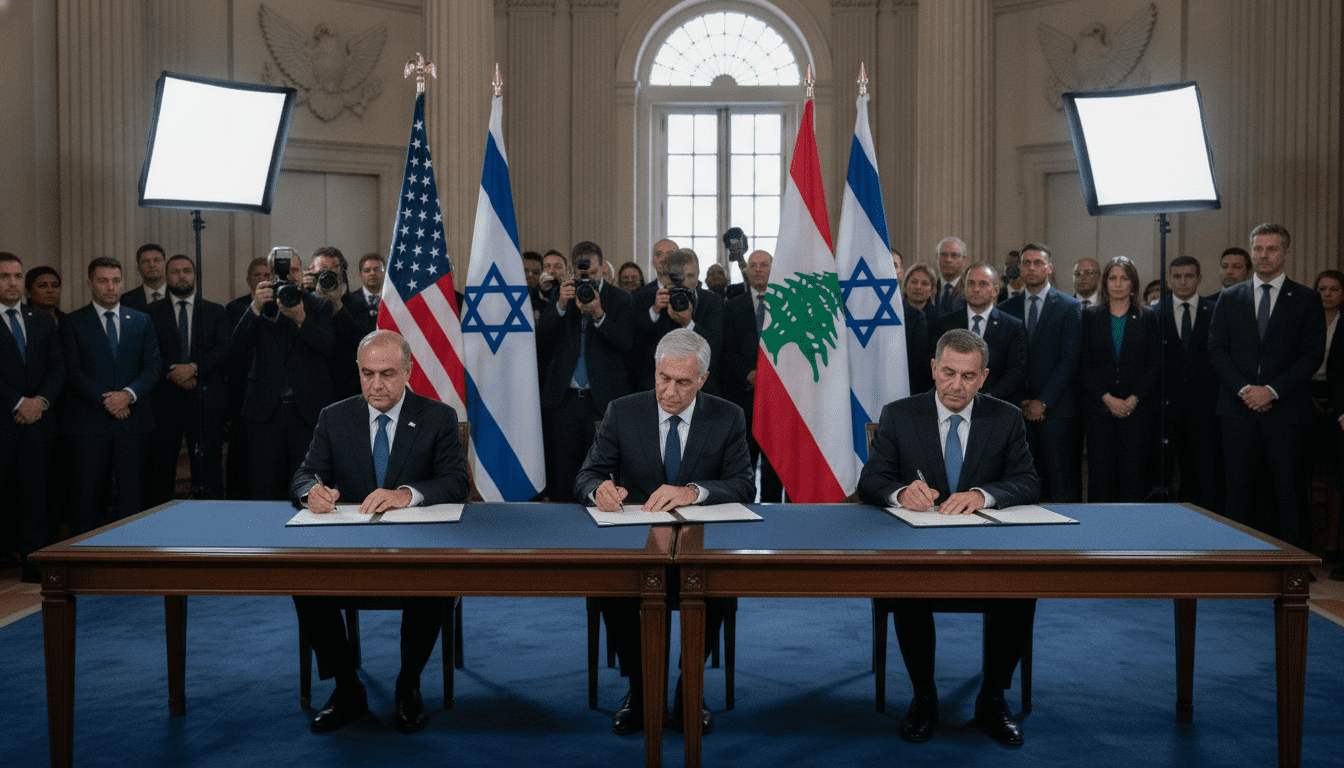
Israel-Lebanon framework agreement signed in Washington signals tentative step toward peace
US-mediated Israel-Lebanon framework agreement signed in Washington aims to reduce hostilities while Hezbollah remains outside talks and a fragile ceasefire holds.
The governments of Israel and Lebanon signed an Israel-Lebanon framework agreement in Washington on Friday, a preliminary diplomatic step that U.S. officials framed as the start of a process toward a more durable peace between the two neighbors. Representatives from both capitals completed the signing after days of U.S.-led negotiations, while leaders warned that the path ahead remains fragile amid ongoing violence in southern Lebanon.
Agreement Signed in Washington
The framework agreement was formally signed in the U.S. capital by Lebanon’s ambassador Nada Hamadeh Moawad and Israel’s ambassador Jechiel Leiter. The ceremony took place in the presence of U.S. Secretary of State Marco Rubio who described the pact as a first step toward lasting settlement of disputes between the two countries.
U.S. officials arranged the talks and hosted negotiators for several days of discussions prior to the signature. The accord is presented as a political framework rather than a final peace treaty and is intended to open channels for further negotiations and confidence building.
Key Provisions and Ambiguities
The framework sets out broad principles for de-escalation, border management and the creation of mechanisms for ongoing dialogue. Officials said the text leaves significant issues for future rounds, including the definition of maritime or territorial lines and the role of international monitors in sensitive areas.
Observers noted the agreement deliberately avoids final legal definitions, instead emphasizing procedures for verification and future negotiation. That vagueness is meant to make the package acceptable to both governments while preserving room for compromises in subsequent talks.
U.S. Role and Rubio Remarks
U.S. mediation was central to the talks from the outset, with Washington hosting and facilitating the discussions that culminated in the signature. Secretary of State Marco Rubio framed the document as a necessary first step, saying both nations deserved an opportunity to pursue lasting peace.
American diplomats described their objective as creating a structured process to reduce miscalculations along the border and expand diplomatic engagement. The U.S. role includes offering technical support for monitoring and helping set timelines for follow-up sessions.
Violence and Recent Military Incidents
The signing came amid continued violence along the Israel-Lebanon frontier, with Israeli forces conducting strikes in southern Lebanon as recently as Thursday evening. Those incidents underscored how quickly battlefield dynamics can threaten diplomatic progress and raised concerns about implementation of any agreement.
Military analysts cautioned that localized clashes or single incidents could unravel trust quickly unless robust verification and response mechanisms are put in place. Both governments face domestic political pressures that could complicate adherence to restraint measures outlined in the framework.
Hezbollah Rejection and Ceasefire Status
The pro-Iranian Hezbollah militia did not participate in the negotiations and publicly rejected the talks, maintaining its long-standing stance against direct engagement with Israel. Despite that, Hezbollah has observed a ceasefire with Israel since June 19, according to officials who track the front line.
The ceasefire has been uneven in previous attempts, but sources said the most recent pause in hostilities had been largely respected by both sides until the recent Israeli strikes. The exclusion of Hezbollah from the agreement leaves a significant enforcement gap because the group remains a dominant armed actor in southern Lebanon.
Next Steps and Diplomatic Outlook
Diplomats signaled that the framework is intended to be the opening of a series of negotiated steps, with follow-up technical talks and confidence building measures planned. Specific timelines were not publicly announced, reflecting the negotiators’ caution and the need for coordination on monitoring arrangements.
Implementation will depend on both capitals aligning domestic political support and on mitigating the influence of nonstate actors outside the formal process. International partners may be asked to provide monitoring teams or logistical assistance to reduce risks of renewed escalation.
Both Israel and Lebanon described the agreement as a constructive development, but analysts emphasized that its success will rest on institutionalizing communication channels and ensuring that battlefield commanders and nonstate fighters do not act in ways that undercut political progress.
The framework signed in Washington represents a tentative diplomatic opening between Israel and Lebanon, but the exclusion of Hezbollah and the persistence of recent strikes highlight the fragile nature of the process and the difficult path ahead.
