
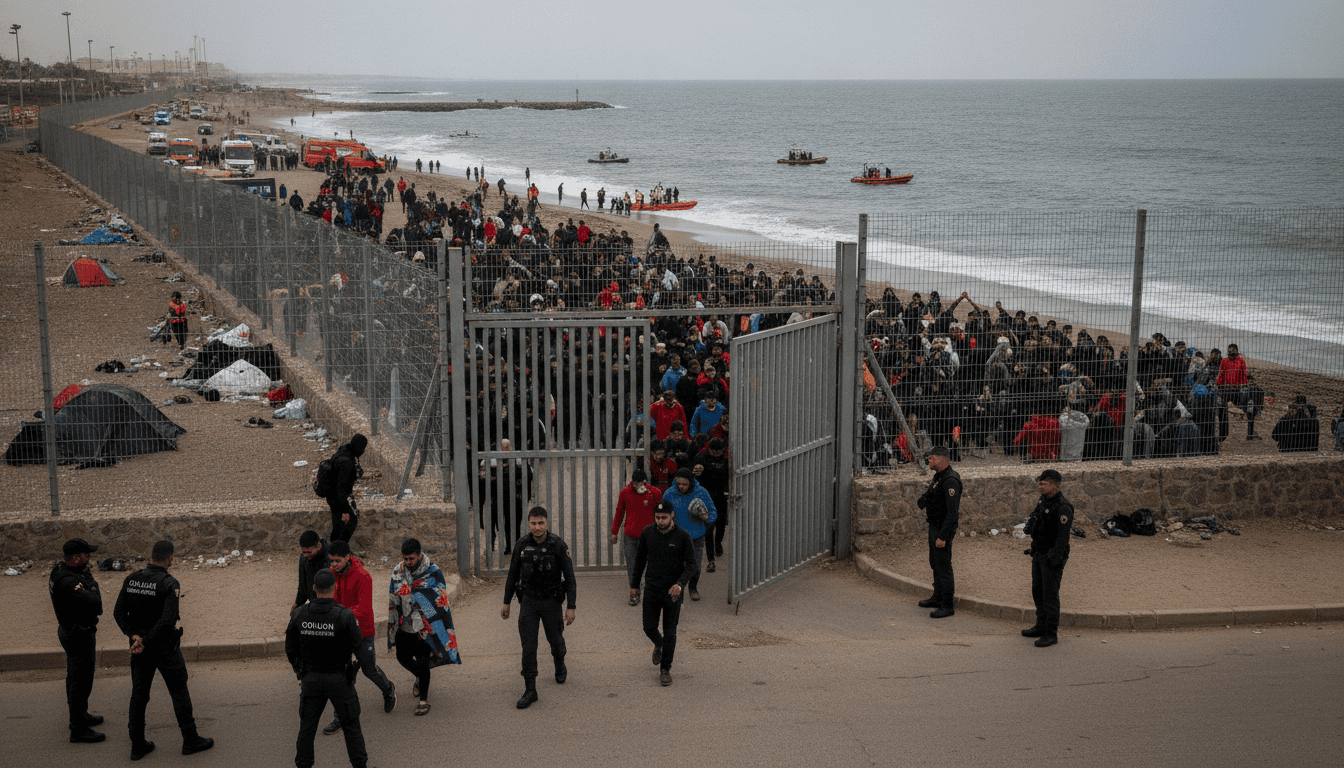
Ceuta migrants depart en masse: nearly 48,300 return to Morocco amid deaths and EU tensions
Nearly 48,300 Ceuta migrants returned to Morocco after a mass arrival; Spanish authorities reported several dozen deaths and rising Schengen tensions.
Spain’s government said Friday evening that roughly 48,300 people who had entered the Spanish enclave of Ceuta in the Strait of Gibraltar left the territory and returned to Morocco, effectively reversing a dramatic influx that began Thursday morning. The rapid departure follows an estimated wave of up to 50,000 entrants, a movement that overwhelmed local reception capacity and prompted emergency deployments of police and military personnel.
Rapid outflow reported by Madrid
The Spanish Interior Ministry announced the figure late on Friday, saying the vast majority of those who had arrived since Thursday had left voluntarily for Morocco. Madrid’s prime minister’s office had earlier reported that groups were departing at a rate of about 150 people per minute at the height of the exodus.
Spain’s foreign minister described the situation in blunt terms, stating that almost all who had entered had returned, while regional authorities in Ceuta offered higher arrival estimates that were difficult to reconcile. The abrupt reversal appeared to stem from a combination of deteriorating local conditions and organized departures across beach points where many had first reached the enclave.
Conflicting tallies and uncertainty over numbers
Local officials in Ceuta initially put the number of arrivals at more than 60,000, a count higher than Madrid’s later estimate of roughly 50,000 entrants. Independent verification of either figure was not possible on the ground, and journalists reported thousands still present in the enclave late into Friday evening.
The discrepancy in tallies complicated response efforts and public understanding of the scale of the episode, with officials and media sources issuing differing figures throughout the day. Authorities emphasized that the majority left for Morocco, but also acknowledged pockets of people who remained or were being processed in reception centers.
Humanitarian strain in Ceuta’s streets and shelters
Local accounts described closed shops, empty petrol stations and a severe shortage of drinking water for those who had arrived, many of whom spent the night outdoors. Reception facilities were already over capacity before the mass arrival, leaving many migrants with nowhere official to stay and little access to basic services.
Eyewitnesses told Spanish broadcasters that word of open borders and unrestricted entry had circulated through social media and personal networks, prompting many young Moroccans to attempt the crossing by swimming or climbing gaps in coastal fences. The sudden influx tested Ceuta’s emergency response and exposed gaps in immediate humanitarian support.
Rising death toll and rescue operations
Rescue services and security forces struggled to contain the flows and to recover those who drowned attempting the sea crossing. Press reports late Friday said that 57 bodies had been recovered that day, bringing the total deaths this year on the route to 89, compared with 46 over the whole of the previous year.
Spanish police and the armed forces were deployed to reinforce border controls and to prevent further landings at some coastal points. Emergency responders continued to conduct searches and to update casualty counts as recovery operations proceeded, underscoring the acute human cost of the crossings.
Political fallout and Schengen tensions across Europe
The events in Ceuta prompted a political response beyond Spain’s borders, with Italy announcing the reintroduction of checks on non-EU nationals arriving from Spain by air or sea. Italy’s premier said she would not remain passive in the face of scenes coming from Ceuta and spoke of suspending aspects of the Schengen framework, a position that Madrid rejected.
Spain’s foreign minister pushed back strongly on calls to question Schengen’s integrity, arguing that it was impossible to reach the Spanish mainland from Ceuta without passing identity controls. Madrid maintained that no one had entered the Schengen area from Ceuta without proper identification, framing the exodus as a contained episode that did not breach broader European border security.
Humanitarian organizations and local authorities in Ceuta called for coordinated assistance and diplomatic engagement to prevent further loss of life and to manage arrivals humanely. The incident has placed renewed emphasis on bilateral cooperation between Spain and Morocco and on wider EU mechanisms for managing irregular migration.
The immediate aftermath leaves questions about how such a large movement began, why it reversed so quickly, and what measures will be put in place to prevent a recurrence while safeguarding lives and legal processes.
