
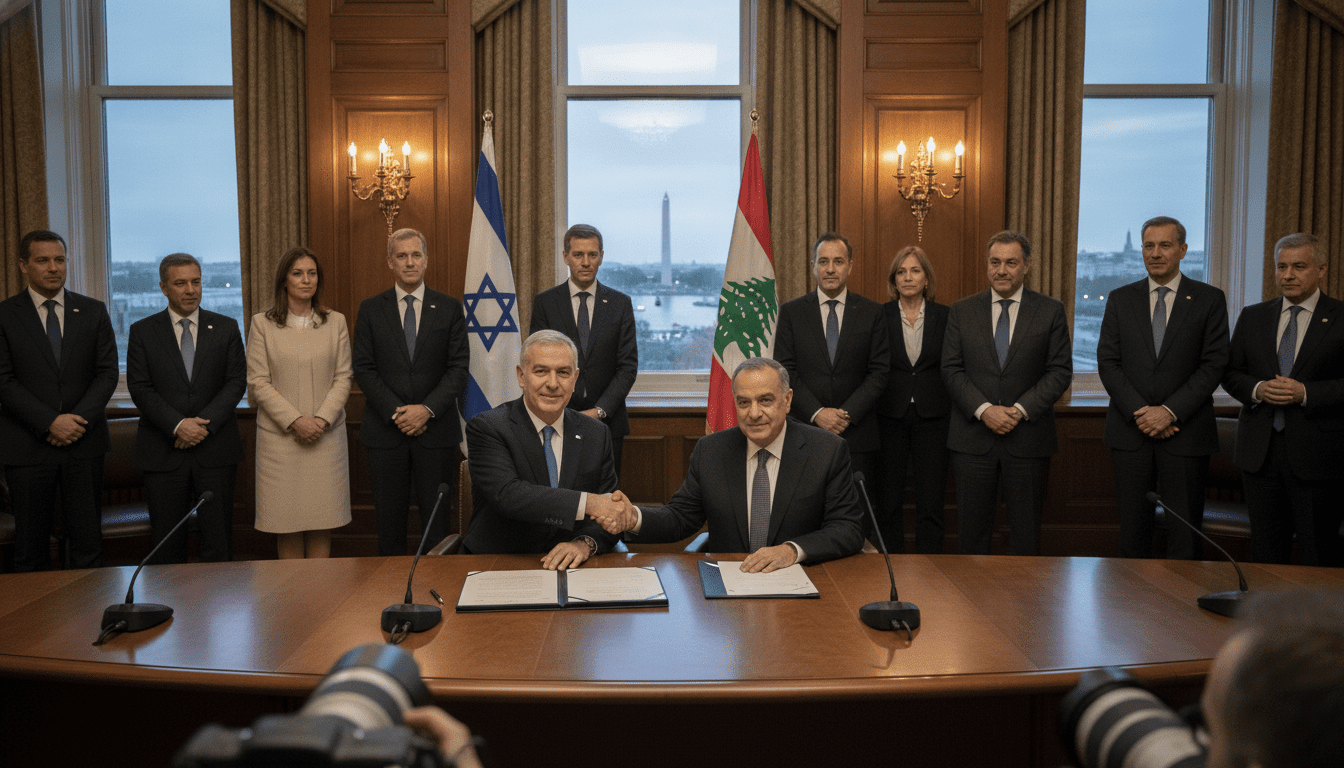
Israel-Lebanon framework agreement reached in Washington, setting out 14-point plan for lasting peace
A new Israel-Lebanon framework agreement signed in Washington on June 26, 2026, outlines a 14-point plan intended to establish lasting peace and security between the two neighbors. Delegations from Israel and Lebanon reached the accord after focused talks mediated by U.S. officials, with the document setting out measures on borders, security, and confidence-building. The framework mirrors a 14-point structure used in other recent regional agreements and aims to move both sides from confrontation toward a negotiated path.
Agreement Reached in Washington
The two delegations concluded talks late on Friday evening, June 26, 2026, in the U.S. capital, where negotiators presented a joint framework intended to reduce tensions along the Israel-Lebanon frontier. U.S. diplomats played a coordinating role, hosting the discussions and providing the venue for the agreement’s announcement. Officials described the outcome as a framework rather than a final treaty, signaling further negotiations and verification steps will be required.
The document consists of 14 discrete points that outline commitments and procedures both sides would follow to de-escalate and build trust. While specific operational details were not published in full, diplomats said the points cover security arrangements, border monitoring, and the establishment of communication channels. Observers noted the choice of a numbered, point-by-point format is intended to make implementation and verification clearer.
Fourteen-Point Framework and Its Components
The framework’s 14 points are designed to address immediate security concerns while creating mechanisms for longer-term stability. Key elements include measures to prevent cross-border incidents, procedures for managing violations, and the creation of joint or third-party monitoring arrangements. The plan also emphasizes humanitarian access, the safety of civilians near conflict zones, and the protection of critical infrastructure.
In addition to security provisions, the document reportedly contains steps for economic and administrative cooperation aimed at reducing drivers of conflict. These measures are intended to create incentives for adherence and to provide tangible benefits for communities affected by years of instability. Diplomats emphasized that the framework leaves room for technical annexes that would specify timelines, monitoring technology, and dispute-resolution methods.
U.S. Mediation and Regional Context
U.S. officials served as mediators and hosts for the talks, a role Washington framed as facilitative rather than prescriptive. The venue in Washington reflected the U.S. interest in stabilizing a volatile front that has broader implications for regional security. Statements from the hosts underscored that the agreement is the result of direct dialogue between Israeli and Lebanese delegations, with international partners offering support for implementation.
Analysts say the initiative must be viewed within a wider regional context where multiple recent diplomatic efforts have used concise, multi-point frameworks to structure complex agreements. The U.S. involvement aims to provide guarantees and logistical support for monitoring, while also leveraging diplomatic relationships with other regional actors to encourage compliance. Whether those partner states will play active roles in enforcement or verification remains an open question.
Potential Obstacles and Domestic Reactions
Despite the cooperative language of the framework, significant obstacles remain that could complicate implementation. Domestic political dynamics in both Israel and Lebanon are likely to shape how leaders interpret and apply the framework’s provisions. In Lebanon, the presence of armed groups and a fragmented political landscape could limit the government’s ability to deliver on commitments. In Israel, security concerns and public sentiment toward any concessions along the northern border may constrain political maneuvering.
Security experts also highlight the technical challenge of monitoring a tense frontier where incidents can escalate quickly. Effective verification will require robust, transparent mechanisms that both sides accept, and the potential use of third-party monitors could face resistance. The framework’s success will depend on matched political will, resources for implementation, and the ability of mediators to respond to violations with credible consequences.
Verification, Timelines, and Next Diplomatic Steps
The framework specifies initial steps toward implementing its 14 points, including the establishment of joint committees and a schedule for technical follow-up meetings. Diplomats indicated that specialists in security, maritime boundaries, and humanitarian access will convene in the coming weeks to draft detailed annexes. A series of confidence-building measures—such as agreed patrol patterns, hotline communications, and limited de-escalation zones—are expected to be piloted early in the process.
International monitors and supporting states are likely to be asked to provide equipment, training, and impartial observation to ensure adherence to the agreement. Negotiators have proposed a phased timeline that ties further concessions and economic cooperation to demonstrated compliance with initial security measures. Observers caution that timelines are contingent and will be adjusted according to on-the-ground developments and political feedback.
The framework’s architects say the document is intended to be durable, but they stopped short of declaring it a definitive peace treaty. Instead, the 14-point plan is being presented as a structured pathway designed to convert a period of relative calm into sustained, verifiable stability along the border.
Final paragraph
The coming weeks will test whether the Israel-Lebanon framework agreement can move from a diplomatic milestone to measurable change on the ground, with implementation hinging on technical precision, international support, and the political capacity of both governments to follow through on the 14-point plan.
