
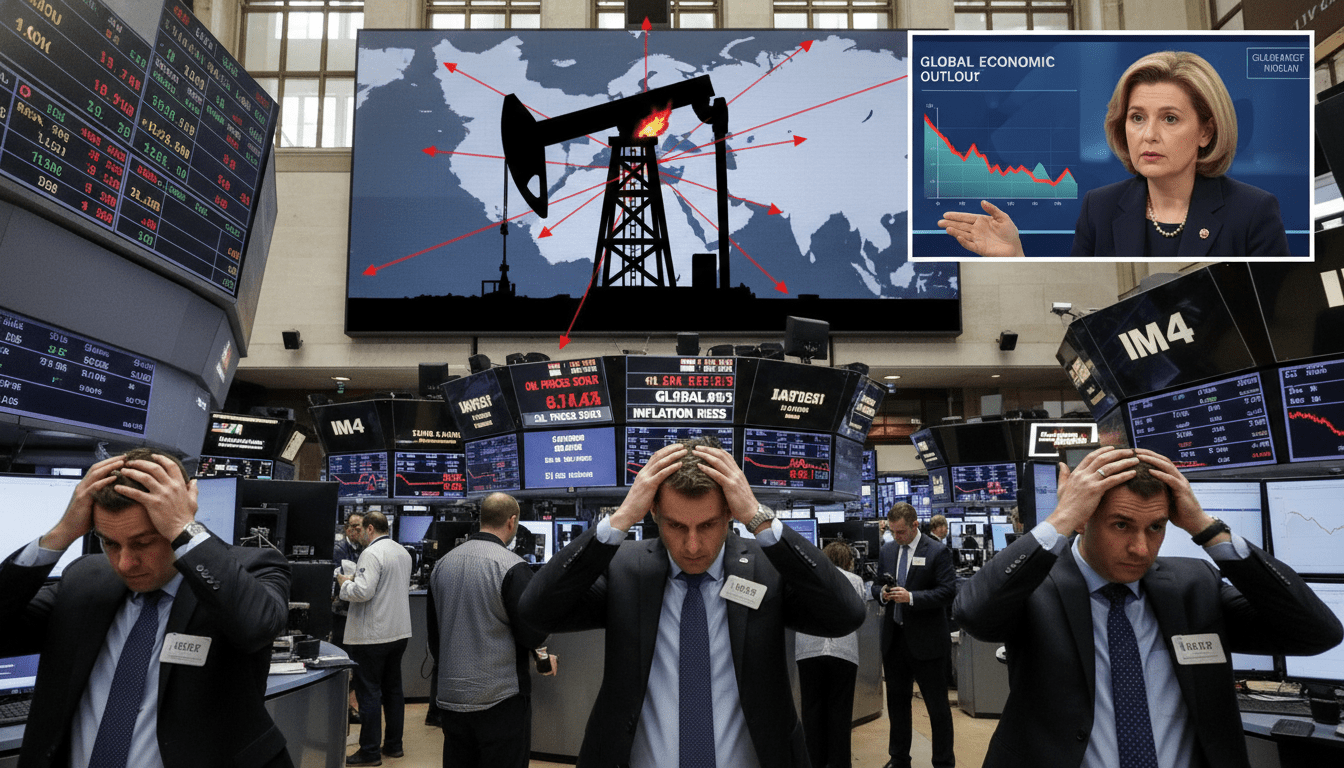
IMF Says War in Iran Dampens Global Growth and Raises Inflation Risks
IMF warns the war in Iran will dent global growth and raise inflation risks, with energy shocks hitting emerging markets, Germany and testing central banks.
IMF downgrades global outlook amid conflict in Iran
The International Monetary Fund has cut its near‑term growth forecast, citing the war in Iran as a major drag on the world economy. In its spring World Economic Outlook, the IMF projects weaker expansion this year and next, warning that the conflict could push commodity prices higher and constrain trade flows.
The report frames the downgrade as contingent on the path of the conflict, with alternative scenarios showing sharply different outcomes for growth and inflation. Policymakers and markets are being asked to weigh a range of risks rather than a single definitive forecast.
Energy bottlenecks and Strait of Hormuz threaten supplies
A central channel for risk is the Strait of Hormuz, where disruption to shipping could sharply elevate oil and gas prices. The IMF notes that even a short‑lived disturbance would raise energy costs substantially, while a prolonged blockade or damage to production and refining capacity would magnify the shock.
Higher energy prices would ripple through manufacturing and transport, raising costs for energy‑intensive goods and aggravating supply‑chain bottlenecks already exposed by geopolitical uncertainty. The report stresses that the severity of economic fallout depends on both the duration of disruptions and the scale of damage to infrastructure.
Inflation scenarios range from moderate to severe
Under the IMF’s baseline scenario, global inflation is expected to tick up again, reversing years of easing, as energy costs surge modestly. That baseline assumes a temporary conflict and a moderate rise in energy prices, producing a noticeable rise in headline inflation but not a return to hyper‑inflationary dynamics.
The fund also lays out a more adverse scenario in which prolonged disruptions and stronger price expectations push inflation higher and growth lower. In that case, inflation could move into the mid‑single digits and real growth would weaken further, while a worst‑case path could see inflation climb above six percent and global expansion slow sharply.
Monetary policy faces a stark trade‑off
The IMF urges central banks to let temporary energy shocks pass if inflation expectations remain well anchored, arguing that monetary authorities cannot control world commodity prices alone. That advice comes with a caveat: if medium‑ or long‑term inflation expectations begin to rise, price stability must take priority, prompting rapid policy tightening.
A rapid shift to tighter monetary policy would aim to prevent a wage‑price spiral but risks curbing demand and tipping fragile economies into recession. The fund underscores that central banks must strike a delicate balance between containing inflationary pressures and avoiding undue harm to growth.
Emerging markets and Germany among the most affected
Emerging and low‑income economies that import energy and other commodities are particularly vulnerable to higher prices and tighter external financing. The IMF highlights that these countries were already exposed before the conflict, and a sustained shock would deepen fiscal strains and heighten debt servicing pressures.
The report also flags near‑term weakness in advanced economies, noting that Germany’s economy is projected to stagnate with only modest growth this year and next. By contrast, some energy exporters, including Russia, are positioned to gain from stronger commodity revenues, widening global divergence.
Markets, wages and the risk of a feedback loop
Higher energy prices could prompt firms to raise output prices, while workers may push for larger pay increases to protect real incomes, creating the risk of a self‑reinforcing wage‑price dynamic. The IMF warns that where inflation expectations are poorly anchored this could lead to persistent inflation and more aggressive monetary responses.
Financial markets would likely react swiftly to a deterioration, with asset valuations falling, risk premia widening and capital flows reversing toward safe havens. A stronger dollar and tighter financing conditions would compound pressures on indebted emerging markets and weaken global demand.
Global growth now hinges on the trajectory of the conflict and the response of policymakers. The IMF’s assessment highlights that while a moderate, short‑lived shock would be manageable, a prolonged escalation would raise the likelihood of higher inflation, tighter financial conditions and a broad slowdown.
