
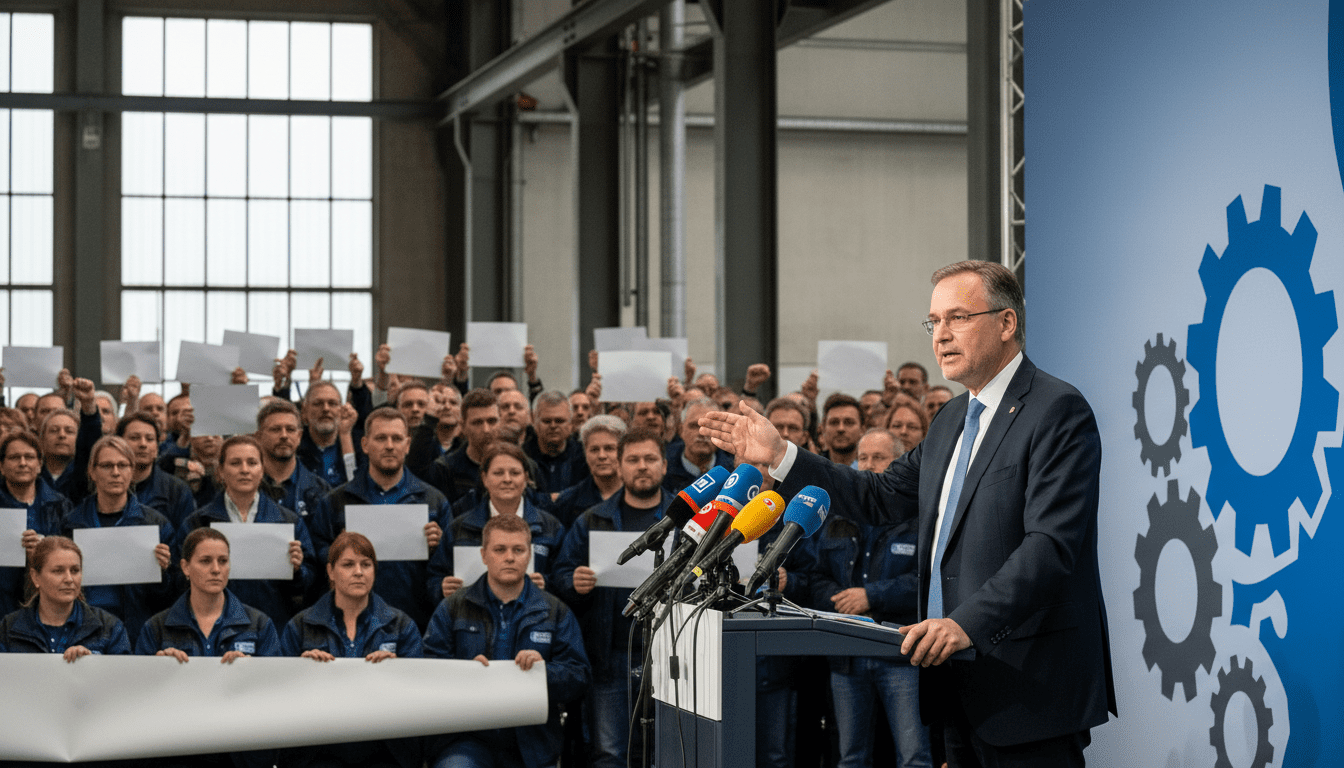
IG Metall threatens strikes if government moves to cut statutory pensions
IG Metall leader Christiane Benner warned of strikes and large-scale protests if the government pursues cuts to the statutory pension, criticizing Chancellor Friedrich Merz and demanding wage increases ahead of industry talks.
Opening summary
IG Metall, Germany’s largest industrial union, has publicly threatened strike action if the federal government implements reductions to the statutory pension that would lower retirement incomes. Christiane Benner singled out Chancellor Friedrich Merz’s recent remarks framing the statutory pension as merely a “basic” safety net and said unions would respond firmly to any measures that reduce workers’ living standards. The warning comes as the metal and electrical sector prepares for a major collective bargaining round in the autumn.
Benner frames pension cuts as a red line
Benner described reductions in statutory pension entitlements as unacceptable and said the union would mobilize members to defend existing benefits. She stressed that while unions are open to structural reforms to ensure sustainability, any reform that translates into lower pensions for current or future retirees will be resisted. The IG Metall leader also made clear the union has financial resources and organisational capacity to sustain industrial action if needed.
Merz’s ‘basic’ pension comment and government debate
Chancellor Merz has argued publicly that the statutory pension may need to become a basic level of protection rather than providing full replacement income in future decades. That positioning has intensified debate within government and across social partners about the objectives of pension policy and how to balance fiscal sustainability with social protection. Social ministry officials and other coalition partners have signalled differing views, underscoring that the issue remains contested inside the cabinet and in advisory commissions.
Union demands and preparations ahead of tariff talks
IG Metall singled out the upcoming autumn tariff round for roughly four million workers in the metal and electrical industries as the context for its demands. Benner called for durable wage increases rather than one-off payments and said the union will prioritize pay and retirement security in negotiations. She also noted the union’s strike fund is well stocked, indicating readiness to mount targeted industrial action if employers and government proposals erode wages or pension rights.
Opposition to ‘Karenztage’ sick-pay changes
In addition to pensions, Benner warned against proposals to introduce so-called “Karenztage” — waiting days during which employees would not receive pay when reporting sick. She argued such measures would shift costs onto workers and disproportionately affect low- and middle-income employees. IG Metall framed these proposals as part of a broader pattern of reforms that would weaken income protection and vowed to mobilize if they were pursued without agreement with unions.
DGB criticizes exclusion from reform process
The head of the Confederation of German Trade Unions, Yasmin Fahimi, echoed concerns about the government’s handling of reform discussions, saying social partners are not being adequately involved. Fahimi warned that sidelining unions and employers harms both the quality and public acceptance of policy changes and called for broader consultation to build societal consensus. She urged the government to engage trade unions more substantively in commissions and working groups addressing pensions, finance and health.
Benner welcomes fuel tax cut but faults unilateral bonus
Benner welcomed the government’s decision to lower the mineral oil tax in response to geopolitical pressure on energy markets and described the move as temporary relief for households. She also acknowledged a proposal for a tax-free €1,000 one-off payment to employees as a positive measure to ease burdens. However, she criticised the lack of prior consultation with social partners and said unilateral action repeats a mistake from 2022; Benner reiterated that permanent wage increases are a more sustainable way to improve workers’ living standards.
Public-sector and private-sector employers are watching the developments closely, mindful that an assertive stance by IG Metall could trigger ripple effects across bargaining tables. Business groups have repeatedly called for predictability and long-term planning in pension and labor market policy, arguing that sudden reversals or cuts would undermine economic confidence.
The unions’ dual approach — pressing for higher recurring wages while simultaneously defending pension entitlements — signals that upcoming months will involve intense negotiations both at the sectoral level and in broader policy forums. Political leaders face the challenge of balancing fiscal constraints, demographic pressures and the need to maintain social consensus, while unions seek to protect members’ purchasing power and retirement security.
The standoff adds pressure to an already fraught policy calendar: parliamentary debates and commission work on pension sustainability will proceed alongside collective bargaining, making coordination with social partners a critical factor for any durable outcome. The tone of exchanges between union leaders, government ministers and employers in the weeks ahead will likely determine whether the dispute escalates into strikes or is resolved through compromise.
