
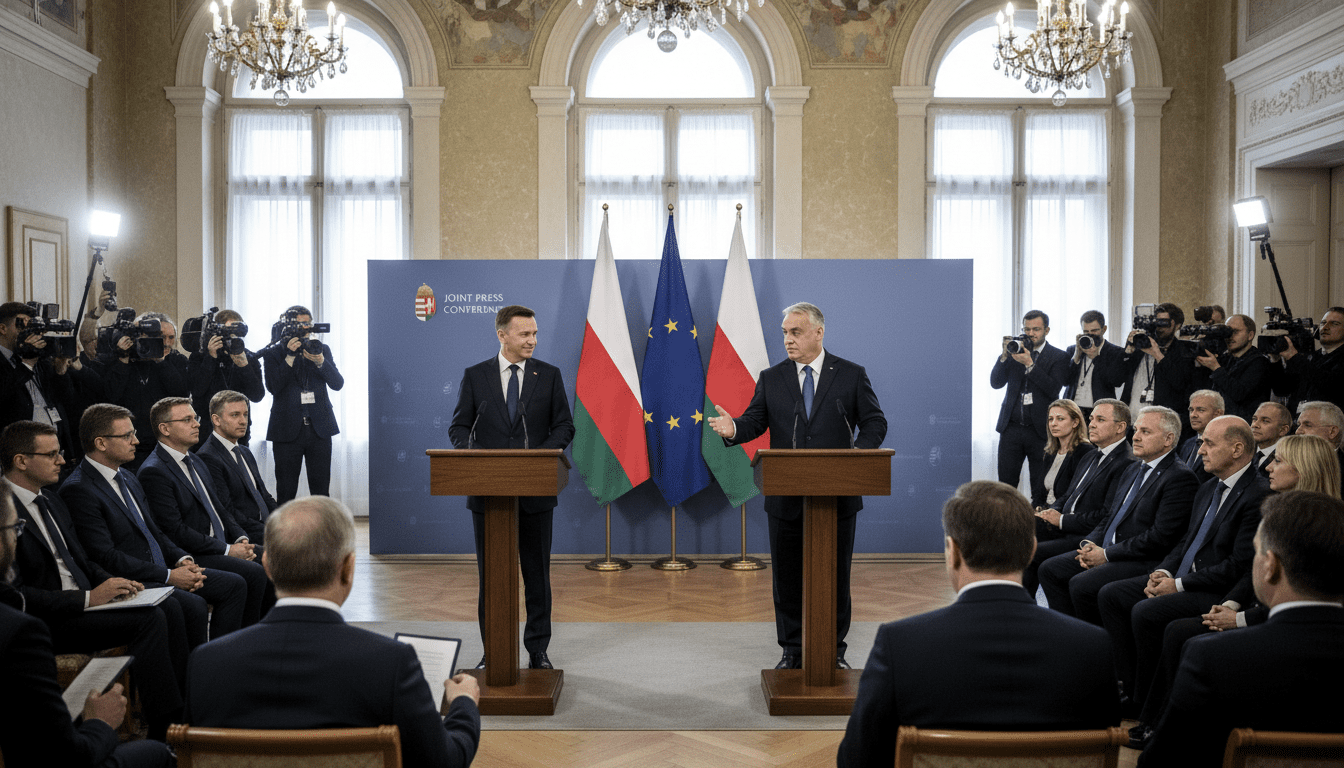
Péter Magyar Pledges Closer Hungary–Poland Coordination on Foreign Policy During Warsaw Visit
Péter Magyar visits Warsaw to announce closer Hungary-Poland coordination on foreign policy, aiming to restore rule of law and unlock €18 billion in EU funds.
Péter Magyar, Hungary’s newly sworn-in prime minister, used his first foreign visit to Warsaw to pledge that Hungary will coordinate closely with Poland on geopolitical questions within the EU. Speaking alongside Polish Prime Minister Donald Tusk, Magyar framed the relationship as a strategic partnership aimed at defending shared interests and accelerating Hungary’s return to compliance with European institutions. The visit signals a sharp break with the previous Budapest government and sets priorities that include restoring judicial independence, pursuing anti-corruption investigations, and seeking the release of frozen EU payments.
Magyar and Tusk Agree to Coordinate on Geopolitical Questions
Magyar and Tusk told reporters that the two governments will consult on major external-policy decisions at EU level, describing the cooperation as necessary in a fraught regional security environment. Tusk emphasized that Warsaw and Budapest share largely the same interests when it comes to geopolitical stability and European unity. The encounter in Warsaw underscored Poland’s role as a model for Magyar, who credited Poland’s post-2023 government with restoring relations with EU institutions.
Plans to Restore Rule of Law and Target Corruption
Magyar presented a domestic agenda that foregrounds judicial reform and the prosecution of alleged corruption linked to the previous administration. He said reversing policies criticized by Brussels will help meet EU rule-of-law benchmarks and pave the way for financial normalization. With a parliamentary two-thirds majority won in the April 2026 election, Magyar argued his government has a stronger institutional mandate to carry out these changes than Poland’s governing coalition, which has faced internal resistance to similar reforms.
EU Funds Release Tops the Agenda with €18 Billion at Stake
A central objective of Magyar’s trip is to secure the unlocking of roughly €18 billion in EU funds that Brussels has withheld amid concerns over governance and legal standards. Polish officials noted that Warsaw’s own post-2023 engagement with the EU led to a partial thawing of frozen payments, a trajectory Budapest now seeks to emulate. Both capitals signaled a willingness to coordinate technical and political steps to meet EU conditions, though Brussels will set the benchmarks and timelines for any release of funds.
Approach to Ukraine: Reset Possible but Conditional
Magyar told Polish hosts he wants to open a new chapter in relations with Ukraine while pressing Kyiv on rights for the Hungarian minority in Transcarpathia. He made clear that Hungary would not deliver weapons to Ukraine but expressed support for restarting diplomatic ties and for conditional engagement on EU matters. Magyar suggested a possible meeting with Ukrainian President Volodymyr Zelenskyy if an agreement on minority rights—such as language status for Hungarian in Transcarpathia—can be reached, marking a departure from his predecessor’s repeated vetoes of some Kyiv-focused EU measures.
Political Context: From Orbán to Magyar and Regional Repercussions
The visit highlights a broader political reset in Budapest after 16 years under Viktor Orbán, whose government often clashed with Brussels and at times aligned with Moscow on strategic matters. Magyar’s Tisza coalition, which campaigned on reversing perceived democratic backsliding, has made addressing these frictions a priority. Warsaw’s experience since 2023—when a pro-EU coalition displaced a right-wing government—provides a blueprint that Magyar referenced repeatedly, portraying Poland’s reforms as an “express train” for change in the region.
Next Steps: Negotiations with Brussels and Regional Diplomacy
Both leaders signalled that the coming weeks will focus on concrete steps: legislative changes in Budapest to guarantee judicial independence, transparent anti-corruption probes, and bilateral talks on minority rights with Kyiv. Poland pledged to share experience and technical support, while Hungary indicated it would engage constructively with EU monitors. Brussels, however, retains the authority to judge progress and release funds only after specific benchmarks are met, meaning the path to full normalization will depend on verifiable reforms.
The Warsaw visit marks a notable pivot in Central European politics, as Hungary seeks quick rapprochement with EU institutions and a calibrated reset in regional diplomacy. Whether Magyar can translate his parliamentary majority into durable legal and institutional change will determine both the pace at which the €18 billion is released and Hungary’s role in shaping EU foreign-policy decisions alongside Poland.
