
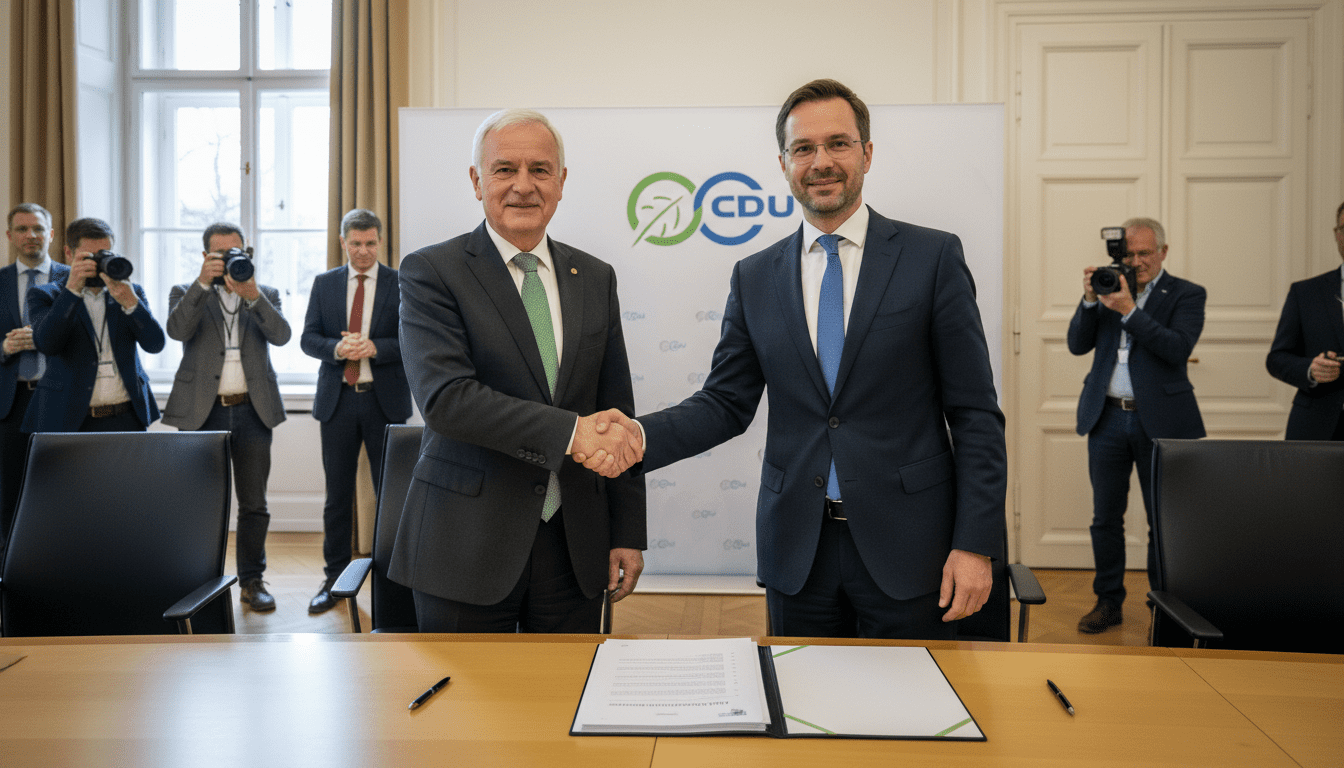
Greens and CDU Reach Agreement on Eckpunkte to Launch Baden-Württemberg Coalition Talks
Greens and CDU leaders have agreed on a set of Eckpunkte to begin formal Baden-Württemberg coalition negotiations, paving the way for talks after weeks of exploratory talks. The compromise was reached overnight by Green lead candidate Cem Özdemir and CDU state chief Manuel Hagel, according to party circles. (zeit.de)
Agreement Reached After Weeks of Sondierungen
Party leaders from the Greens and the CDU said their teams had negotiated a clear list of key points that would form the basis for coalition talks. Negotiators described the accord as a compromise meant to bridge contentious issues, with the two leaders meeting repeatedly during the talks. (swp.de)
Officials indicated the agreement came at the end of a process that began with formal Sondierungsgespräche in late March and included multiple rounds of technical talks. The aim now is to translate the Eckpunkte into a full coalition contract once internal party approvals are secured. (zeit.de)
Sondierungspapier with About 40 Points to Be Presented in Stuttgart
A Sondierungspapier reportedly containing roughly 40 points is scheduled to be presented in Stuttgart this afternoon, outlining policy positions and the division of responsibilities. The document is expected to set out priorities on climate policy, the economy, and public services, and will be used to guide detailed negotiations. (zeit.de)
Negotiators have focused in recent days on sensitive portfolio allocations, including how many ministries the CDU would receive if coalition talks proceed. Observers say agreement on the distribution of ministries was a central sticking point throughout the Sondierungen. (stuttgarter-zeitung.de)
CDU Gremien Must Approve Next Steps
Before formal coalition negotiations can begin, CDU internal bodies must endorse the decision to enter talks, and a meeting of the party’s state executive is expected to consider the proposal. Manuel Hagel has previously stated that the CDU will make a collective decision on whether to begin formal coalition negotiations. (landtag-bw.de)
If the CDU boards give their consent, both parties will move from exploratory discussions to intensive drafting of a coalition agreement. That process typically includes subject-specific working groups and timetabled sessions to produce a full contract for party ratification. (swp.de)
Election Results Leave Parliament Evenly Split
The outcome of the March 8 state election left the Greens narrowly ahead of the CDU, with the Greens winning 30.2 percent and the CDU 29.7 percent of second votes, producing parity in seat numbers in the new Landtag. The result means both parties hold 56 seats each, making a continuation of a green–black coalition the only realistic pathway to a stable majority. (stuttgarter-zeitung.de)
Other parties in the Landtag — the AfD and the SPD — hold significantly fewer seats, and mainstream parties have ruled out cooperating with the AfD, narrowing coalition possibilities. That arithmetic has increased pressure on the Greens and CDU to find common ground quickly. (sueddeutsche.de)
Timetable and Constitutional Deadlines
Negotiators have identified the planned dates for the Landtag’s first session and a potential minister-president vote as reference points, with the inaugural sitting currently scheduled for May 12 and the election of the state’s minister-president targeted for May 13. Although the state constitution allows a government to be formed within three months of the first session, the parties are seeking a quicker resolution. (swp.de)
Party officials say there is no formal constitutional requirement to meet the mid-May target, but political momentum and the need for a functioning government on fiscal and administrative matters have created informal time pressures. Historically, Baden-Württemberg governments have often been formed faster than the maximum period allowed. (landtag-bw.de)
Key Policy Fault Lines and Negotiation Priorities
Negotiators reportedly prioritized economic policy, public investment, and environmental measures while also negotiating the distribution of ministries. The CDU pushed for stronger emphasis on economic competitiveness and structural support for industry, while the Greens sought commitments on climate and transport reform. (stuttgarter-zeitung.de)
Observers expect detailed discussions on coalition governance, such as the scope of any new or restructured ministries, budget commitments, and timelines for implementing major reforms. The size and remit of economic and infrastructure ministries remain among the most closely watched items. (stuttgarter-nachrichten.de)
The agreement between Cem Özdemir and Manuel Hagel marks a decisive step toward renewing the green–black government in Baden-Württemberg, but both parties still face internal ratification steps and technically demanding negotiations before a full coalition contract is signed. The coming days will determine whether the compromise reached overnight can be converted into a stable governing majority ahead of the Landtag’s planned sessions in May.
