
Google Pentagon AI contract prompts DeepMind staff backlash and fuels wider debate
Google Pentagon AI contract draws DeepMind employee backlash, raising alarms over autonomous weapons and mass surveillance and prompting calls for clearer AI rules.
The Google Pentagon AI contract, finalized this spring, has triggered public criticism from DeepMind researchers and renewed debate over how corporate AI can be used by government agencies. Senior research scientist Andreas Kirsch and hundreds of colleagues signed an open letter and publicly opposed the deal, saying it fails to bar uses they find ethically unacceptable. The controversy follows a separate standoff between Anthropic and the U.S. government that centered on restrictions for surveillance and autonomous weapons.
Details of the Pentagon agreement
The Pentagon agreement grants the U.S. Defense Department access to commercial AI models for a range of classified purposes described in reports as “lawful” uses. According to employee statements and reporting, the contract language stops short of absolute prohibitions and contains phrasing such as models “should not” be used for autonomous weapons or domestic mass surveillance. Critics argue that such wording leaves legal and operational loopholes for future interpretive changes.
Company sources said Google will provide models under terms the firm described as industry standard, while employees maintain internal communications about the deal were limited. Reports suggest the Pentagon may request modifications to safety filters and that Google would not retain an outright veto, an arrangement that unsettled many staffers who expected stronger safeguards.
Employee revolt at Google DeepMind
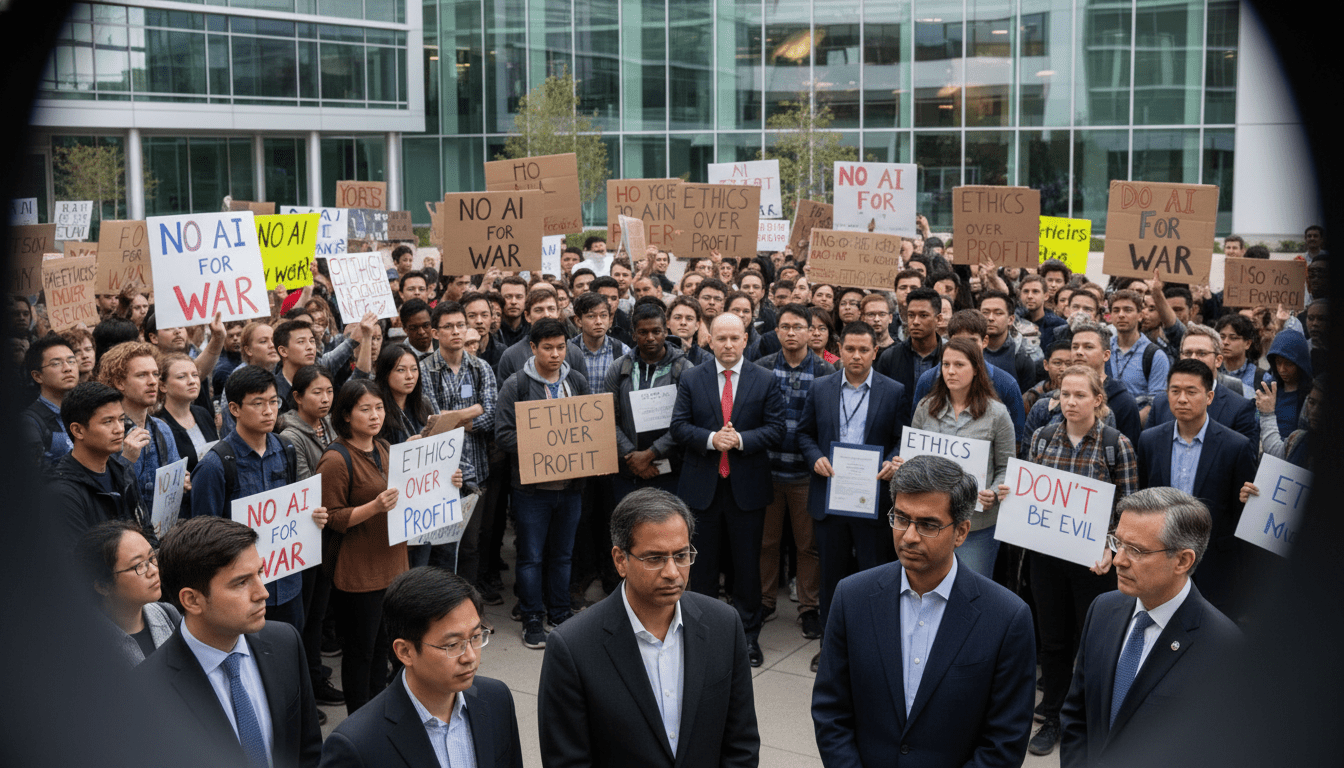
Several hundred Google employees signed an open letter urging leadership to reconsider the agreement, citing ethical and reputational risks. The protest was notably visible inside Google DeepMind, where researchers who focus on model safety and governance said they were blindsided by the speed of the deal and the lack of internal consultation. Staff reactions included public posts on social platforms, work leave, and discussions about resignations.
The internal backlash echoes the 2018 Project Maven episode but also differs in scale and context, with employees today expressing additional fears about diminished leverage and shifting corporate priorities. Multiple signatories said they felt their principles were at odds with the company’s current course and that management had not offered clear, convincing answers to their concerns.
Researcher Andreas Kirsch speaks out
Andreas Kirsch, a senior research scientist who returned to Google in 2024 after doctoral studies, became one of the most vocal critics of the deal. Kirsch told colleagues and reporters he felt “ashamed” to work for a company that he believes framed its safeguards as stronger than they are in practice. He argued publicly that the agreement’s language is primarily public relations rather than enforceable limits.
Kirsch emphasized his integrity and willingness to risk career consequences to highlight the issue, saying many researchers at DeepMind are idealists who joined the company because of its stated ethical principles. His statements resonated with staff and added a personal dimension to a conflict that many see as emblematic of tensions between commercial incentives and research ethics.
Anthropic dispute and government response
The Google controversy unfolded against the backdrop of Anthropic’s dispute with U.S. authorities, in which Anthropic insisted its Claude model not be used for mass surveillance or fully autonomous weapons. The company’s refusal reportedly led to a designation as a supply chain risk and prompted legal action. That dispute deepened worries among employees and civil society groups about how contracts and government pressure can reshape corporate behavior.
While Anthropic positioned itself as defending restrictions, other major vendors including OpenAI and Google negotiated agreements that allowed broader use scenarios. Observers say the differing company responses have set a precedent that could influence future negotiations and the regulatory landscape for AI deployment in national security contexts.
Concerns over autonomous weapons and surveillance
Opponents of the contract argue today’s large language models are error-prone and lack reliable mechanisms to guarantee lawful targeting or to refuse unlawful orders. They warn that deploying such systems in lethal or policing roles risks civilian harm and could entrench tools for mass surveillance. Researchers pointed to historical examples of misuse and highlighted the difficulty of embedding legal or moral judgment into opaque models.
Critics also said the rapid adoption of AI by security agencies risks shifting power balances between state and society, particularly where independent oversight is weak. They urged that any collaboration with government entities include binding, enforceable constraints, transparent oversight, and independent audits to prevent mission creep.
Calls for clearer rules and company accountability
The debate has prompted renewed calls for legislation and stronger corporate governance on AI export and use. Employees and outside experts urged lawmakers to define legal limits for AI in autonomous systems and domestic surveillance, and recommended that companies adopt verifiable, legally binding contract clauses rather than aspirational statements. Some researchers also asked for independent oversight structures that remain insulated from political pressure.
Company critics stressed that voluntary principles without enforcement mechanisms are insufficient and that present contract terms could serve as a baseline for looser agreements in the future. They warned that the current precedent will shape both technological deployment and public trust in AI firms for years to come.
The Google Pentagon AI contract controversy has become more than an internal dispute: it is a touchstone for broader questions about corporate responsibility, national security, and the need for durable legal frameworks governing AI use. As conversations continue inside Google, in Washington and among regulators worldwide, researchers and policymakers are pressing for clearer, enforceable rules to govern how advanced AI systems may be applied by states and militaries.
