
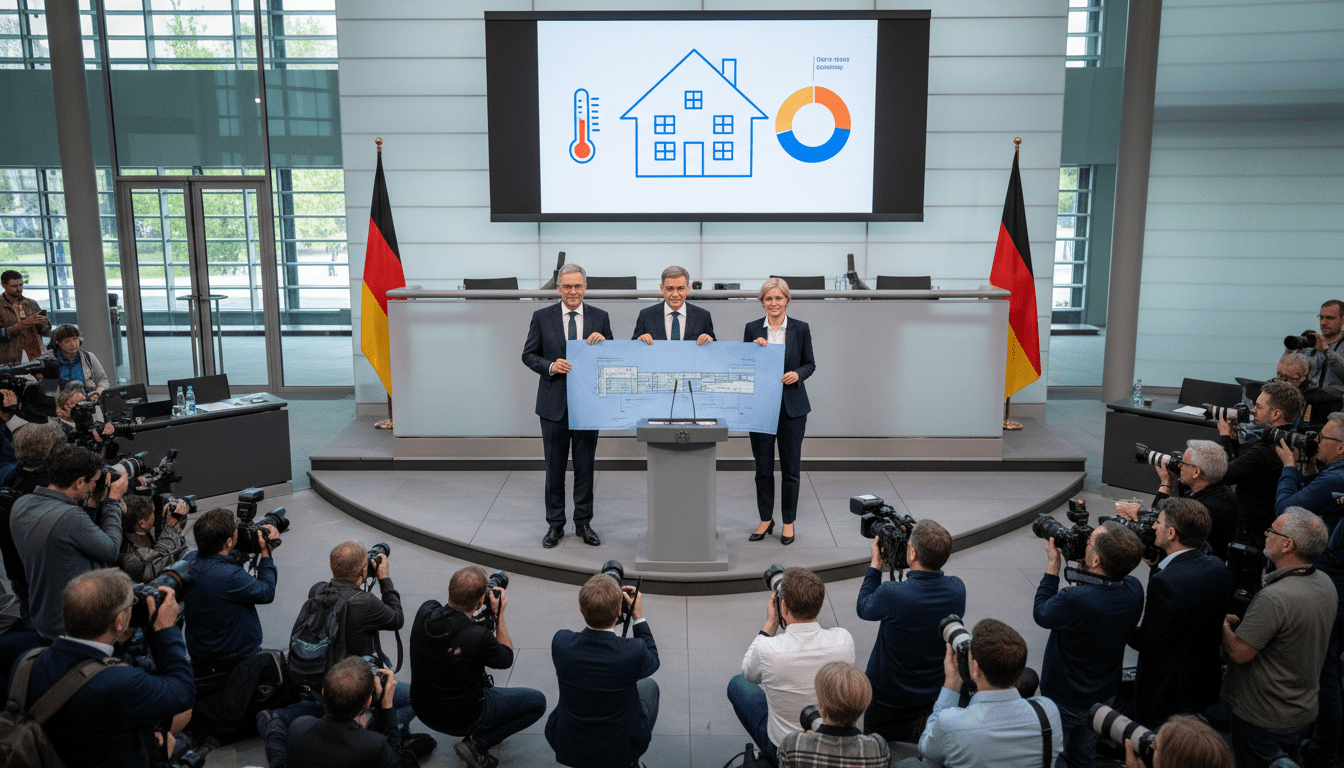
Germany coalition agrees heating law reform to cap tenant costs and split CO₂, grid fees with landlords
Coalition agrees heating law reform to cap tenant costs; CO₂ and grid fees to be split with landlords, biogas quotas phased in from 2028 to 2040. Aid kept.
The ruling CDU/CSU–SPD coalition has agreed a heating law reform that will cap cost risks for tenants and split charges between renters and landlords, marking a major rewrite of Germany’s Heizungsgesetz. The heating law reform commits to halving tenant exposure to CO₂ levies, gas network fees and costs for biogenic fuels in the early phases, while preserving funding for heater replacement. Lawmakers described the package as a balance between protecting households and keeping investment incentives for owners.
Coalition agreement and political framing
The agreement was brokered by the parliamentary leadership of CDU/CSU and SPD alongside Economy Minister Katherina Reiche and Housing Minister Verena Hubertz. SPD parliamentary chief Matthias Miersch framed the move as necessary to ensure climate measures remain affordable for tenants. CDU leaders called the change a rollback of stricter rules introduced by the previous government and argued it restores freedom for building owners in heating decisions.
The reform replaces the more prescriptive demands of the earlier law, removing the 65 percent renewable operation requirement for newly installed systems and opting for a staged, technology-neutral approach. Government officials said the new text aims to be simpler and more practicable while maintaining long-term decarbonisation objectives.
Four-stage biogas roadmap set through 2040
A central element of the reform is a four-stage “biotreppe” that phases in requirements for biogenic fuels up to 2040. In the first three stages landlords and tenants will split the price differences for biogenic fuels equally, according to the coalition outline. From 2028, CO₂ charges and gas network fees are also slated to be shared on a 50/50 basis between tenants and property owners.
The staged approach is intended to provide transition certainty while increasing the renewable share in the gas supply over time. Officials say the sequence gives the heating market predictable milestones, but critics warn the structure could prolong reliance on fossil-based systems during the transition.
New installations and fuel quotas from 2029
Under the reform, landlords will for the first time be required to share costs arising from fuel and network charges when installing new gas or oil boilers. New gas and oil heating systems will remain permissible, but as of January 1, 2029, they must be operated with a progressively increasing share of climate-neutral fuels such as biomethane or synthetic alternatives. The coalition says this will allow continued use of existing technologies while ensuring a clearer path to lower-emission operation.
Supporters emphasise that subsidies for heater replacement — described as multibillion-euro programmes — will remain in place to smooth the conversion process. The government also intends to exempt functioning systems from immediate replacement, retaining transition periods for existing buildings.
Hardship exemption for low-rent, unmodernised housing
Lawmakers included a hardship clause aimed at unmodernised buildings with particularly low rents to shield vulnerable tenants and small landlords from disproportionate burdens. The exemption is meant to prevent forced costs that could endanger longstanding rental income for private owners, a consideration repeatedly raised by representatives of smaller landlords. Union lawmakers framed the provision as a necessary safeguard so that renting remains economically viable.
At the same time, the rule is likely to limit the pace of upgrades in certain segments of the housing stock, raising questions about long-term efficiency and decarbonisation in those buildings. Policymakers said the clause will be narrowly defined to target genuinely constrained cases.
Reactions from environmental groups and property associations
Environmental organisations warned the new pillars of the heating law reform could create a cost trap if CO₂ prices and network fees continue to rise, arguing that shifting costs risks to tenants and shared charges for biogas may still increase household heating bills over time. They also cautioned that allowing fossil-fuel boilers to remain in use longer could slow progress on emissions reductions in the building sector.
By contrast, landlord associations sharply criticised the coalition compromise, saying it offloads responsibilities onto private property owners who rely on rental income for retirement. Industry groups warned of negative effects on investment in the housing stock and said additional operating costs could undermine affordable housing supply.
The German Tenants’ Association had previously warned that earlier reform drafts could leave tenants exposed to higher ancillary costs, a concern that played into negotiations shaping the current compromise.
The coalition’s plan trades some of the former law’s prescriptive targets for a phased, cost-sharing model aimed at political and social acceptability. Observers say the next steps will hinge on the exact legal text, parliamentary debate and implementing regulations that define the thresholds, calculation methods and the hardship criteria.
The reform’s success will depend on its administrative clarity and on the balance it strikes between short-term affordability and the longer-term emissions trajectory for Germany’s building sector.
