
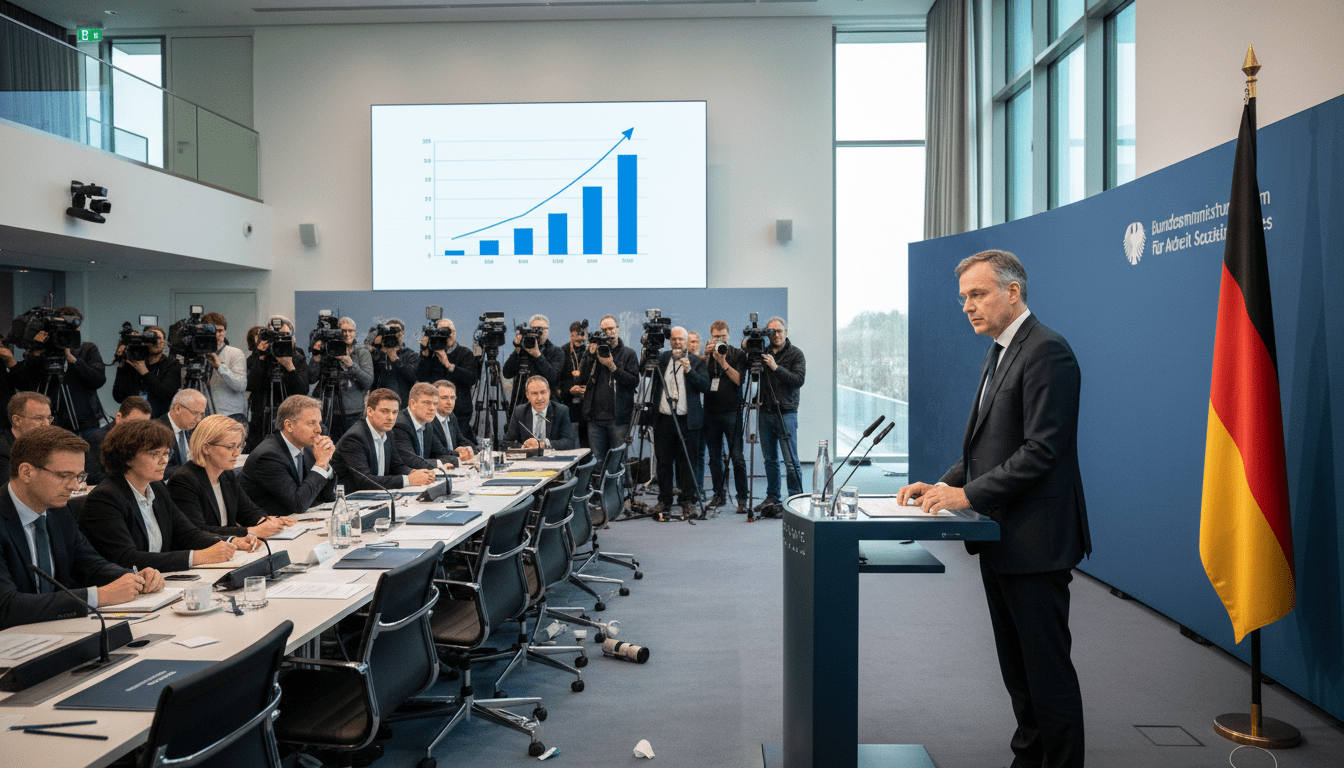
German unemployment stays above three million in April as employment falls
German unemployment remained above three million in April, with 3.01 million people registered as jobless and employment declining year‑on‑year, pressuring agency finances and policy responses.
Germany’s labour market showed only a modest spring uptick in April, leaving German unemployment at 3.01 million — about 13,000 fewer than in March but still well above the three‑million threshold. Seasonal adjustment data indicate a worse picture: unemployment rose by 20,000 from March when taking out normal seasonal effects. The persistence of higher joblessness compared with April 2025, up 77,000, has dimmed hopes that the labour market has already passed its worst point.
Agency chief warns of continued strain
Andrea Nahles, chair of the Federal Employment Agency, summarized the monthly report by saying the situation on the labour market remains tense. The agency highlighted that the usual spring boost to hiring — typically strong in outdoor trades and hospitality — failed to materialize at previous rates this year. Officials pointed to a three‑year deterioration in underlying labour market conditions as a structural headwind against seasonal recovery.
Seasonal pattern masked deeper weakness
Although headline unemployment edged down month‑on‑month, the seasonally adjusted rise underscores a deeper slowdown beneath the surface. Historically, German unemployment often falls by more than 70,000 from March to April, but this year that pattern did not hold. Analysts and officials note that weaker demand and international uncertainty have blunted the usual spring hiring surge across several sectors.
Employment figures show notable year‑on‑year decline
Labour market statistics for the early part of the year paint a consistent picture of job losses. Data for January show 34.98 million people in social‑security‑contributing positions, about 99,000 fewer than a year earlier. Broader employment figures for February, which include civil servants, marginal jobs and the self‑employed, recorded a decline of 182,000 compared with the same month in 2025, bringing total employment to approximately 45.7 million. These drops signal that weakness is not limited to temporary fluctuations but is affecting core payrolls.
Industry, temporary work and construction contract
The private sector bore the brunt of declines, led by manufacturing where social‑security employment fell by nearly 180,000 year‑on‑year. Temporary employment, closely tied to industrial demand, lost roughly 40,000 positions in the same period. Construction employment also contracted, with forecasters noting that unusually adverse weather this year may have further reduced seasonal activity in that sector. By contrast, the public sector continued to expand, adding around 150,000 jobs in public administration, health and social services compared with the prior year.
Political reactions and union demands
The Federal Ministry of Labour attributed part of the slowdown to deteriorating global conditions and the economic fallout from the Middle East conflict, and Labour Minister Bärbel Bas said the government would act to support growth and protect jobs. Trade unions urged policy measures to prevent long‑term scarring: the German Trade Union Confederation argued for easier access to short‑time work benefits to help firms and workers weather demand shocks. Union leaders warned that cuts to social protection would not create jobs and called for targeted support measures similar to those used during the pandemic.
Rising unemployment strains agency finances and contribution policy
Higher unemployment is already widening the Federal Employment Agency’s budget shortfall. The agency warned that rising expenditures for unemployment benefits will increase its deficit and require additional federal transfers. In November planning, the agency had anticipated a 2026 deficit of roughly four billion euros based on an average unemployment forecast of 2.9 million; government figures now point to an average of about 2.978 million. New budget framing for 2027 includes a potential additional loan of up to two billion euros to the agency. Officials noted that without such fiscal support the contribution rate for unemployment insurance, currently 2.6 percent of gross wages, would have needed to rise earlier; repayment of loans may push necessary increases into a later period.
The latest monthly report thus presents a mixed and fragile picture: headline unemployment is marginally lower than in March, but seasonally adjusted data, sectoral losses and rising fiscal pressures signal that the German labour market remains under sustained strain as policymakers weigh support measures and budgetary trade‑offs.
