
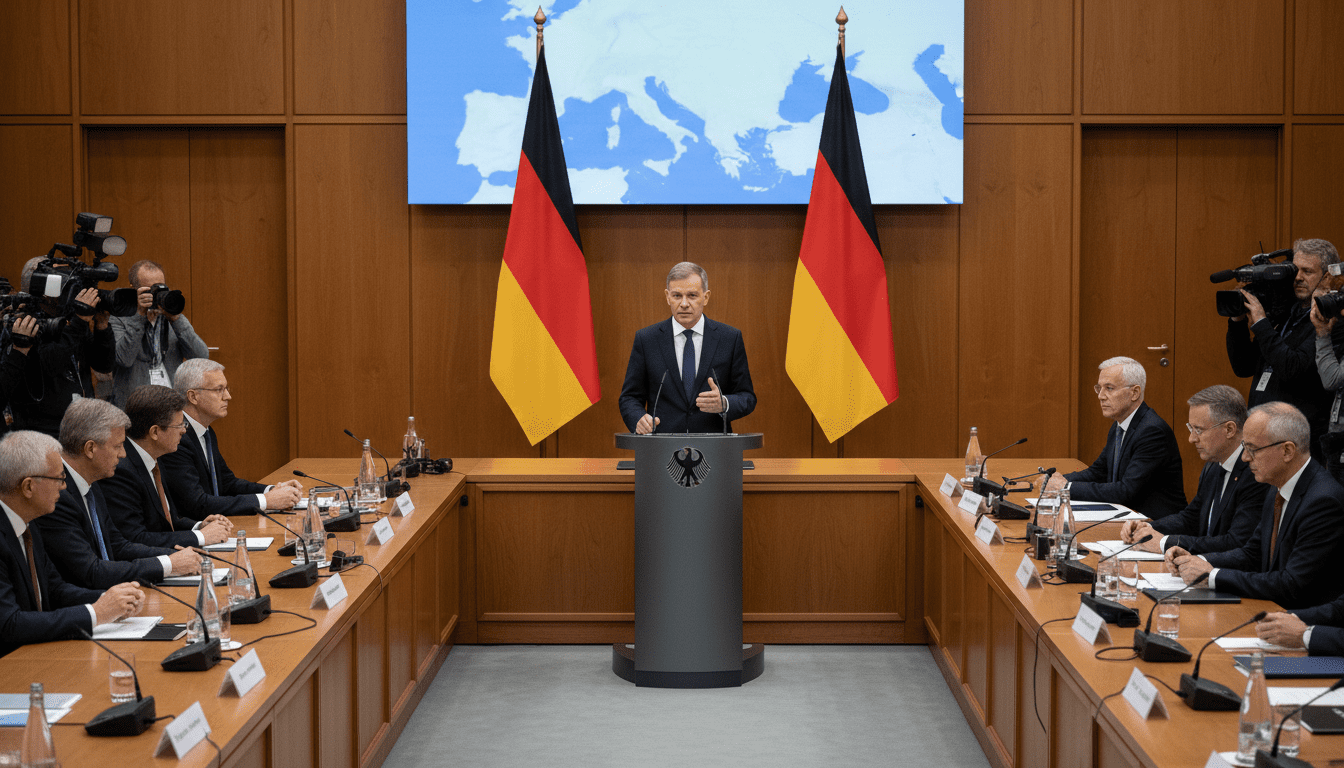
German government rejects Putin mediation offer as not credible amid ceasefire disputes
Berlin dismisses Putin mediation offer as insincere; firmly demands an extended ceasefire to May 11, European negotiators at the table, and Ukraine’s consent.
The German government has publicly cast doubt on Russian President Vladimir Putin’s recent Putin mediation offer, saying his remarks are not credible and require concrete steps before talks can proceed. Berlin said it had taken Putin’s comments, including his suggestion that former Chancellor Gerhard Schröder could mediate, “into account” but treated them as part of a pattern of insincere gestures reported by Reuters and dpa. Government sources signaled that any genuine move toward peace must be accompanied by verifiable changes on the ground and clear European participation in negotiations.
Government officials call rhetoric part of hybrid tactics
Senior German officials characterized the remarks from Moscow as consistent with what they described as hybrid strategies aimed at dividing Europe rather than producing honest diplomacy. Sources in Berlin said the test of sincerity would be immediate: Russia should extend a ceasefire and demonstrate it can abide by it. Officials warned that words alone, without concrete alterations of Russia’s negotiating posture or operational behavior, would not shift Germany’s cautious stance.
Putin floated talks and named Gerhard Schröder as intermediary
In public comments that drew international attention, President Putin said direct talks with Ukrainian President Volodymyr Zelenskyy were conceivable and suggested the former German chancellor Gerhard Schröder as a preferred intermediary. Putin further asserted that the conflict was “drawing to an end,” a formulation German officials and others treated skeptically in light of unchanged Russian conditions for peace. Schröder and Putin have maintained a long-standing personal relationship dating back to Schröder’s time in office from 1998 to 2005, a history that complicates perceptions of neutrality.
Berlin lays out specific conditions for credible negotiations
German government circles insisted that negotiation credibility must be demonstrated by concrete steps, foremost among them an extended, verifiable ceasefire that would allow diplomacy to proceed without immediate resumed hostilities. Berlin also called for European representatives to be present at any talks and invoked the E3 framework — Germany, France and the United Kingdom — as part of a possible negotiating configuration alongside Ukraine. Officials emphasized that any negotiation outcome must fully respect Ukraine’s sovereignty and require Kyiv’s explicit consent.
Ceasefire tied to May 9 Victory Day and alleged violations
Moscow and Kyiv had agreed to a temporary ceasefire tied to Russia’s Victory Day commemorations on May 9, 2026, with the pause set to last until Monday, May 11, 2026. Both sides, however, accused the other of breaching the truce during the brief cessation of active operations, raising questions in Berlin and among European capitals about whether a durable pause can be enforced. German sources said that extending the ceasefire beyond scheduled commemorations would be a first, tangible indicator that Moscow was serious about de-escalation.
SPD figures urge measured consideration of Schröder role
Leading Social Democratic Party foreign-policy figures in the Bundestag said Schröder’s involvement should not be dismissed out of hand, but stressed that any mediating role must be scrutinized for reliability and impartiality. Adis Ahmetović, the SPD’s foreign-policy spokesman, said offers must be “seriously examined” while underscoring that Europe cannot cede decision-making to only the United States and Russia. Ralf Stegner echoed the call for engagement, arguing that turning down every channel outright could foreclose opportunities, but both stressed that any outcome must have the unequivocal agreement of Ukraine.
European diplomacy confronts sensitive political realities
The episode is testing how European governments balance the desire for negotiations with caution about Moscow’s motives and the political sensitivities that accompany potential intermediaries with close ties to the Kremlin. Berlin and other capitals face the diplomatic challenge of ensuring Ukraine’s voice is central while preserving a united European front that can both support Kyiv and press for de-escalation. Analysts in government circles noted that any move to involve controversial figures will require transparent mandates, clear European participation and rigorous verification mechanisms to avoid rewarding insincere gestures.
Germany’s response underscores a broader European insistence that peace efforts be anchored in verifiable changes on the ground, multilateral participation and the consent of the Ukrainian government. Berlin has signaled willingness to engage in talks under those conditions, but it will treat the extension of the May 9 pause through Monday, May 11, 2026, and any further concrete commitments as the essential first steps toward meaningful negotiations.
