
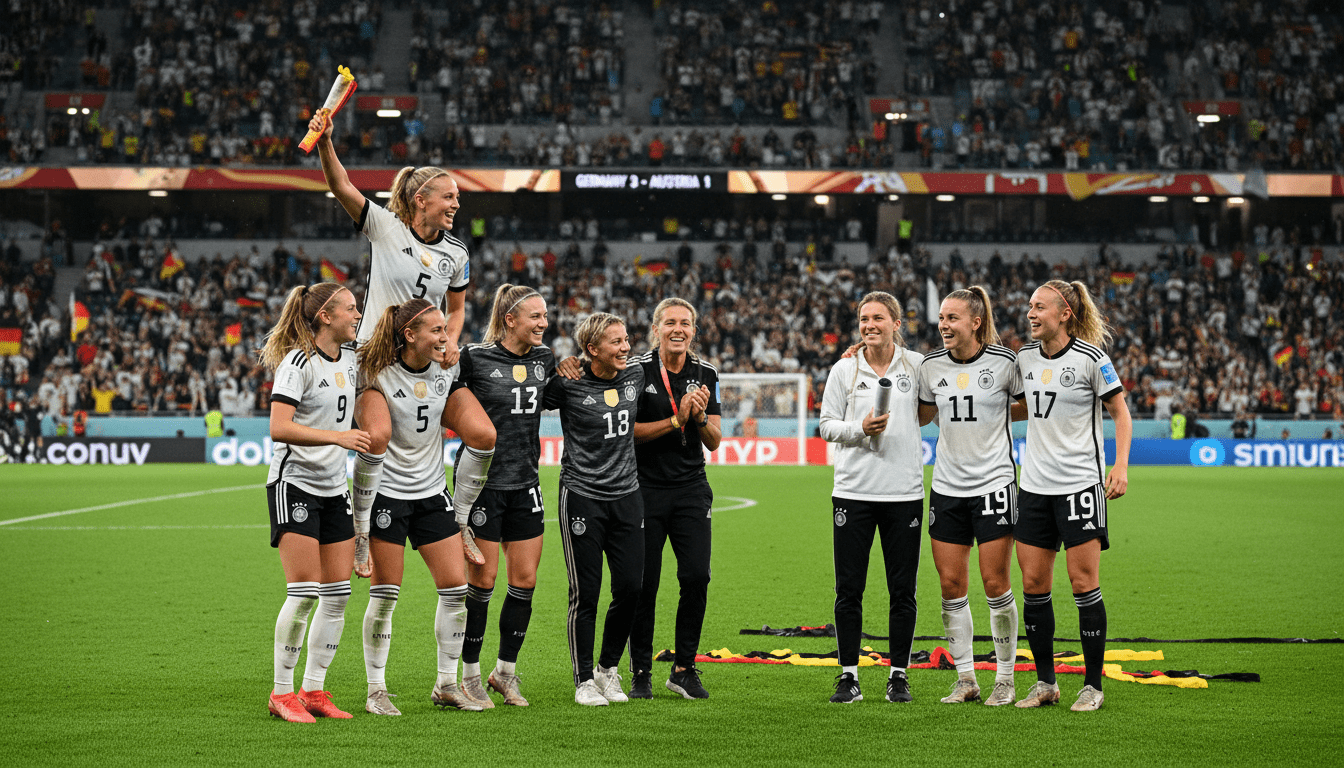
Germany women’s national team show renewed promise after 5-1 win and Sara Däbritz farewell
Germany women’s national team routed Austria 5-1 in Nuremberg as Sara Däbritz was honored; coach Christian Wück praised progress but warned work remains before summer 2027.
The Germany women’s national team delivered a confident statement in Nuremberg, beating Austria 5-1 in a World Cup qualifying match that doubled as a farewell to midfielder Sara Däbritz. The result extended a flawless start to qualification — three wins and a 14:1 goal differential — and underlined a phase of consolidation under coach Christian Wück. While the victory offered cause for optimism, Wück’s postgame message made clear that consistency against top-tier opponents will determine whether the side can close the gap on the world’s best by the 2027 World Cup in Brazil.
Match context and key moments
The win in Nuremberg lacked dramatic flair but delivered practical rewards, as Germany controlled possession and finished chances with clinical efficiency. Däbritz’s send-off provided an emotional backdrop, and the team balanced tribute with a professional performance that showcased depth across the pitch. The 5-1 scoreline masked some early wastefulness in attack, but it also highlighted Germany’s ability to convert when opportunities presented themselves.
Coach’s tactical approach and philosophy
Christian Wück has prioritized reliability over experimentation in this phase of qualification, selecting a lineup designed to build cohesion rather than test unproven rotations. Under his guidance the team presses earlier, speeds transitions and seeks to dictate tempo, reflecting an intention to act proactively rather than merely react. Wück’s insistence on “cleverer wins” signals a broader ambition: to eliminate lapses that allow individual opponents to swing tight matches.
Emerging leaders and squad reconfiguration
The squad has reshaped its leadership since the retirements of long-serving figures such as Alexandra Popp, Marina Hegering and Svenja Huth. New voices have stepped forward—Giulia Gwinn has grown into the captain’s responsibilities, while Janina Minge and Rebecca Knaak have provided defensive organization and composure. Franziska Kett has emerged as a dynamic presence whose willingness to take risks exemplifies the team’s collective mentality and helps define a new spine for the side.
Shortcomings exposed by elite opposition
Recent encounters with Spain in the Nations League exposed the narrow margin separating Germany from elite nations, where moments of individual quality decided outcomes. Against Spain, Germany matched the opponent for long stretches but ultimately paid for isolated mistakes and a relative lack of cutting edge in attack. The first half against Austria again demonstrated occasional profligacy in the final third, a deficiency Wück acknowledged as an area requiring sustained attention.
The toll of four tournaments without a title
A decade after the Rio 2016 Olympic triumph, Germany has endured four major tournaments without lifting another title, a sequence that has left marks on expectations and structure alike. That barren run has nevertheless prompted introspection and a reappraisal of personnel and systems, producing clearer roles and more stable axes within the squad. The absence of a major trophy has been a motivator as much as a burden, sharpening focus on long-term balance between experience and fresh talent.
What the remainder of qualification and the road to Brazil will reveal
This year, free from the pressures of a knockout tournament, offers a window for the coaching staff to refine patterns and address weaknesses ahead of the 2027 World Cup in Brazil. Remaining qualifying fixtures and scheduled friendlies will test whether Germany’s progress holds up against the tactical diversity and individual brilliance typical of top international sides. The true measure will be consistent performances against opponents of Spain’s, England’s and the United States’ calibre, where margins are slim and corrective work must translate into results.
The Nuremberg night combined remembrance with a tactical progress report: a convincing scoreline, clearer leadership structures and a coach determined to turn solidity into sustained excellence. As Germany’s women push toward summer 2027, the team’s task is straightforward in ambition though demanding in execution — translate domestic cohesion into match-winning quality on the global stage.
