
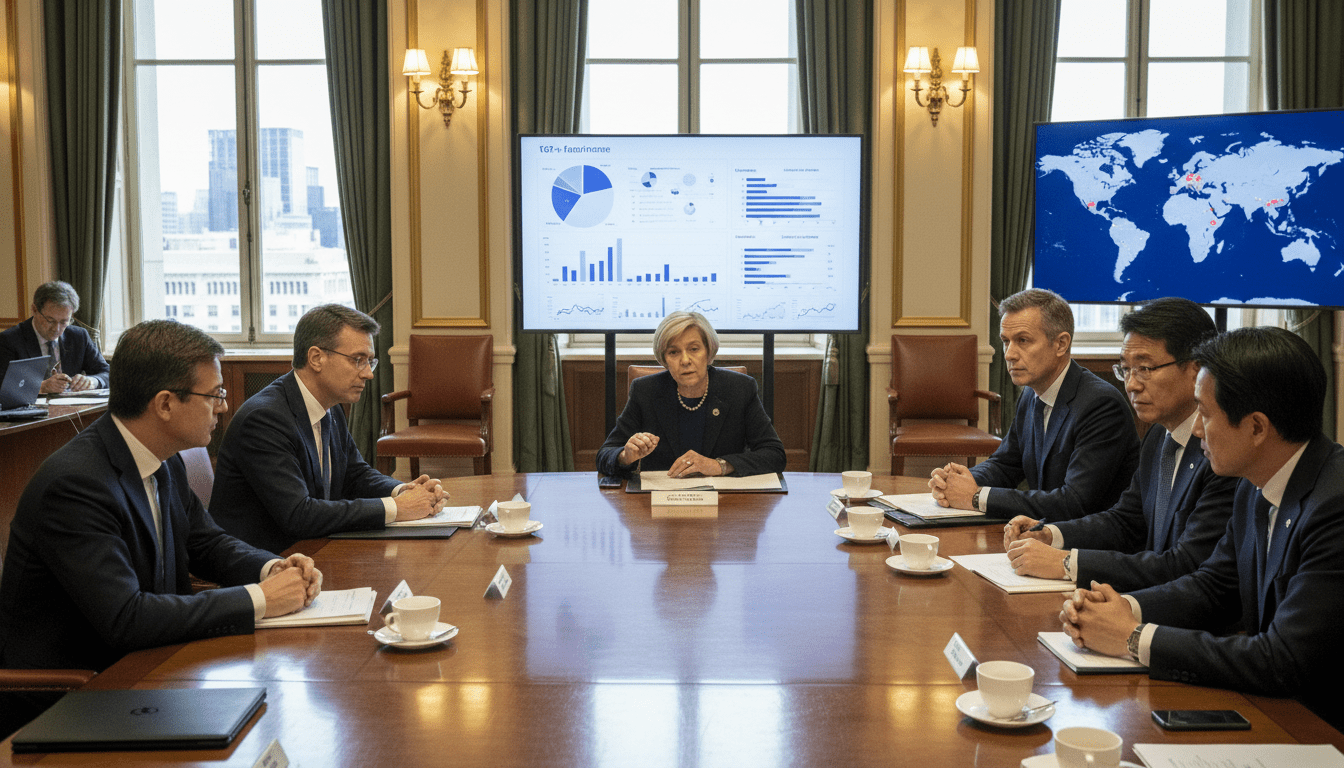
G7 finance leaders warn of economic fallout from prolonged Middle East war
G7 finance leaders warn of economic fallout from a prolonged Middle East war, urging urgent action to stabilise markets, energy flows and secure supply chains.
A group of G7 finance ministers and central bank governors cautioned that a protracted war in the Middle East could cause serious economic disruption and called for coordinated measures to limit knock-on effects. The officials met on the sidelines of the IMF and World Bank spring gatherings in Washington and framed the conflict as a central near-term risk to global stability. They emphasised the need to move towards a lasting peace while simultaneously protecting markets and energy supplies.
G7 Ministers and Central Bank Governors Convene in Washington
Finance ministers and central bank governors from G7 countries held discussions in Washington during the IMF and World Bank spring meetings, according to a statement from France, which holds the G7 presidency. Delegates described the conflict in the Middle East as a priority issue that warranted sustained attention across policy channels. The meetings provided a forum for assessing immediate economic vulnerabilities and for coordinating policy responses among major economies.
Urgent Call to Contain Economic Fallout
G7 finance leaders warned that a prolonged conflict could produce ripple effects across trade, investment and financial markets, and urged early action to contain those impacts. Officials highlighted the need for contingency planning to minimise disruptions to global supply chains and to limit volatility that could impede recovery in fragile regions. The emphasis was on pragmatic, coordinated steps to reduce uncertainty rather than on immediate punitive measures.
Stabilising Markets and Energy Flows
Ministers stressed stabilising markets and energy flows as a priority to prevent further economic contagion from the region’s unrest. They discussed measures aimed at ensuring liquidity in financial markets and preventing abrupt spikes in energy prices that could feed inflationary pressures worldwide. Authorities indicated that maintaining predictable energy supplies and mitigating price shocks would be critical to shielding vulnerable economies.
Securing Supply Chains for Critical Minerals
The talks also focused on securing supply chains for critical minerals, which are essential to technology and clean-energy transitions, France said in its statement. Delegates noted that disruptions in mineral supply could have long-term implications for industrial production and strategic sectors across G7 countries. Participants discussed ways to diversify sources, boost resilience, and coordinate investments to reduce dependence on single suppliers.
Officials emphasised that strengthening supply-chain resilience requires public-private coordination and international cooperation, including targeted support for alternative production hubs. They stressed that short-term measures must be paired with longer-term strategies to improve transparency and reduce bottlenecks. The conversation reflected growing concern about the intersection of geopolitical conflict and the energy transition.
Continued Support for Ukraine Amid Ongoing Conflict
G7 finance leaders reaffirmed their commitment to continue support for Ukraine while managing new strains on public finances caused by simultaneous crises. The statement linked the need for ongoing assistance to the broader imperative of preserving international rules and stabilising neighbouring regions. Ministers indicated that economic support and reconstruction financing would remain part of the agenda even as attention turned to new risks.
Coordination, Monitoring and Next Steps
Delegates agreed on the importance of close monitoring of economic indicators and agreed to keep communication channels open among central banks and finance ministries. They signalled intent to coordinate policy tools where necessary to limit spillovers, including through dialogue with international financial institutions. The G7 presidency said follow-up actions would be taken to refine contingency plans and keep markets informed.
The G7 finance leaders’ discussions in Washington underscore the growing recognition among major economies that geopolitical conflict can quickly translate into broad economic instability, and that cross-border coordination will be necessary to limit fallout while advancing longer-term diplomatic efforts.
