
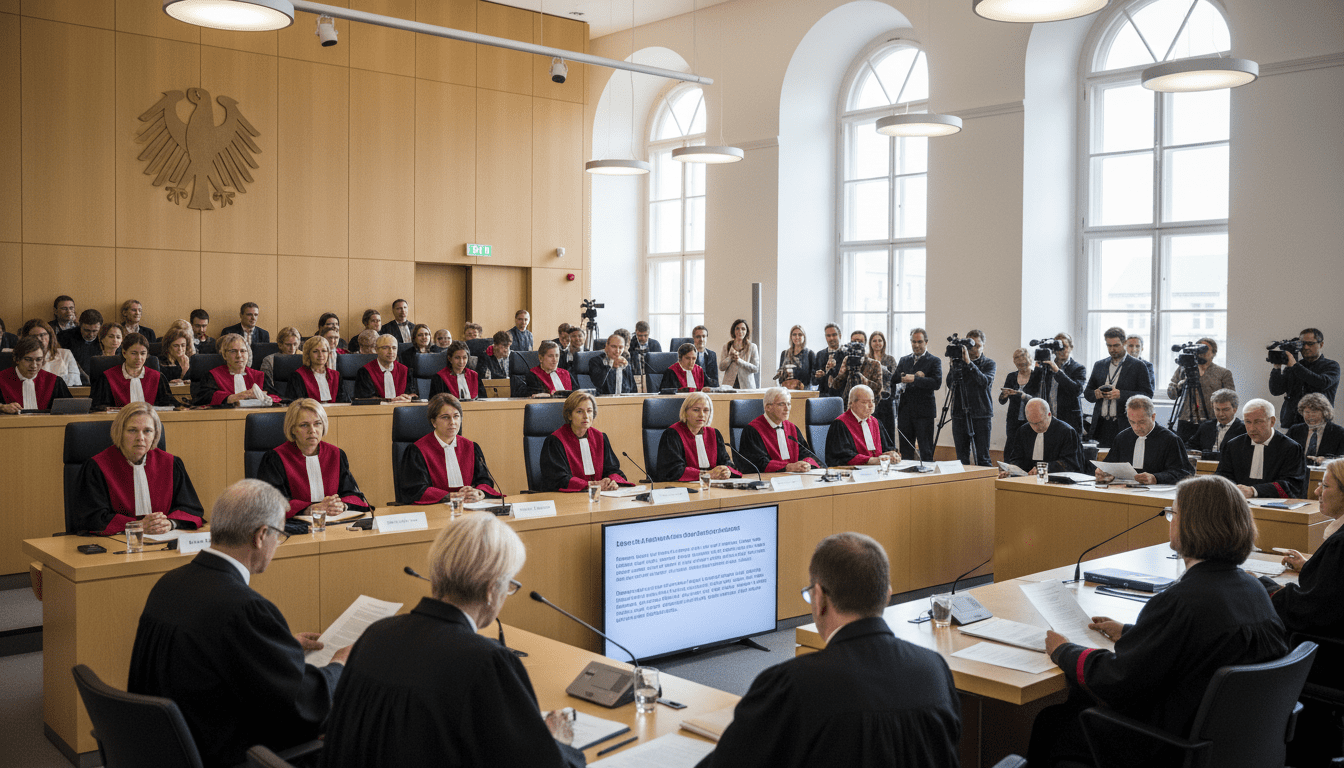
German Constitutional Court upholds ban on subcontracting in the meat industry
Federal court rejects challenge to Germany’s ban on subcontracting in the meat industry, citing health protection and employer obligations.
The Federal Constitutional Court has rejected a constitutional complaint by a meat processing company challenging Germany’s ban on subcontracting in the meat industry. The decision, which concerns the law that prohibits work contracts and limits temporary agency labour in core slaughtering and meat-processing activities, found the restriction compatible with the constitutional guarantee of occupational freedom. The ruling underscores the court’s view that public health considerations can outweigh a moderate intrusion on company autonomy.
Court cites health protection as decisive
The court held that the ban on subcontracting in the meat industry is compatible with businesses’ freedom to pursue their professions because it serves “high-ranking” health and labour-protection interests. The judges said the interference with business freedom is moderate and justified by the need to prevent conditions that previously facilitated COVID-19 outbreaks. The ruling explicitly weighed collective health safeguards above the contested economic liberties in the overall constitutional balance.
No constitutional right to benefit without employer obligations
In its reasoning, the court emphasized there is no constitutional entitlement for companies to profit from labour while avoiding the legal responsibilities of an employer. The decision made clear that relying on external contractors to perform core slaughtering and processing functions cannot be insulated from employer duties, such as ensuring safe working conditions and legal compliance. That principle formed a central pillar of the court’s assessment of the law’s proportionality.
Challenge to temporary agency prohibition dismissed on standing grounds
A separate element of the complaint, which sought to overturn the prohibition on temporary agency work in the sector, failed on procedural grounds. The court found the claimant had not sufficiently demonstrated concrete personal affectedness to establish admissibility. Earlier emergency requests by other firms had similarly been dismissed, and subsequent main proceedings by companies repeatedly faltered when they could not document how the rules had directly infringed their rights.
Pandemic outbreaks and the origins of the reform
The law in question was adopted in response to COVID-19 outbreaks in slaughterhouses in 2020 that brought poor working and housing conditions for many foreign-employed workers into public view. The federal government enacted the Law to Safeguard Workers’ Rights in the Meat Industry, which entered into force on January 1, 2021, and prohibited work contracts and temporary agency labour in the core activities of slaughtering, cutting and primary processing. Lawmakers framed the reform as a measure to strengthen oversight and to move formerly subcontracted employees into direct employment relationships.
Industry objections and government evaluation
Plaintiffs argued that the factual basis for a blanket ban was insufficient and pointed to a government evaluation that had recommended a limited exception for agency labour until the end of March 2024. Their legal counsel, citing that evaluation, urged the court to find a narrower regulatory approach. The court, however, found the legislative judgment permissible in light of the documented outbreaks and the systemic deficits they revealed, and it rejected the contention that the statute was disproportionate.
Union and enforcement perspectives
Labour representatives welcomed the court’s decision as a consolidation of workers’ rights and oversight. Guido Zeitler, chair of the Food, Beverages and Catering union (NGG), said the rule has resulted in many former subcontracted workers being taken on into direct employment, strengthening individual labour positions and giving state authorities clearer enforcement avenues. The shift to direct employment has, according to union statements, improved contractual clarity and made inspections and compliance monitoring more straightforward.
Implications for companies and regulators
For companies in the slaughtering and meat-processing sector, the ruling affirms that regulatory constraints on employment models remain in force and constitutionally grounded. Firms that previously relied on chains of subcontractors must maintain direct employer responsibilities or restructure operations accordingly. For regulators, the judgment supports ongoing oversight powers and may serve as legal support for intensified inspection regimes addressing health and labour conditions.
The court’s rejection of the constitutional challenge closes another chapter in the post‑pandemic regulatory overhaul of Germany’s meat industry and leaves in place a legal framework intended to reduce dependence on precarious, outsourced labour arrangements while prioritising worker health and public safety.
