
Enhanced Games in Las Vegas Fall Short of Promised Records, Raising New Anti‑Doping Questions
Enhanced Games in Las Vegas produced a lone world record amid medically supervised doping, provoking criticism from IOC and WADA and fresh debate on testing.
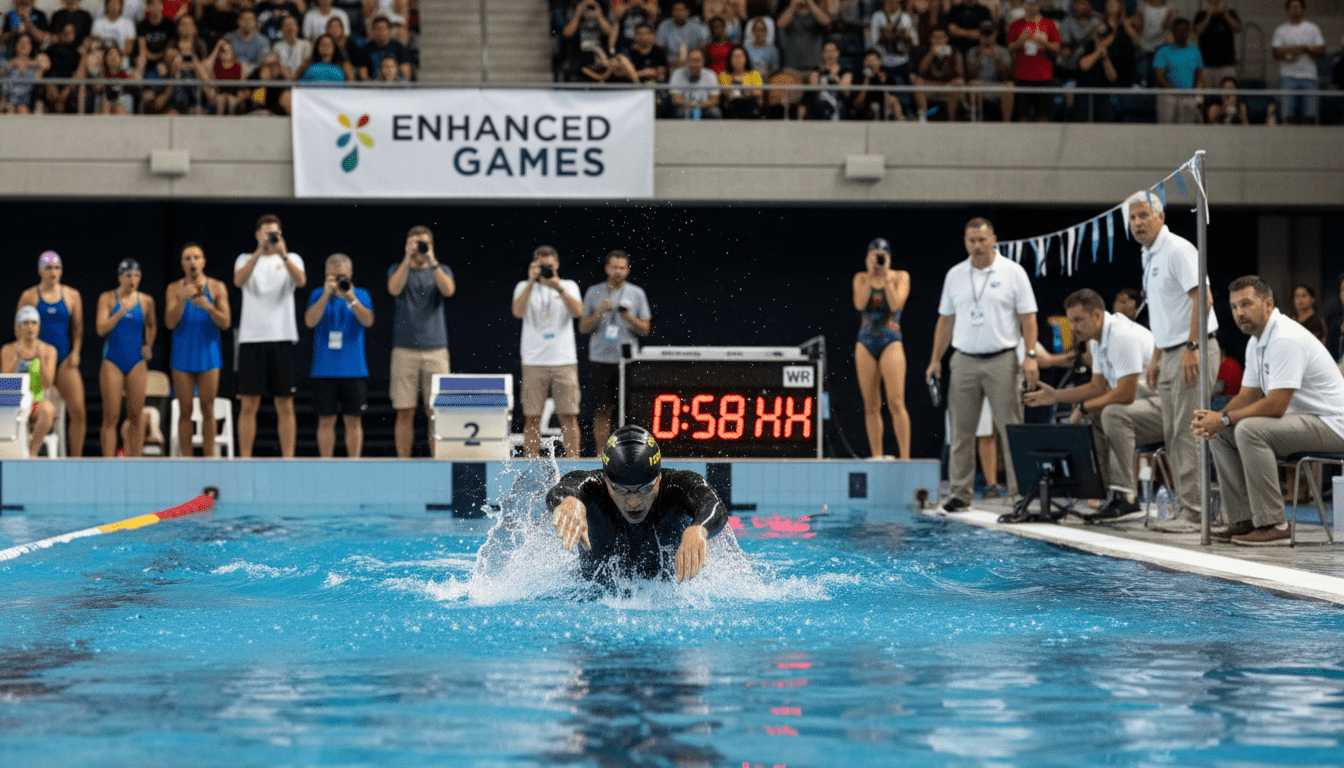
The Las Vegas edition of the Enhanced Games ended with much less spectacle than its promoters had promised, producing only a single ratified world record despite months of hype around performance-enhancing drug trials. The event, which openly allowed competitors to take EPO, testosterone and growth hormone under medical supervision, drew roughly three dozen sprinters, swimmers and weightlifters and offered large appearance fees. Organizers said they expected multiple world records; instead the standout result was a controversial 50m freestyle mark by Kristian Gkolomeev.
Organizers’ ambitions and the modest results
The Enhanced Games were marketed as an extreme experiment in performance, combining competition with explicit medical oversight and commercial spectacle. Promoters had hoped that legal, supervised use of multiple substances would produce a cascade of record-breaking performances and large broadcast interest. Instead, event managers conceded that live sport is unpredictable after only one world record was set, underscoring a gap between promotional rhetoric and athletic reality.
The limited field compounded expectations: with only a few dozen entrants and a mix of disciplines, statistical comparisons with conventional championships are unreliable. Several athletes posted personal bests, but the small sample size and unknown dosages make it impossible to draw clear conclusions about the efficacy of the methods employed. The outcome left organizers and some investors visibly disappointed, even as the spectacle itself drew attention.
Kristian Gkolomeev’s record and suit controversy
The lone world record of the meet came in the pool when Kristian Gkolomeev posted a 20.81 time in the 50m freestyle. That performance immediately stoked controversy because Gkolomeev wore a full-body suit that remains banned in sanctioned international competition. Critics argue the suit materially aided his speed, complicating the narrative that the Games were solely a drug-fueled experiment.
Officials and observers questioned whether equipment advantages rather than pharmacological regimens were the decisive factor in the record. The presence of the suit — banned by the sport’s international federation in standard events — has prompted calls for clearer equipment rules when competitions operate outside mainstream governance. The record therefore raised as many technical and regulatory questions as it did headlines.
Notable performances beyond the headline result
Beyond the headline world mark, the program produced a handful of credible individual performances that did not radically outpace established benchmarks. German swimmer Marius Kusch recorded a personal best to win the 100m butterfly, shaving seven hundredths of a second off his previous top time. Several competitors achieved season or career bests, but there were no widespread, dramatic jumps in record lists.
Analysts caution that individual improvements are common in elite sport and cannot be unambiguously attributed to doping without detailed testing and transparency. The event’s format — limited entries, bespoke conditions and undisclosed regimens — prevents reliable comparison with major meets where larger fields and standardized testing protocols prevail.
Organizers’ defense and the event’s commercial pitch
Promoters framed the Enhanced Games as a controlled environment where athletes could legally pursue performance gains under medical supervision while earning larger fees than in many sanctioned meets. Executives emphasized that the event was intended as both entertainment and a challenge to the existing anti‑doping framework, arguing for athlete autonomy in a commercial setting.
Organizers also highlighted safety measures, stressing medical teams monitored treatments, dosage and athlete welfare. Yet the commercial imperative — high payouts, media spectacle and the novelty factor — remained central, blurring the line between biomedical experimentation and professional competition. This fusion of showmanship and sport is likely to keep the meet in public debate.
Reactions from IOC, WADA and broader sport governance
Governing bodies reacted with predictable condemnation, with senior officials describing the event as antithetical to the ethos of clean sport. Representatives from the International Olympic Committee and the World Anti‑Doping Agency publicly criticized the meet’s premise and warned of reputational damage to competitive sport. Their statements also highlighted a tension: while denouncing the event, these institutions face persistent criticism over the adequacy of testing and enforcement in regular competition.
Commentators noted that doping remains a deeply entrenched problem across sports and countries, and that the mere existence of a public, medically managed doping event exposes uncomfortable weaknesses in current anti‑doping systems. Critics argue that despite substantial budgets and high-profile prosecutions, detection probabilities and enforcement consistency still fall short of deterring systematic abuse.
What the Enhanced Games reveal about performance and policy
The Las Vegas experiment underscored that pharmacology alone does not guarantee explosive improvements across the board; successful doping tends to be embedded within long-term training, individualized responses and comprehensive support systems. This nuance underlines why a one-off, medically supervised program may not instantly produce a parade of record breakers.
At the same time, staging an openly doped competition forces the wider sporting community to confront uncomfortable questions about testing, deterrence and the incentives that drive athletes and their entourages. If prominent figures can publicly pursue enhancement without the same regulatory constraints that govern most competitions, policy makers may face renewed pressure to clarify rules, strengthen enforcement and debate the future of equipment and pharmaceutical oversight.
The Las Vegas Enhanced Games will likely remain a provocative footnote in debates over doping, sport commercialization and athlete autonomy, but it also serves as a reminder that the struggle against performance-enhancing abuse is far from solved.
