
Messi’s Opening 85 Seconds in Dallas Raise Tactical Questions Ahead of Argentina’s Group Match
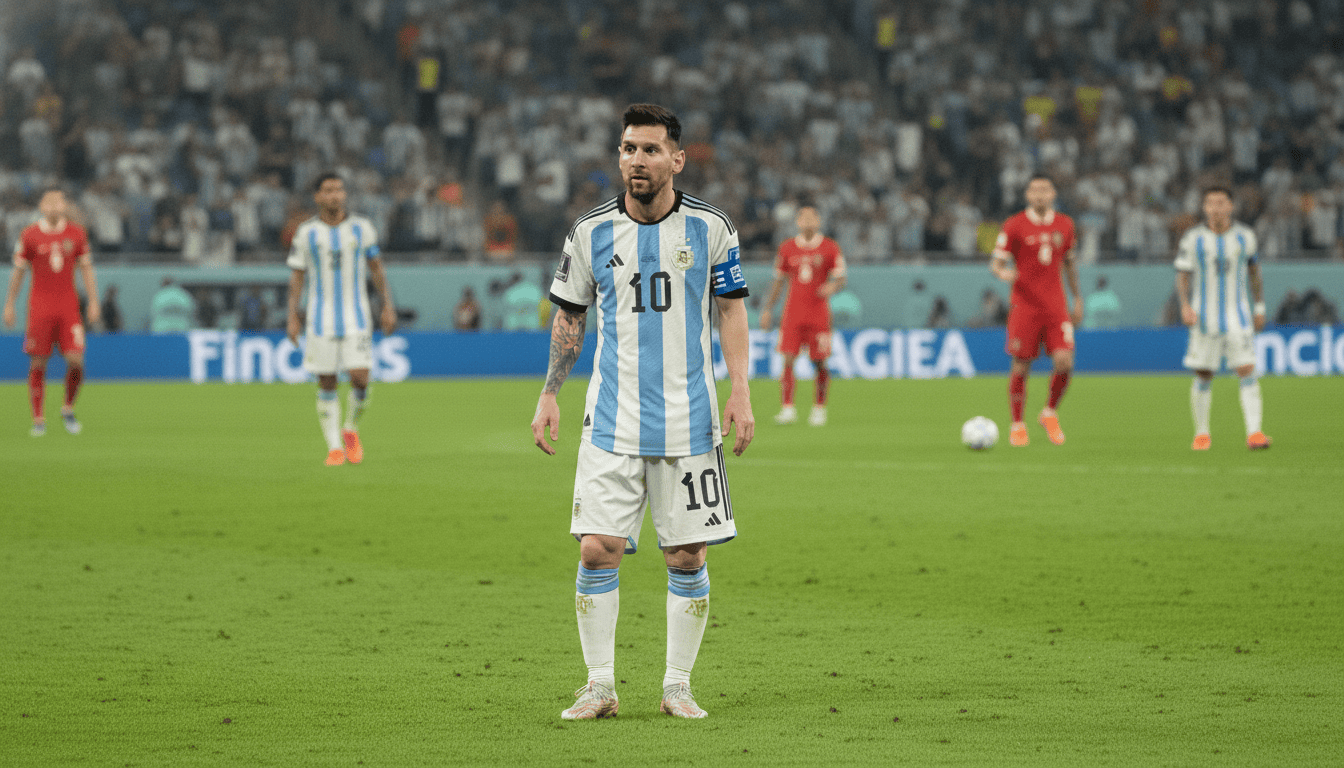
Messi spent the first 85 seconds of Argentina’s World Cup group match in Dallas largely stationary at kickoff, a brief but conspicuous choice that focused attention on his role. The Argentina No. 10 remained near the center circle while teammates moved across the field, waiting for the ball to reach him rather than seeking space immediately. That early stillness set the tone for observers and analysts who watched the opening sequence closely.
Messi’s Stationary Kickoff Moment Draws Cameras
Television coverage lingered on Lionel Messi as players streamed past him in the opening exchanges. For roughly one minute and twenty-five seconds he barely left the center circle, an unusual image given modern expectations of a forward’s early movement.
Cameras picked up subtle body language and positioning from the Argentina captain, with broadcasters noting the contrast between his measured presence and the activity around him. The scene quickly became a talking point among commentators and viewers at the stadium.
Kickoff Positioning and Tactical Intent
Standing close to the center circle at kickoff can be a deliberate tactic rather than a sign of hesitation, and Argentina’s shape suggested a planned approach. By allowing play to come toward him, Messi appeared to invite opposition runners into specific lanes before exploiting gaps.
Coaches often use static early positioning to manipulate defensive markers and create passing corridors in the first phase of possession. Whether this was primarily to conserve energy, to draw Austria’s markers out of position, or to signal a different starting structure, the immediate effect was to centralize the ball through Argentina’s midfield.
Contrast with Teammates’ Movement
While Messi remained largely still, the other 19 outfield players moved dynamically to create options and space. Full-backs and midfielders were quick to rotate and stretch the Austrian defensive shape in the opening minute.
That contrast highlighted Argentina’s broader tactical plan: use off-ball movement to open channels and then feed the ball to the team’s creative hub. It also underlined how Messi’s influence can be exerted from a compact starting point rather than constant roaming.
Stadium Setting and Timing in Dallas
The match took place at midday local time in Dallas, where bright conditions and a packed crowd framed the opening moments. Spectators responded to the unusual kickoff image with a mix of curiosity and heightened attention, amplifying the sequence on social feeds.
Timing matters in tournament football, and early sequences often shape momentum. In this case the opening 85 seconds became a microcosm of tactical preference, immediately dissected by pundits and fans alike.
How the Sequence Relates to Messi’s Role
Throughout his career Messi has been as effective when drifting into compact areas as he has when making sweeping runs, and the Dallas kickoff underlined that duality. Remaining close to the center circle can facilitate quick exchanges and allow a team to funnel play toward its most dangerous player at the right moment.
The moment also reinforced Messi’s status as a midfield fulcrum who can influence the game from different starting points. Coaches and opponents must account for both his movement and his ability to change the tempo through a single touch.
Early Match Flow After the Opening Minute
After the initial lull around Messi, Argentina’s ball circulation picked up and players started probing wide and vertical options. The early phase showed the team testing Austria’s compactness and seeking to create forward deliveries into designated channels.
How that early static positioning translated into offensive patterns over the course of the match became a point of interest for tactical observers. The kickoff choice did not exist in isolation; it fed into Argentina’s overall plan for possession, transition and how to unlock a disciplined defensive block.
Messi’s opening 85 seconds in Dallas was a small but telling episode that illuminated larger tactical themes for Argentina. The moment served as a reminder that even brief positional decisions can carry strategic weight in tournament football.
In the days after the match, the sequence will likely be replayed in analysis rooms as coaches and journalists examine how elite teams use positioning to influence opponents. Small openings and deliberate stillness can be as important as rapid movement when the stakes are high.
