
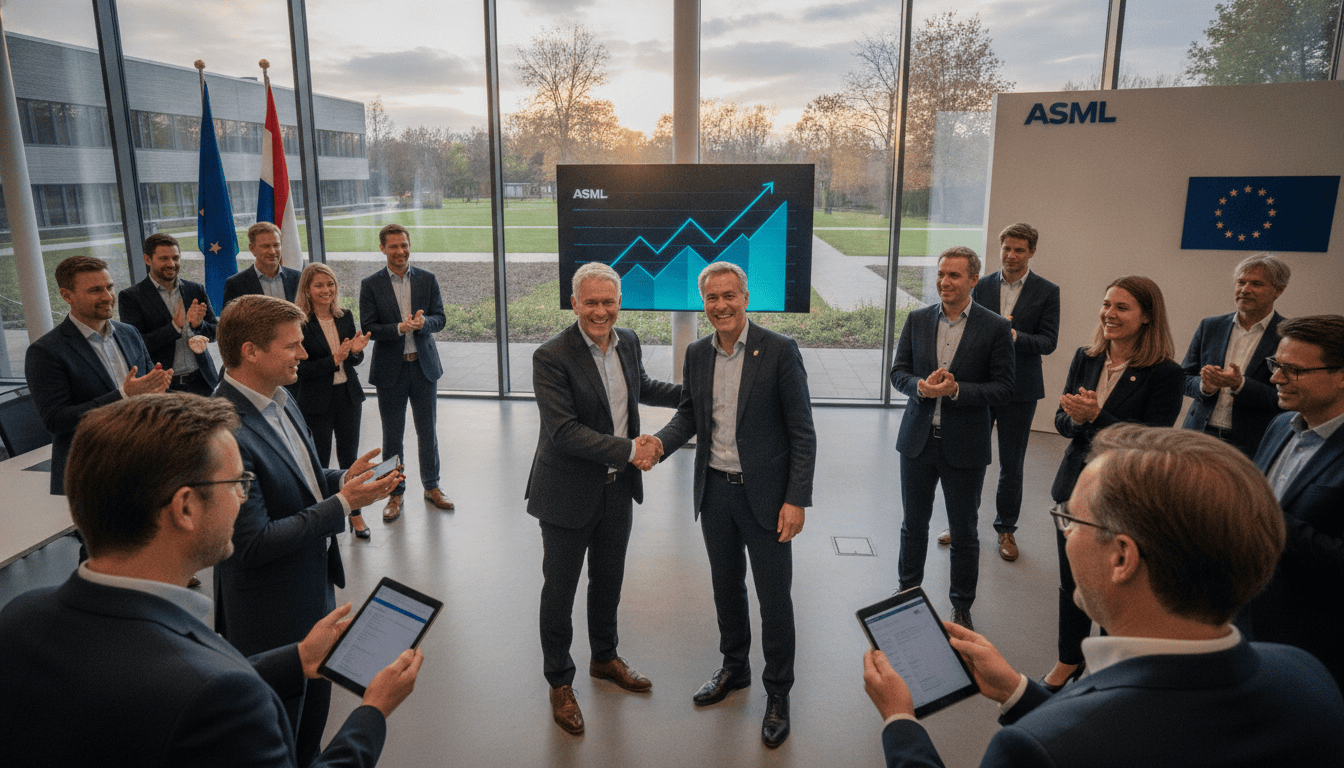
ASML Now Europe’s Most Valuable Company as Chipmaking Dominance Widens
ASML becomes Europe’s most valuable company at over €600 billion, its EUV chip machines driving markets, shaping tech supply chains and export policy.
ASML’s market value has surged past that of traditional European giants, placing the Dutch manufacturer of extreme ultraviolet (EUV) lithography systems at the top of continental rankings. The company’s machines, which are essential to producing cutting-edge semiconductors, have made ASML central to both global chip supply chains and investor sentiment. This ascent reflects a months-long rally in semiconductor-related stocks and renewed focus on the industrial groups behind advanced chipmaking.
ASML Tops European Market Capitalization Rankings
ASML is now the single most valuable company listed in Europe, with a market capitalization reported at more than €600 billion following recent equity gains. That valuation outstrips well-known Swiss, French and British blue-chips that traditionally dominated the list.
The rise has attracted attention because ASML supplies capital equipment rather than consumer products, making its public profile lower among general audiences despite its outsized financial footprint.
Chipmakers Rely on ASML’s EUV Machines
ASML’s EUV systems are a technical linchpin for factories that produce the most advanced logic and memory chips. Without the extreme ultraviolet lithography technology the company provides, leading-edge nodes used in AI accelerators and high-performance processors would be difficult to produce at scale.
The company’s products are specialized and complex, and a very small number of customers worldwide can develop or operate them, which amplifies ASML’s influence over the semiconductor production ecosystem.
Major Customers Include Nvidia, Intel and TSMC
A broad cross-section of the industry depends on ASML equipment, with manufacturers such as Nvidia, Intel and TSMC among those that rely on its machines to advance node performance. Their production road maps have increasingly intertwined with ASML’s delivery schedule and technology roadmap.
When ASML revises sales forecasts or reports quarterly results, the ripple effects are visible across chipmakers’ share prices and procurement plans, because equipment availability constrains how quickly fabs can transition to newer process nodes.
Dutch Export Controls Place ASML at Geopolitical Center
The Netherlands has long restricted exports of ASML’s most advanced lithography systems to China, citing national and allied security concerns. Those controls are part of broader efforts by Western governments to limit access to technology seen as critical for modern military and surveillance applications.
U.S. officials have repeatedly urged tighter restrictions and at times raised concerns that devices have moved beyond intended recipients, prompting closer scrutiny of export licensing and supply-chain safeguards.
Earnings Upgrades Drive Semiconductor Stocks
Investors have responded to ASML’s upgraded outlook and robust order book by bidding up prices across the semiconductor equipment and chipmaker spectrum. Positive guidance from ASML is frequently interpreted as a leading indicator for industry demand, encouraging analysts to revise estimates for downstream companies.
This correlation means ASML’s financial updates are monitored not only by equity traders but also by corporate planners whose capital-expenditure cycles depend on predictable access to high-end lithography tools.
Strategic Risks as ASML Balances Growth and Policy
ASML’s unique market position brings strategic vulnerability: the company must manage rapid growth while navigating export controls and geopolitical pressures. Balancing commercial ambitions with compliance obligations and allied policies will be a recurring operational challenge.
Further, reliance on a concentrated base of sophisticated customers and the long lead times for machine production expose ASML to supply-chain disruptions and cyclical demand swings that could affect revenue momentum.
ASML’s elevation to Europe’s top market cap company underlines how industrial technology firms can become pivotal to both markets and geopolitical strategy. As nations weigh technology access and firms adapt to changing demand, ASML’s performance will likely remain a key indicator for the semiconductor industry and for policymakers monitoring technological leadership and national security concerns.
