
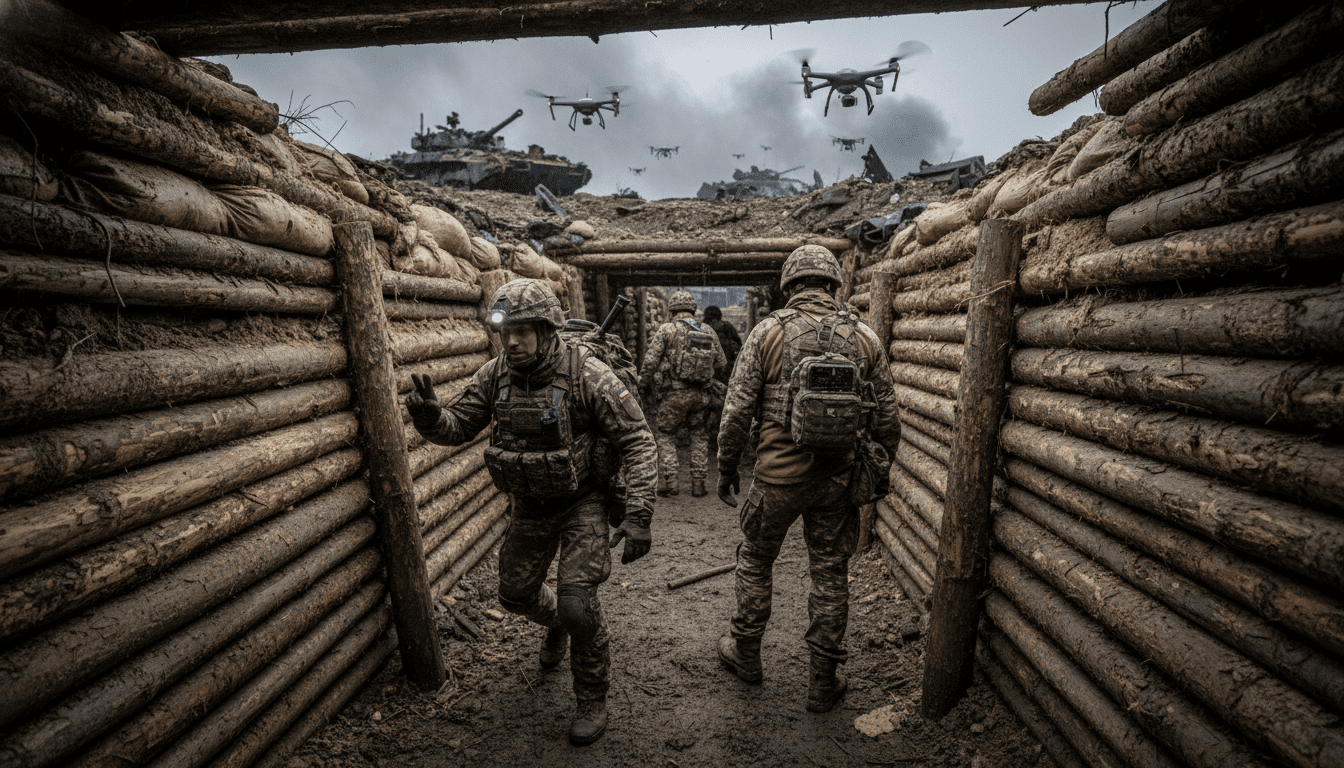
Drone warfare reshapes frontline life and tactics in Ukraine
Drone warfare has transformed fighting near Kharkiv and across the Donbass, soldiers say, altering rescue attempts, movement and the role of infantry at the front. Interviews with fighters engaged near Kharkiv, Chasiv Yar and Kostiantynivka depict a battlefield where aerial systems dominate visibility and lethality. The shift has forced new survival practices, from using fog to attempt medevacs to burying tanks under camouflage nets to avoid constant drone surveillance.
Fog and improvised rescue attempts
Soldiers recounted a recent night when dense fog temporarily blinded drones and allowed medevac attempts that would otherwise have been impossible. Two wounded men—one with a broken leg and one blinded by facial injury—were located but early unmanned ground vehicles stalled and soldiers on quads struck mines while trying to reach them. Ultimately, infantrymen carried the casualties to a deserted house between the lines and concealed the recovery drone under branches, waiting for weather to mask further movement.
Those accounts illustrate how weather remains one of the few equalizers on a battlefield overseen by sensors and small strike drones. Troops deliberately time movement for twilight, fog or high winds, since those conditions reduce drone effectiveness and briefly restore some freedom of action.
Drones dominate the “death zone”
Combatants describe a many-kilometre-wide strip between opposing forces where any movement is likely to be detected and attacked by unmanned aircraft. Reconnaissance drones monitor even small details, while kamikaze-style systems and larger armed UAVs can deliver lethal strikes or destroy armor from the air. The result is a zone where wheeled vehicles and conventional maneuvering are severely constrained by the constant presence of aerial sensors and loitering munitions.
Because drones can strike rapidly and from unexpected angles, soldiers now prefer to limit exposure rather than mass forces for a decisive maneuver, fundamentally changing how engagements begin and end.
Infiltration replaces massed assaults
Veterans and junior soldiers alike say the era of massed infantry advances—so-called human waves—has effectively ended where drones can see and strike at range. Both Russian and Ukrainian forces increasingly rely on small-team infiltration tactics, moving in pairs or trios to exploit gaps in long, thinly manned frontlines. Commanders send dozens or hundreds to attempt to secure a village, accepting catastrophic attrition en route as a grim arithmetic of modern warfare.
Western analysts quoted by those soldiers estimate that many infiltration attempts suffer extremely high casualty rates, reinforcing the turn toward stealth, night movement and improvised routes through trenches, scrub and buried pipelines.
Armor kept in pits, used as shoot-and-scoot fire support
Tanks have been reconfigured in purpose and posture, often kept under camouflage nets in dug pits and used in short, indirect firing missions when drones call targets. Crew reports suggest traditional open maneuver and tank-on-tank engagements are now rare; one commander said his unit experienced only a single conventional tank duel over the past year, and UAVs had already engaged many targets before direct contact could occur. The practical effect is that armored units act more like mobile artillery than as the decisive shock element they once were.
When tanks do move, the pattern is rapid exposure, a barrage of long-range fire and a quick return to concealment—an adaptation to persistent aerial reconnaissance and strike threats.
Daily survival: supply by drone and underground living
Forward positions have shifted into subterranean and cramped constructions to avoid aerial detection, with many troops living in narrow tunnels, cellar complexes and mud-lined dugouts. Resupply overwhelmingly arrives by unmanned aircraft: food, batteries and medicines are dropped into positions isolated by the “death zone,” while water remains the most precious and scarce commodity. Simple hygiene is a logistical challenge; soldiers receive moist wipes and rationed water because hauling supplies by ground is often suicidal.
The long durations between reliefs magnify these hardships. Some reported rotations lasting weeks or months—intervals where personnel remain within the same undercroft to reduce the risk of movement-induced detection and casualties.
Casualties, prisoners and the psychological toll
The presence of drones reshapes not only how combat is fought but how casualties and captives are handled. Troops described instances where a captured combatant was guided to friendly lines by a reconnaissance drone carrying a bottle and a note reading “follow me.” Prisoners become bargaining chips for exchanges, and the sound of an approaching loitering munition can trigger surrender or chaos in infiltrating groups. Medical evacuation often depends on brief weather windows or unmanned rescue platforms, with ground teams risking mines and enemy observation for retrieval.
Beyond physical injury, many soldiers suffer persistent symptoms from blast exposure—sleep disturbance, tinnitus, tremors and mood changes—and commanders acknowledge a growing burden of psychological trauma among frontline troops. Even those who return home briefly for rest report that the front’s stressors continue to ripple through daily life.
Soldiers’ testimonies from multiple sectors of the front portray a conflict shaped and constrained by unmanned systems, where weather, concealment and small-unit adaptability determine survival as much as firepower. Drone warfare has not only increased lethality at range; it has rewritten tactics, logistics and the experience of fighting at the front.
