
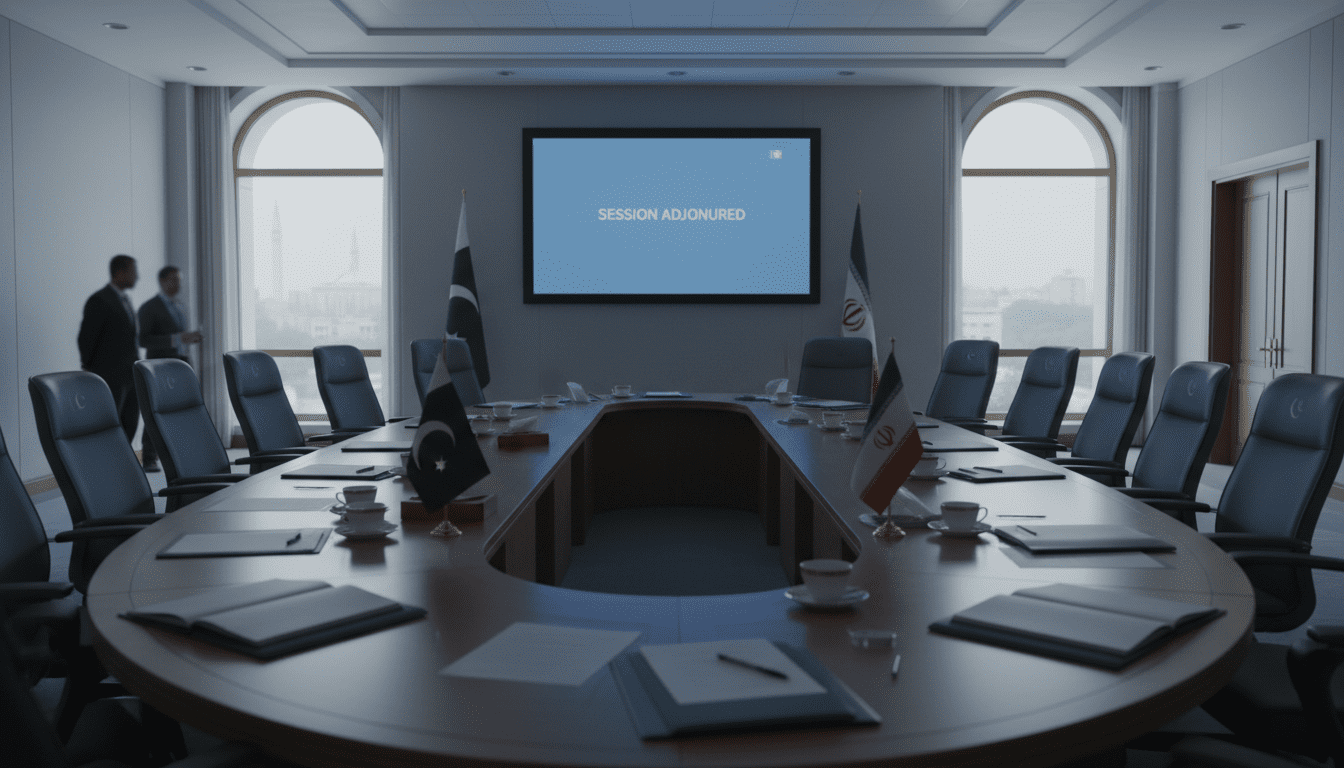
Iran peace talks in Islamabad stall as Tehran declines direct U.S. meetings
Iran peace talks in Islamabad stalled Saturday as Tehran reiterated it can wait, while planned U.S. envoys were not dispatched amid heightened tensions and heavy security.
Diplomatic Talks Resume in Islamabad
Diplomatic talks between Iran and mediators resumed on Saturday inside Islamabad’s heavily secured red zone, where checkpoints and barbed wire blocked civilian access near the government district. The Iran peace talks in Islamabad brought Iranian Foreign Minister Abbas Araghtschi to the capital for a series of meetings aimed at ending the conflict that began on February 28, according to local accounts.
Araghtschi met separately with Pakistan’s army chief, prime minister and foreign minister, officials said, underscoring Islamabad’s role as the host and conduit for contact between the parties. Despite the high-level encounters, the day produced no breakthrough and ended with a clear divergence between Tehran’s stance and U.S. expectations.
Tehran Signals Patience and Refuses Direct U.S. Talks
Iran made clear it is in no rush to conclude a deal, portraying itself as able to outlast pressure from Washington and signaling that it would not sit directly with American representatives at this stage. The stance left negotiators in Islamabad grappling with a fundamental mismatch: Tehran’s willingness to delay versus the apparent urgency felt in Washington.
Observers in Islamabad described Tehran’s posture as strategic patience, with officials emphasizing that Iran could exploit an advantage by waiting for more favorable terms. That calculation, critics say, has hardened the diplomatic impasse and complicated the mediators’ efforts to find a path forward.
U.S. Envoy Travel Cancelled After Last-Minute Shift
The U.S. administration announced plans for senior envoys to travel to Islamabad — including Jared Kushner and special Middle East envoy Steve Witkoff — but those plans were reversed and the envoys were not sent. Washington first signaled its intent to dispatch the delegation, then abruptly decided against the trip after Tehran indicated it would not negotiate directly with U.S. representatives.
The cancellation fed perceptions among local analysts that the United States appeared more eager for a deal than Iran, a dynamic that Tehran used to reinforce its negotiating position. Officials in Islamabad said the late changes increased confusion and contributed to a day marked more by posturing than concrete progress.
Pakistan’s Mediator Role and Strict Security Measures
Pakistan positioned itself carefully, hosting talks and managing access to sensitive areas while maintaining strict secrecy about the content of the discussions. Security forces sealed roads around the parliamentary precinct and the Serena Hotel, where previous high-level exchanges took place, and journalists were restricted from filming key sites.
Pakistani authorities urged local media to avoid reporting based on unnamed sources, reflecting a deliberate preference for controlled communication as part of their mediator role. Insiders said Islamabad’s dual objective was to preserve credibility as a neutral facilitator and to avoid escalating domestic tensions amid the international crisis.
Past High-Level Contact and Remaining Channels
Earlier in April, a noteworthy meeting saw U.S. Vice President J. D. Vance and Iranian Parliament Speaker Mohammad Bagher Ghalibaf meet at the Serena Hotel in Islamabad, the highest-level U.S.-Iran contact since 1979. That encounter had raised hopes that further engagement could be possible, prompting the hotel to reserve spaces and restrict bookings for subsequent negotiations.
Yet those earlier contacts did not translate into sustained momentum Saturday, and diplomats described the current phase as one of information-gathering and signaling rather than decisive bargaining. Pakistani and former diplomats noted that the exchanges could still yield useful clarity on each side’s red lines if Islamabad conveys Iran’s positions back to Washington accurately.
Economic Strain and Civilian Frustration in the Capital
Residents of Islamabad and neighboring Rawalpindi followed developments with frustration as security measures and economic strains compounded daily life, local observers said. Fuel prices have surged since the start of hostilities, with a reported price of 395 Pakistani rupees per liter — roughly €1.21 — marking an increase of more than 50 percent from weeks earlier.
Those price rises come against a backdrop of low average incomes; the typical monthly wage in Pakistan converts to about €120, amplifying the economic pain of supply disruptions and blocked transport routes. Locals and business owners warned that prolonged instability would further impede goods movement and deepen hardship for ordinary citizens.
The lack of a clear diplomatic breakthrough in Islamabad leaves the Iran peace talks in Islamabad stalled for now, with both sides continuing to exchange warnings. Mediators say channels remain open but fragile, and the immediate outlook depends on whether either side alters its public posture or chooses to resume direct engagement in the coming days.
