
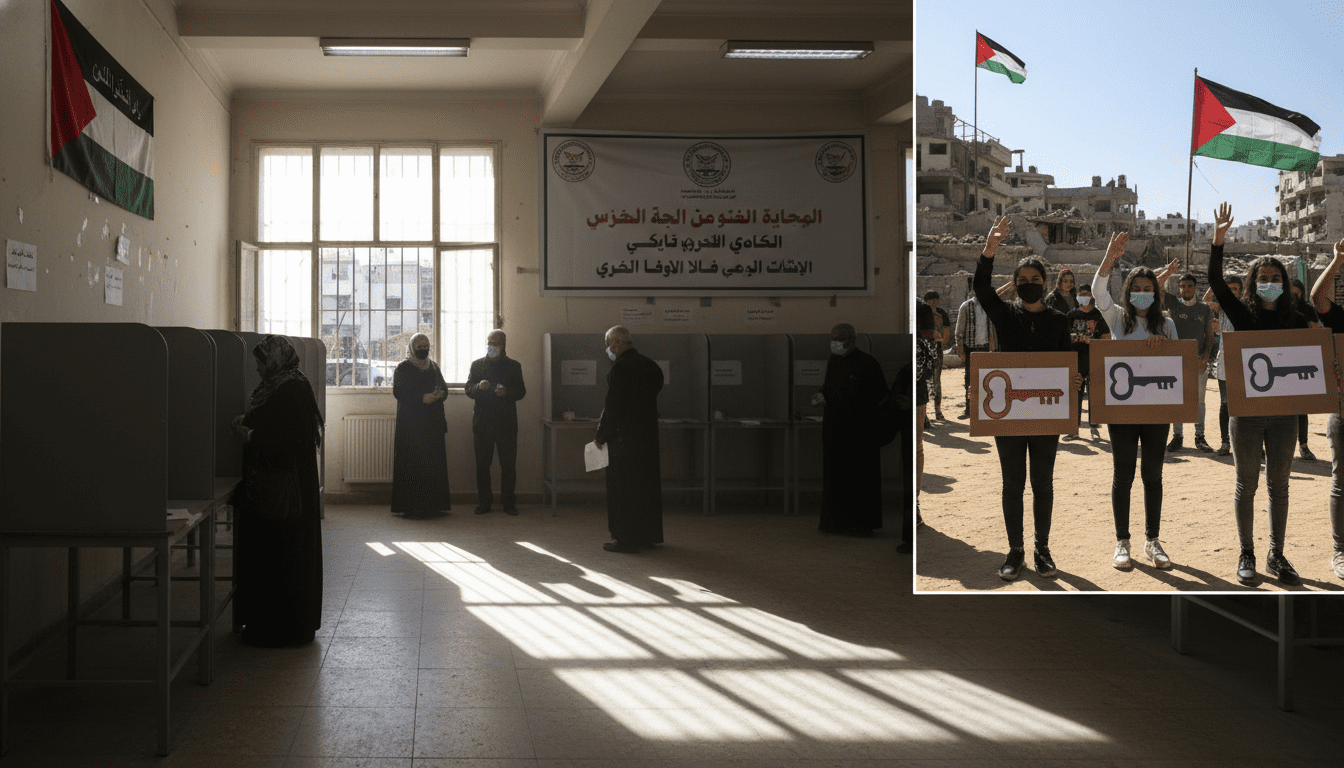
Low turnout shadows West Bank municipal elections as Deir al‑Balah ballot serves symbolic role
West Bank municipal elections on April 25, 2026, saw low turnout and a symbolic Deir al‑Balah vote as the Palestinian Authority seeks to reassert local control and legitimacy.
The first local polls held in the West Bank since the Gaza war opened in the morning with roughly 1.5 million eligible voters called to the ballot, and a separate contest in Deir al‑Balah in the Gaza Strip where up to 70,000 people could vote. By midafternoon official tallies and reporting by AFP showed turnout running at roughly 24.5 percent, with many polling stations reported as nearly empty. Palestinian officials framed the vote as an opportunity to exercise civic rights amid conflict, while critics warned the results could do little to alter the region’s broader political and economic strains.
Midday turnout and polling patterns
By 13:00 local time, the central election commission reported that about one in four eligible voters had cast a ballot, a figure that suggested muted public enthusiasm. Observers and media described many polling places as quiet, with long gaps between arriving voters and slow movement through polling rooms. Polling hours were set to close at 19:00 in the West Bank and at 17:00 in Gaza to permit an initial count in daylight in areas affected by frequent power outages.
Election officials emphasized the logistical challenges of running a vote in conflict-affected areas, noting contingency plans for counting and transport of ballots. Low participation will complicate efforts by the Palestinian Authority to claim a broad popular mandate from the exercise. Turnout figures through the afternoon signalled that any authority conferred by these results could be limited by public disengagement.
Party alignments and the absence of Hamas lists
Most candidates contesting municipal seats were linked to the secular-nationalist Fatah movement or ran as independents, with entire municipalities in some cases presenting only a single list. The Islamist group Hamas did not present official slates, although analysts and local activists flagged at least one list suspected of close ties to the movement. The Gaza ballots marked the first local vote in the strip since Hamas’s 2006 parliamentary victory, underlining the unusual political circumstances of the current contest.
Some groups announced boycotts in protest of prior conditions set by the Palestinian Authority, including demands tied to broader political agreements. Hamas said in advance that it would accept the official outcome, even as its organizational absence from formal lists left voters with fewer clearly distinct political choices. The limited variety of candidacies in major towns such as Nablus and Ramallah narrowed electoral competition in key urban centers.
Deir al‑Balah vote focused on reconstruction and services
Officials described the Deir al‑Balah contest in Gaza as largely symbolic and instrumental for the Palestinian Authority’s efforts to reassert governance in the war-damaged strip. The municipal ballot in Deir al‑Balah allowed voters to choose from four lists, each presenting 15 candidates with a minimum of four women per list, and the 15 top vote-getters will form a new council and select a mayor. Local campaign messaging centered on reconstruction, restoring basic utilities and urgent service delivery for residents amid widespread destruction.
Political scientists said the Gaza ballot was as much a test-run as an election, offering the PA an early indicator of public support in a place where polling data since the war are scarce. Jamal al‑Fadi, a political scientist referenced by local outlets, described the vote as an experiment to assess administrative capacity and popular response to reconstruction pledges. For many residents, immediate material needs—electricity, water, housing—dominated voting considerations.
Security arrangements and UN commentary
The United Nations coordinator for the Palestinian territories, Ramis Alakbarov, characterized the organization of the vote as credible and a chance for citizens to exercise democratic rights under difficult conditions. UN statements also noted the challenges of running polls in areas with damaged infrastructure and ongoing security concerns. International agencies and diplomats monitored developments closely, framing the exercise as part of a fragile political process rather than a definitive political reset.
Reuters and other outlets reported that local security arrangements in Gaza included the deployment of civil police elements with militia links to protect polling stations, an arrangement that raised questions about impartiality among some observers. Election authorities stressed measures intended to safeguard voters and ballots, while acknowledging the unusual security environment in parts of the Gaza Strip and West Bank.
Economic pressure on the Palestinian Authority and the political backdrop
The Palestinian Authority entered the vote under mounting financial strain after Israel withheld tax transfers that it collects on the PA’s behalf, a move that has left some public salaries unpaid. Israel has tied the withholding to PA payments to prisoners and families of Palestinians killed in confrontations, arguing that such payments incentivize attacks; the PA and its supporters dispute that linkage and warned of fiscal collapse. The economic squeeze has amplified public frustration and fuelled political tensions ahead of the municipal contests.
The broader context includes the long-standing Israeli occupation of parts of the West Bank since 1967, restrictions on movement for Palestinians, and a dual legal regime that treats Israeli settlers and Palestinian residents differently. Policy moves by the Israeli government, including accelerated settlement approvals and an August 2025 decision to advance a contested settlement project, have further polarized the political landscape and prompted warnings from Palestinian leaders that the prospect of a two-state solution is increasingly constrained.
The municipal vote, modest in turnout and scope, unfolded against those structural pressures and against continued debate about the PA’s ability to deliver services and maintain legitimacy. Observers said the elections would likely offer limited immediate change but could shape local governance and the calculation of political actors in the months ahead.
