
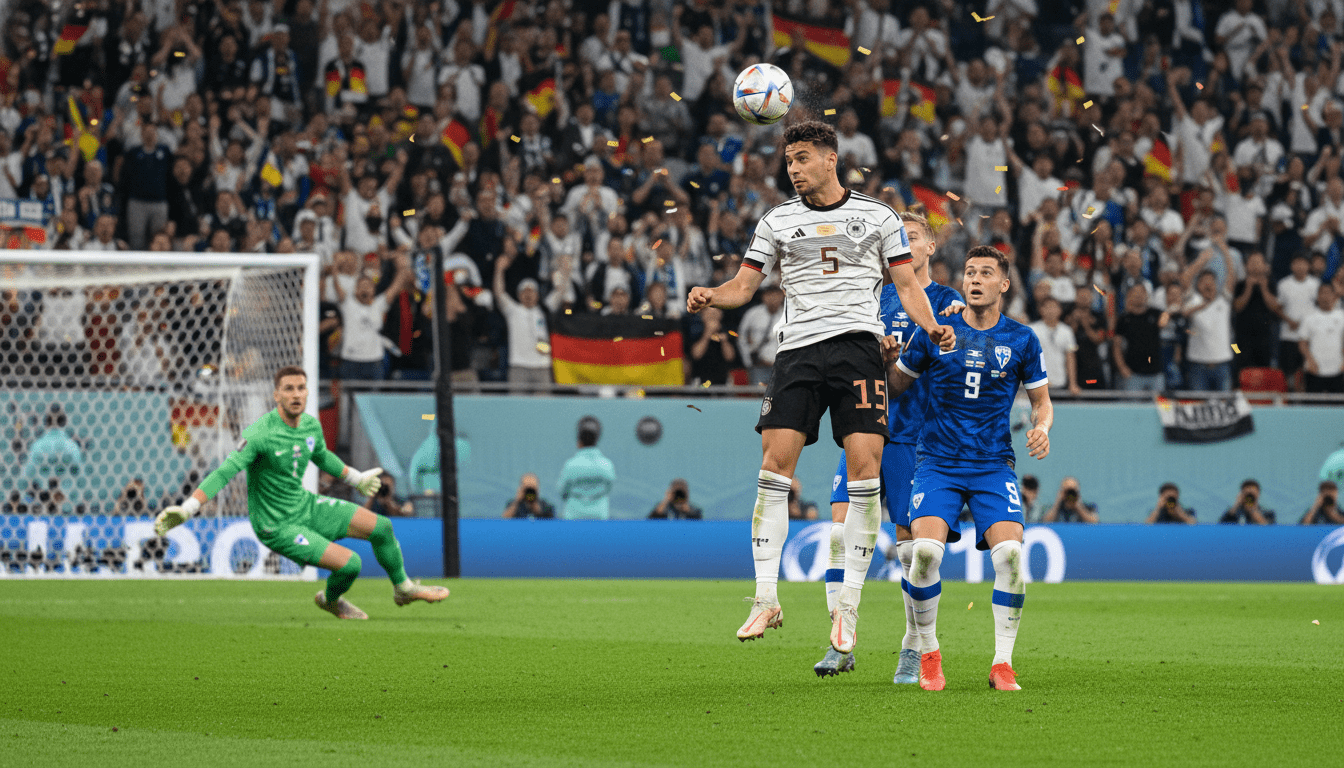
Deniz Undav’s smart header provides Germany a practical aerial answer in 4-0 win over Finland
Deniz Undav’s headed goal in Germany’s 4-0 win over Finland gave Julian Nagelsmann a practical low-trajectory solution to his aerial striker dilemma.
Germany forward Deniz Undav produced a deceptively simple answer to a long-standing question for manager Julian Nagelsmann when he steered a headed goal into the net during Sunday’s 4-0 victory over Finland. The strike, fashioned from a quick corner and a precise cross, illustrated that aerial effectiveness need not rely on height or power alone. Nagelsmann had earlier identified a need for a striker who could influence the air game, and Undav’s finish injected a fresh option into that debate.
How the goal unfolded
Lennart Karl’s corner was played quickly and short to Joshua Kimmich, who delivered a measured cross into the box.
Undav, starting from a central position, met the ball with a calm, forehead flick rather than an athletic leap, directing it past the goalkeeper with composure.
The simplicity of the movement — timing, positioning and anticipation rather than sheer verticality — underlined a different way to solve aerial challenges.
What Nagelsmann has said about aerial needs
Earlier this year Julian Nagelsmann told Kicker he wanted a forward “who can sort things out in the air,” describing aerial play as a squad priority.
Nagelsmann identified that traditional target-men like Niclas Füllkrug and Tim Kleindienst were unlikely to meet the manager’s evolving requirements for the national side.
Undav’s goal offered a practical retort: aerial value can be delivered through technique and situational awareness as much as by towering stature.
Tactical implications for Germany’s attack
Undav’s movement at sea level suggests new ways to approach set pieces and crosses without committing to tall, single-focused forwards.
By prioritising runs that exploit defensive blind spots and by honing delivery patterns — quick corners, near-post flicks and early crosses — Germany can widen its attacking templates.
This adaptability gives Nagelsmann options to blend technical link-up play with effective aerial moments, complicating defensive assignments for opponents.
Set-piece execution and the role of quick thinking
The goal also highlighted the significance of set-piece routine and on-pitch improvisation.
Lennart Karl’s decision to take the corner short and Kimmich’s rapid crossing freed Undav to attack an area where he could apply a precise header without contest.
Such coordinated yet flexible routines increase the value of players who read the game and act instantly, qualities Undav demonstrated.
Selection questions and the broader striker picture
Undav’s performance inevitably reopens discussion about the forward positions ahead of major tournaments, where balance and versatility matter.
While Füllkrug and Kleindienst have long represented the traditional centre-forward profile, Nagelsmann now has evidence that alternative traits can answer aerial concerns.
Selectors will weigh consistency at club level, finishing proficiency, and ability to operate within Germany’s preferred patterns when finalising any long-list or squad.
Club form and international prospects for Undav
At 1.79 meters, Deniz Undav does not possess the archetypal target-man frame, but his club form and recent displays suggest a forward capable of contributing different dimensions.
Scouts and coaches will track his consistency against stronger opponents and his contributions beyond single moments, such as pressing, link play and defensive work.
If Undav sustains this mix of timing, technical finish and tactical intelligence, his candidacy for longer-term inclusion in Germany’s plans will strengthen.
Undav’s headed goal on Sunday was a concise demonstration that football’s aerial battles can be won with more than height; they can be won with timing, technique and clever preparation.
