
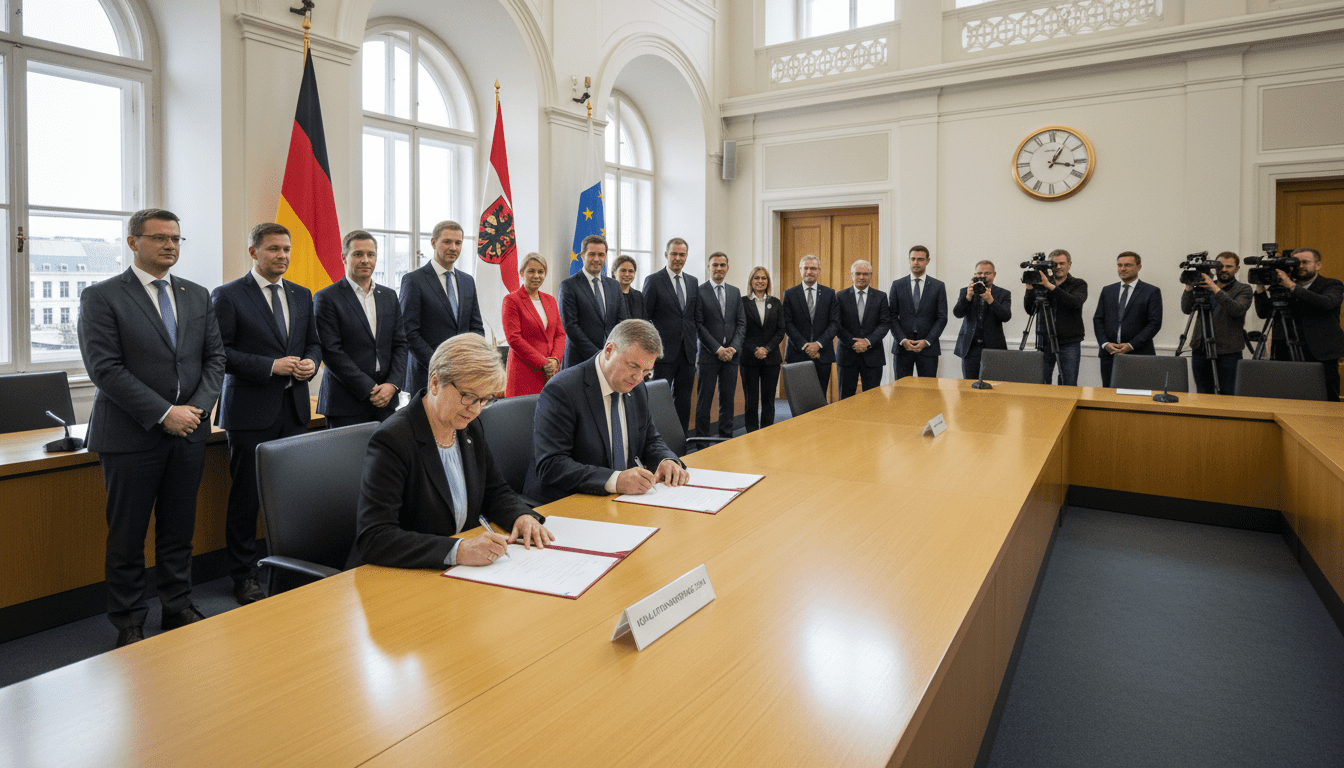
CDU and SPD Seal Rhineland-Palatinate Coalition, Schnieder Poised for May 18 Vote
CDU and SPD in Rheinland-Pfalz approved a coalition agreement, forming a new Rhineland-Palatinate coalition that paves the way for Gordon Schnieder to be elected minister-president on May 18, 2026.
The CDU and SPD in Rhineland-Palatinate have formally endorsed a coalition agreement that clears the path for a CDU-led state government after the March election, marking a significant political shift in Mainz. The coalition contract — nearly 100 pages long, delegates said — received sustained applause at the CDU state committee in Mainz and won broad backing from the SPD at a party conference in Nieder-Olm. The agreement establishes a policy agenda focused on compulsory early childhood education, expanded policing, and stricter measures on deportations, and sets a timetable for a Landtag confirmation vote on May 18, 2026.
Party ratification and internal reception
The CDU approved the coalition paper at a state party meeting in Mainz, where delegates gave extended standing ovations, reflecting party enthusiasm for the Rhineland-Palatinate coalition. SPD delegates in Nieder-Olm endorsed the contract by a large majority, indicating coordinated support on both sides for the power-sharing arrangement. Party leaders framed the pact as pragmatic and solution-oriented, underscoring a desire to move quickly from negotiation to governing.
Leadership and the bid for the state chancellery
Gordon Schnieder, the CDU state chairman and designated minister-president, campaigned intensively within his party for the coalition and the top job, arguing voters want stable, effective government. SPD leader and outgoing minister-president Alexander Schweitzer also urged his party to back the deal, warning against frequent role-swapping between opposition and government and emphasizing continuity in public service. If the Landtag confirms Schnieder as expected, a CDU politician will return to the Mainz Staatskanzlei for the first time in 35 years.
Policy priorities in the coalition contract
The coalition sets several headline reforms that will define the Rhineland-Palatinate coalition’s early agenda, beginning with a mandatory final kindergarten year for all children in the state. The pact calls for an expansion of language support in early childhood settings by deploying 1,000 designated language officers to strengthen preparation for school. Public safety commitments include raising the total number of police officers to 10,500 through annual intakes of up to 500 trainee officers, alongside measures to lower initial driving costs for young residents by covering administrative fees for first-time applicants under 25.
Migration, enforcement and legal measures
On migration and law enforcement, the agreement signals firmer deportation policies for those lacking a right to remain and for foreign nationals convicted of serious crimes. The coalition plans to intensify returns where legal grounds exist and to streamline procedures that authorities say will improve enforcement. Supporters argue these steps respond to public concerns about rule of law and security, while critics are likely to scrutinize the concrete legal and humanitarian safeguards attached to any accelerated returns.
Electoral results that produced the coalition math
The coalition follows the state election on March 22, 2026, in which the CDU led with 31.0 percent and the SPD took 25.9 percent of the vote, leaving the AfD with 19.5 percent and the Greens with 7.9 percent as the remaining parliamentary groups. Together the CDU and SPD command a comfortable majority in the Landtag — reported as roughly two-thirds — giving the proposed coalition a strong mandate to form government and to vote its candidate for minister-president into office. Party strategists said the arithmetic provided cover for a broad centrist alliance focused on governance rather than ideological purity.
Timetable for confirmation and cabinet formation
The Landtag is scheduled to vote on May 18, 2026, to elect the new minister-president, with the new cabinet expected to be sworn in subsequently in Mainz if Schnieder secures the necessary votes. Both parties have indicated they will move swiftly to operationalize agreed measures, including personnel plans for the police and the deployment of language officers in kindergartens. Observers will be watching the cabinet lineup to see how ministerial portfolios are divided between the coalition partners and which policy priorities receive immediate attention.
The newly approved Rhineland-Palatinate coalition represents a tactical alliance between Germany’s two major parties aimed at stable governance after a fragmented election result, and its success will be tested by how quickly the partners translate their compact into administrative action and whether the promised reforms withstand scrutiny in implementation.
