
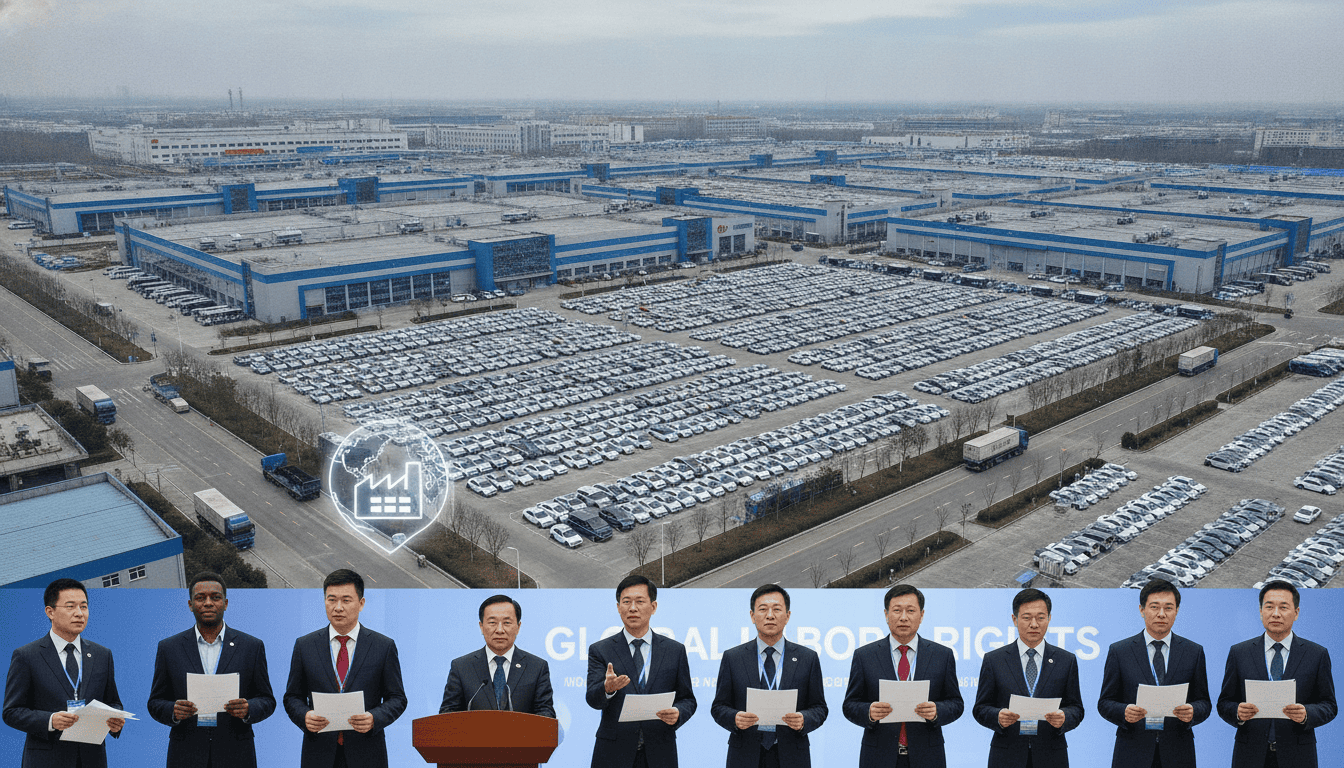
BYD Zhengzhou factory exposes scale and strains of China’s export-driven production model
Satellite imagery shows BYD Zhengzhou factory spans roughly 50 km², highlighting rapid expansion and mounting scrutiny over worker conditions and global impact.
The BYD Zhengzhou factory has become a focal point in debates over China’s industrial model, with satellite images and on-the-ground reporting showing a sprawling complex and tens of thousands of employees. The plant, now measured at approximately 50 square kilometres and slated for further expansion, reflects BYD’s push to mass-produce electric vehicles at very low unit cost. Alongside the factory, dense worker housing and a second massive electronics campus underline how concentrated production and large, transient labor forces shape the local economy.
World’s largest car plant rising near Zhengzhou
Satellite analysis and local accounts indicate the BYD Zhengzhou factory already covers an area far larger than typical auto plants and is planned to expand toward 100 square kilometres in its final phase. Company projections and infrastructure additions aim to lift output to volumes that would make the site one of the highest-capacity vehicle hubs globally. The scale of roads, rails, worker dormitories and service buildings around the site has effectively created a new industrial city on the outskirts of Zhengzhou.
Factory town architecture and worker accommodation
Rows of uniform high-rise dormitories and shared multi-occupancy rooms characterize the residential areas built to house the factory workforce. Reports describe four to six workers per room, basic communal facilities and limited private space, with social life structured around night markets, canteens and company-run amenities. The concentration of housing, transport and leisure facilities within walking distance mirrors decades-old models of company towns scaled to contemporary manufacturing volumes.
Adjacent Foxconn campus and the iPhone supply chain
A second megasite nearby belongs to a major contract electronics manufacturer that assembles smartphones for global brands, creating a dense corridor of output for both cars and consumer electronics. Personnel recruiters and local intermediaries say hundreds of thousands of workers rotate through the combined complex in peak months, supplying assembly lines that require limited formal qualifications but sustained long-shift labour. The proximity of both facilities has reinforced a regional specialization in high-volume, labour-intensive production.
Wages, hours and daily conditions on the shop floor
Compensation levels reported for factory employees remain modest by international standards, with typical monthly pay at the BYD site cited around 5,000 RMB and comparable ranges at the electronics plant. Shift patterns of ten to twelve hours daily and only a few days off each month result in workweeks that commonly exceed local legal thresholds, according to former employees and recruiters. Workers’ primary concern, recruiters say, is take-home pay, and high turnover after initial bonus periods is used by firms to manage labour costs and maintain throughput.
Role of local authorities and recruitment incentives
Local governments have actively facilitated rapid hiring and land assembly to attract and retain large-scale manufacturers, offering logistical support and incentives to labour brokers. Recruiters operating in the city describe subsidy and referral payments that make mass mobilisation of workers viable at short notice. Labour experts argue this close alignment between municipal authorities and corporations accelerates production but also limits workers’ bargaining power and constrains independent workplace representation.
Global expansion and repeated labour allegations
As BYD builds factories and construction projects overseas, watchdogs and labour advocates report similar patterns: prolonged shifts, crowded accommodation and safety incidents at sites from Eastern Europe to Latin America. Investigations by rights groups and national inspectors have led to temporary shutdowns, public allegations and denials from the company, while political ties in some host countries have influenced regulatory responses. BYD executives have publicly rejected characterisations of mistreatment and said the group complies with applicable standards as it expands internationally.
The pattern unfolding in Zhengzhou raises broader questions for competitors and policymakers in Europe and beyond about how arbitrage in labour costs and concentrated supply chains reshape global manufacturing. For European automakers, the possibility of competing against ultra-low-cost producers on scales that exploit dense labour pools presents a strategic challenge that touches trade policy, industrial strategy and social standards. At the same time, the experience of local economies hosting such plants shows mixed benefits: rapid job creation stands next to stagnating income growth and hollowed-out retail districts, suggesting that high-volume assembly does not automatically translate into broad-based prosperity.
Long-term responses will likely include closer scrutiny of overseas labour practices, targeted regulatory measures and renewed emphasis on automation and value-added production to protect wage standards. For the workers in and around the BYD Zhengzhou factory, however, immediate realities remain centered on long hours, shared housing and the need for reliable pay, even as the plant’s output reshapes markets and supply chains worldwide.
