
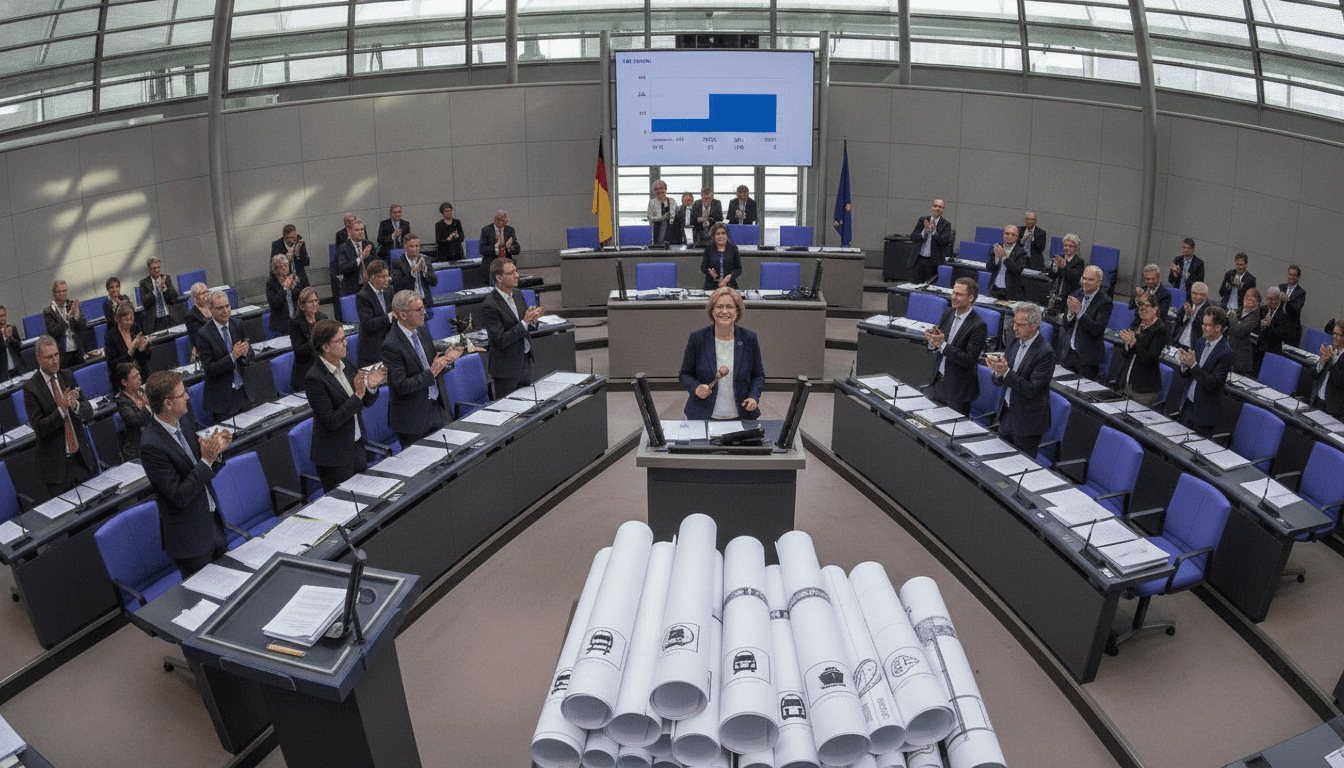
German Bundestag approves infrastructure law to fast-track highways, rail and waterways
Bundestag approves infrastructure law to fast-track highways, rail and waterways with simplified permits and project prioritisation; Bundesrat consent is pending.
The Bundestag has approved a sweeping infrastructure law designed to speed construction of highways, rail lines and waterways across Germany, marking a major push to shorten planning and permitting times. The infrastructure law aims to streamline and digitalise approval procedures while giving central projects higher legal priority, according to the government. The measure still requires Bundesrat consent before becoming law and is already drawing both industry praise and environmental criticism.
Parliamentary vote and stated goals
The bill passed the Bundestag with the backing of the governing black-red coalition, which framed the package as a response to long delays in transport infrastructure. Federal Transport Minister Patrick Schnieder argued the changes would prevent projects from taking “years and decades” to complete and would accelerate essential maintenance and new builds. Lawmakers said the move is intended to deliver faster, more predictable project timelines for state and federal authorities.
Changes to permitting and planning rules
Key elements of the infrastructure law include simplification and digitalisation of permitting procedures and adjustments to planning statutes that affect environmental reviews. The law creates a legal category for projects deemed to be of “overriding public interest and public safety,” which is intended to assign greater weight to such projects in administrative and judicial balancing decisions. Supporters say the reform will reduce procedural complexity and bring approvals into a single, faster workflow.
Link to the €500 billion special fund
The government has signalled that projects financed from the €500 billion debt-funded special asset should benefit from the faster procedures introduced by the law. Lawmakers emphasised that streamlining approvals is crucial to ensure money earmarked for large-scale transport upgrades is actually spent rather than stalled in legal and planning backlogs. If enacted, the changes would prioritise projects tied to that fund and other major federal investments.
Industry response and calls for follow-through
Business groups welcomed the measure as a decisive step to remove bottlenecks in Germany’s transport network. The head of the Federation of German Industries described the Bundestag decision as an important signal for speedier planning and permitting, while the German Chamber of Industry and Commerce called it a “big step” and urged states to pursue the reforms consistently. Industry representatives stressed that faster approvals must be matched by clear implementation at the federal and state levels.
Environmental groups raise alarm over safeguards
Conservation organisations have warned the law could weaken protections for habitats and species by shifting the balance in favour of construction projects. The head of the German League for Nature Conservation described the proposal as an attack on material and procedural safeguards, arguing that prioritisation could be applied broadly to road and infrastructure schemes even where serious environmental harm would result. Critics also object to provisions that may allow monetary payments in lieu of on-the-ground land compensation for ecological damages, saying financial offsets would not replace lost habitat.
Political friction and potential legal challenges
Opposition voices, particularly from the Greens, said the reform risks undercutting the core of German nature-protection law and offered little benefit to affected wildlife and plants. Members of parliament warned that the prioritisation mechanism will invite legal scrutiny and could lead to a wave of challenges in administrative courts as authorities and developers test the new standards. The shape and scope of implementation will depend heavily on subsequent rules and on how courts assess the weight to be given to projects labelled as carrying overriding public interest.
The law now moves to the Bundesrat, where state governments will decide whether the package becomes statute; approval is required for it to enter into force. If the Bundesrat consents, ministries and agencies will need to write implementing regulations and update digital permit platforms to realise the promised acceleration. Even with political backing, the reform is likely to generate contested cases that will determine how quickly projects actually advance and how environmental safeguards are preserved.
