
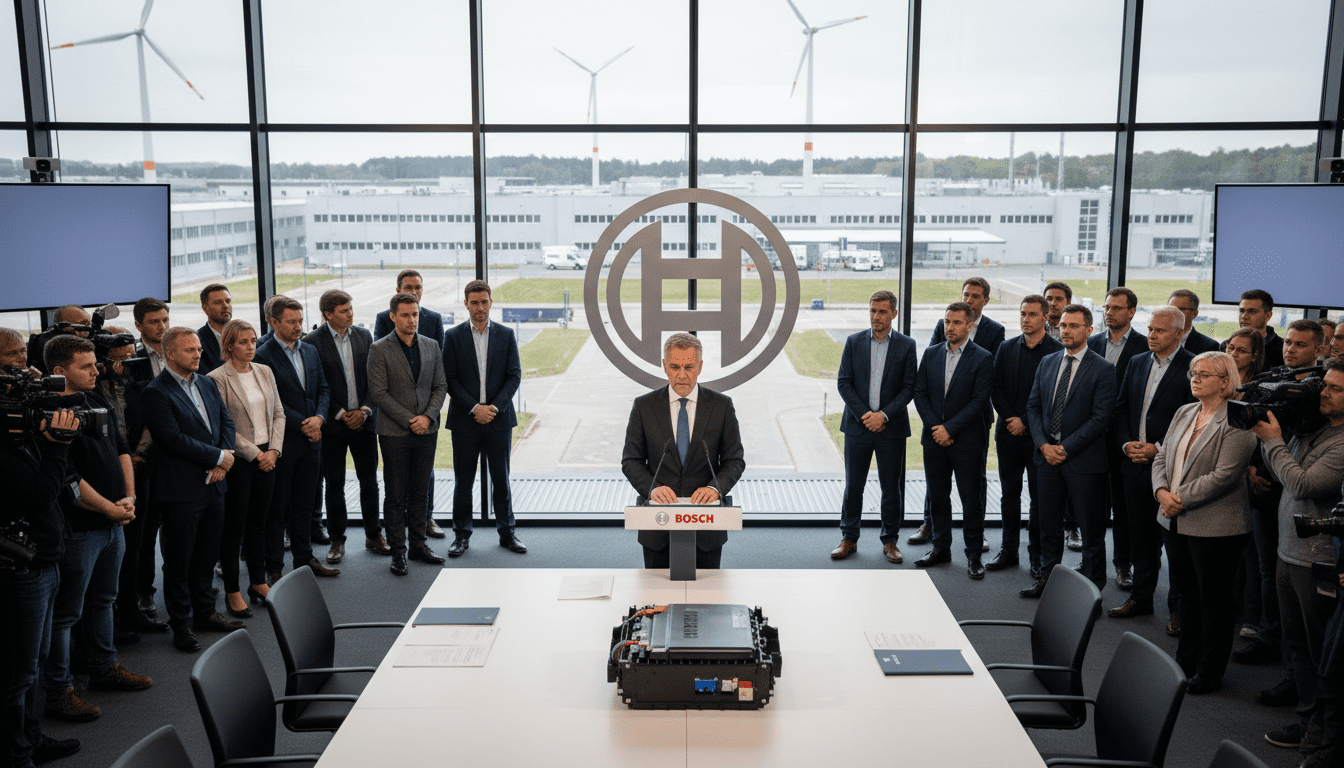
Bosch restructuring: German cuts and strategic shift as auto industry pivots to electrification
Bosch restructuring prompts plans to cut about 28,000 jobs in Germany as the supplier recalibrates amid falling car production, global competition and the shift to electric powertrains.
Bosch restructuring announced as workforce reductions begin
Bosch has unveiled a sweeping restructuring that will affect thousands of employees in Germany, with the company planning reductions across multiple divisions as it adapts to deep changes in mobility. Leadership said the package includes around 28,000 job losses nationwide and up to 22,000 positions specifically in the automotive unit, reflecting a need to realign costs and capabilities. Executives framed the move as a difficult but necessary response to a prolonged slump in global vehicle production and shifting value pools within the industry.
Global automotive demand decline pressures suppliers
The company cites a persistent downturn in automotive output: global production has not returned to its 2017 peak of roughly 95 million cars and light trucks, while regions such as Europe have seen production fall by about a quarter. That weaker demand has reduced utilization at supplier plants and compressed margins, particularly for components tied to traditional internal-combustion drivetrains. Bosch officials emphasize that declining value depth in powertrain technology—once the firm’s principal profit engine—has eroded revenues and forced a strategic reset.
Why Bosch declined to enter battery-cell manufacturing
A central strategic choice behind the restructuring was Bosch’s decision not to invest in large-scale battery-cell production. Company leaders argue that entering the cell business would have required an estimated investment of roughly €20 billion to secure a meaningful market share, an outlay they judged too risky given raw-material concentration and thin margins. According to the firm’s analysis, commodity costs account for the vast majority of cell production expenses, leaving only a small share of costs that engineering expertise could influence, which constrained the economic rationale for vertical entry.
China’s industrial push and implications for Europe
Bosch executives warned that China’s coordinated industrial strategy has given its companies a decisive advantage in scaling battery production and related supply chains. Five-year planning and tight state-supported ecosystems have accelerated capacity building in Asia, they said, challenging European industry to construct complementary networks spanning raw materials, suppliers and manufacturers. The company urged European policymakers and industry partners to accelerate efforts to build a resilient continental value chain if European suppliers are to remain competitive in electrified mobility.
Politics, infrastructure and the need for systemic policy
Leadership called on governments to think systemically when shaping industrial and climate policy, stressing that vehicles are only one element of the broader electrification puzzle. Officials argued that public investment in charging infrastructure, regulatory alignment across the single market and measures to secure raw-material access are necessary to unlock private-sector investments. They also urged a realistic balance between setting ambitious targets and ensuring the practical conditions for companies to meet them without disproportionate market risk.
Core strengths that Bosch aims to preserve and scale
Despite the cost-cutting, Bosch highlighted areas of continuing competitive advantage where it seeks to consolidate leadership. The company pointed to its Vehicle Motion Management systems—integrating steering, braking, damping and chassis controls—as an example of complex electromechanical and software expertise that remains in demand. Bosch also stressed its broad capabilities in automated-driving systems and sensor technologies, areas it intends to prioritize as the automotive market transitions toward more software-driven value.
Supervisory board stance, corporate values and the restructuring process
The firm’s supervisory leadership defended the pace and scope of the restructuring as the result of extended dialogue with employee representatives and as necessary to secure the company’s long-term survival. Executives framed the program as consistent with the company’s social legacy while also acknowledging the hardship it imposes. They described the board’s role as more dialog-driven than adversarial, emphasizing the need for constructive negotiation and the willingness to revisit past decisions in pursuit of the best outcome for the enterprise.
Outlook and near-term financial picture
Bosch reported an operational profit in 2025 and described its start to 2026 as cautiously optimistic, with first-quarter revenue roughly matching the prior year. Company leadership said they still expect an improvement in results relative to the previous year but cautioned that geopolitical risks, such as the conflict in the Middle East, could amplify supply-chain disruptions and price pressures. Executives said the coming months will be pivotal in determining how quickly the business can stabilize and reorient around growth segments.
The unfolding Bosch restructuring marks a significant moment for Europe’s largest automotive supplier as it seeks to balance fiscal prudence with investment in future technologies, while calling on policymakers and industry partners to help rebuild a competitive industrial ecosystem.
