
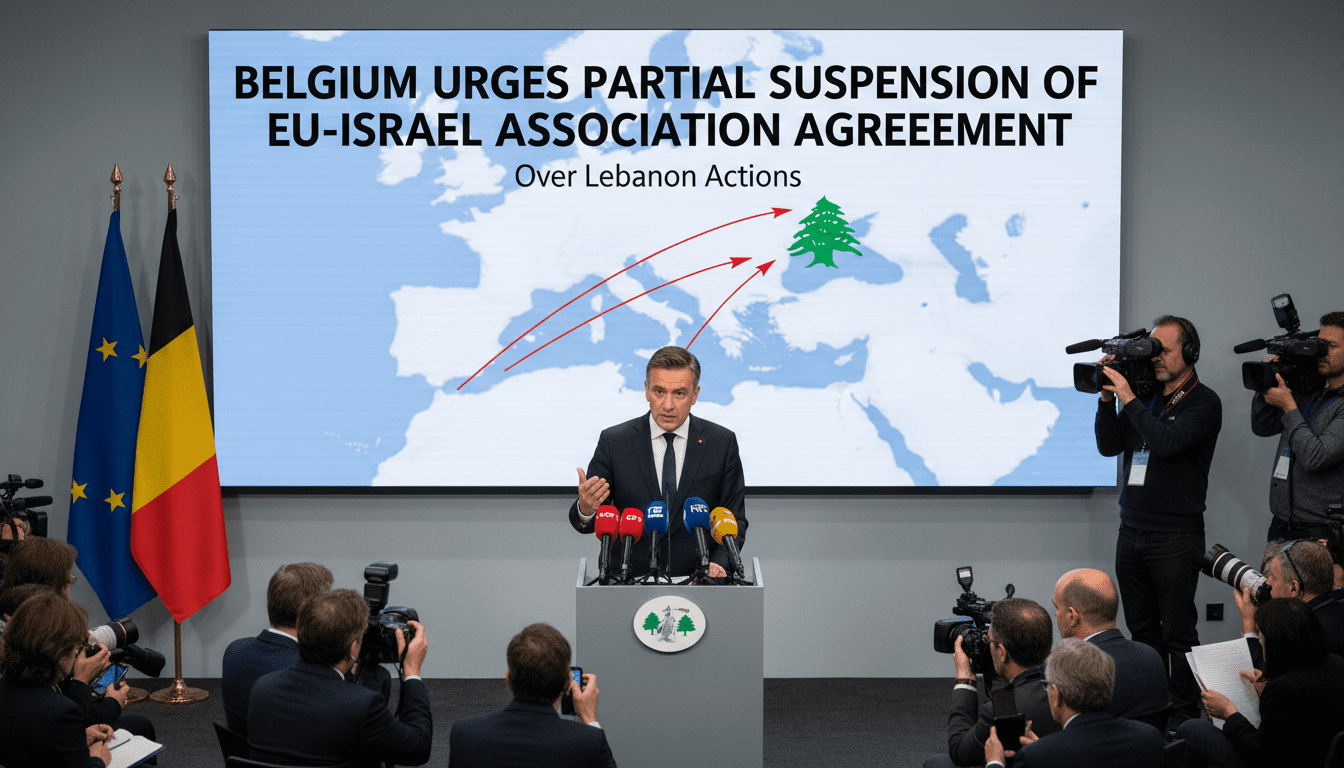
Belgium Urges Partial Suspension of EU-Israel Association Agreement After Lebanon Strikes
Belgium urges a partial suspension of the EU-Israel Association Agreement after calling Israel’s strikes in Lebanon “totally unacceptable” ahead of EU foreign ministers’ talks.
Belgian Foreign Minister Maxime Prevot said on Tuesday that Israel’s conduct in Lebanon was “totally unacceptable” and that the initial attacks by Hezbollah must also be condemned. He raised Belgium’s call for at least a partial suspension of the EU-Israel Association Agreement ahead of a meeting of EU foreign ministers in Luxembourg. Prevot added that a full suspension is likely out of reach given the differing positions among member states.
Prevot’s Statement in Luxembourg
Belgium’s intervention came just before a scheduled gathering of EU foreign ministers where the region’s escalating violence is expected to be a central topic. Prevot framed his remarks as both a condemnation of Hezbollah’s initial actions and a rebuke of what he described as Israel’s disproportionate and indiscriminate response. His comments signal Belgium’s intent to press for concrete EU policy measures rather than limiting discussions to expressions of concern.
Belgium is positioning itself as a vocal critic within the bloc while acknowledging the diplomatic constraints that limit sweeping measures. The call for a partial suspension is presented as a calibrated step intended to register European disapproval without severing all institutional ties. Prevot’s approach underscores the balancing act facing capitals that want to deter further escalation while preserving channels for diplomacy.
Proposal to Partially Suspend the EU-Israel Association Agreement
The Belgian proposal seeks a targeted rollback of elements of the EU-Israel Association Agreement rather than a full termination of the pact. Such a partial suspension could involve freezes on specific cooperation programs, adjustments to trade facilitation mechanisms, or curbs on political dialogue in certain formats. Proponents argue these measures would allow the EU to signal consequences while keeping broader cooperation intact.
Belgium itself conceded that unanimous support for a full suspension is unlikely among EU partners, reflecting divergent strategic and political calculations. Countries with close security and economic ties to Israel have historically resisted sweeping punitive steps, while others favor stronger measures in response to actions they view as breaching international humanitarian norms. The proposed partial approach is therefore pitched as a compromise to build wider support.
Condemnation of Hezbollah and Israeli Response
Prevot explicitly condemned Hezbollah’s initial attacks, emphasizing that aggression from non-state actors must be rejected by the international community. At the same time, he accused Israel of responding in ways that are disproportionate and indiscriminate, signaling concern for civilian harm and broader humanitarian consequences. That dual condemnation seeks to frame Belgium’s position as even-handed while placing particular scrutiny on the scale of Israel’s military operations.
European officials reacting to Prevot’s remarks noted the sensitivity of criticizing actions taken in self-defense claims while also stressing international law obligations. Humanitarian groups and diplomatic missions in the region have reported rising civilian casualties and infrastructure damage, concerns that have amplified calls in several capitals for measures to reduce civilian suffering. The Belgian stance thus taps into wider EU anxieties about escalation and humanitarian fallout.
EU Political Divisions and Member-State Dynamics
Diplomats in Brussels say the EU remains split on the appropriate mix of pressure and engagement with Israel, complicating decisions on punitive measures. Some member states emphasize the strategic partnership with Israel, including security cooperation and technological links, and are wary of steps that could undermine those ties. Others prioritize adherence to international humanitarian law and are prepared to endorse targeted sanctions or suspensions to signal disapproval.
Prevot’s acknowledgment that a full suspension is “probably out of reach” reflects these entrenched differences. Building consensus will require negotiation over the scope and targets of any partial suspension, as well as legal and technical assessments of which elements of the association accord can be curtailed. The debate is likely to extend beyond the Luxembourg meeting as capitals weigh domestic politics, transatlantic relationships, and regional stability.
Regional and Diplomatic Implications
A partial suspension of the EU-Israel Association Agreement would carry symbolic and practical implications for EU-Israel relations and for regional diplomacy. Symbolically, it would mark a clear European rebuke of Israeli actions seen by some member states as breaching proportionality norms. Practically, curtailing specific cooperation streams could slow joint research projects, trade facilitation, or funding arrangements tied to the agreement.
Analysts warn that any punitive measure risks hardening positions and complicating efforts to de-escalate on the ground, particularly if it is perceived as one-sided by actors in the region. Conversely, supporters contend that calibrated pressure could help incentivize restraint and create leverage for diplomatic channels. The coming weeks will test whether EU governments can translate political concerns into a coherent and actionable policy response.
Belgium’s call adds momentum to an EU debate about how to respond to violence in Lebanon, with member states now tasked with reconciling security partnerships and humanitarian imperatives. The Luxembourg meeting will offer a platform for that negotiation, but significant disagreement suggests that any decision will more likely produce incremental measures than a sweeping break in relations.
