
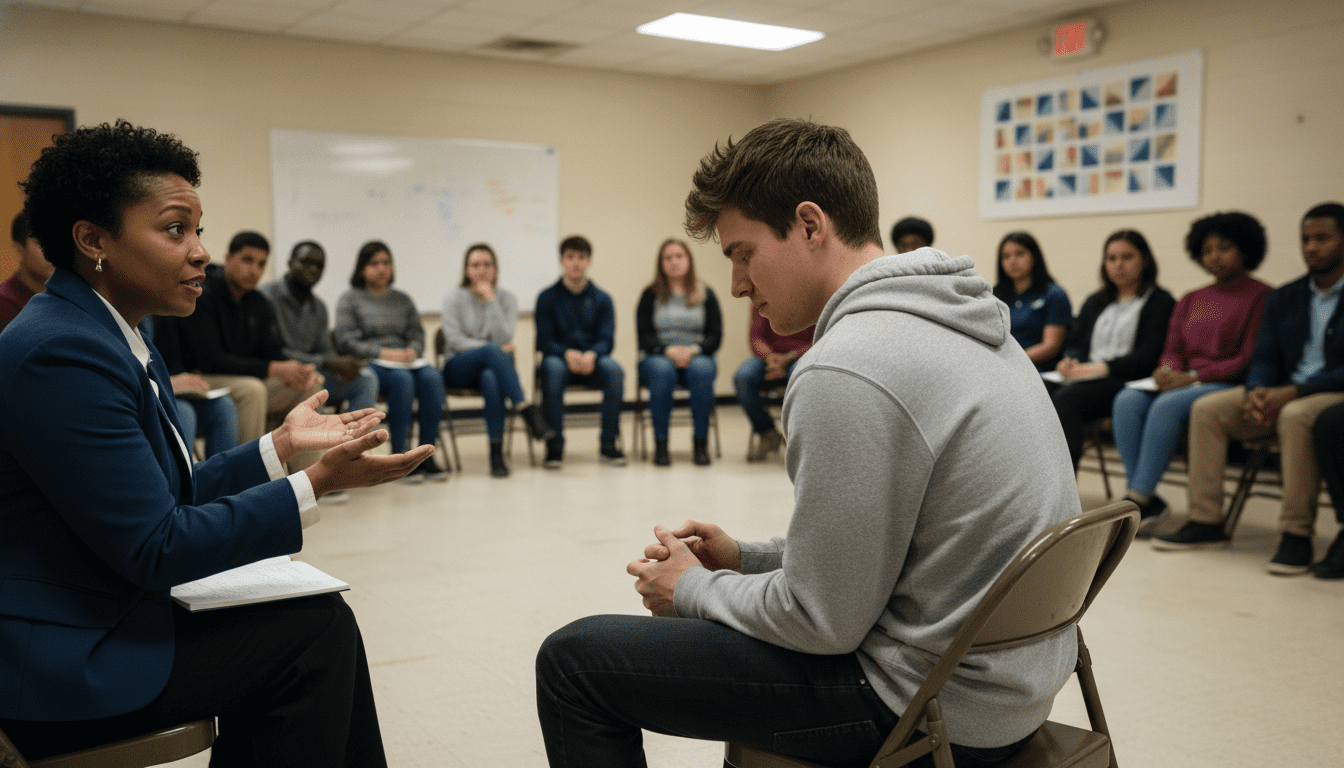
Court-ordered anti-violence training aims to curb repeat youth assaults
An 18-year-old offender attends a court-ordered anti-violence training program to address repeated assaults, trauma and triggers as authorities seek to reduce recidivism.
Young offender enrolled in court-ordered anti-violence training
The participant is an 18-year-old man who has been subject to multiple interventions since his first recorded assault at 14. A judge imposed 14 weekly sessions of 90 minutes each as part of a suspended youth sentence, requiring him to take part in the anti-violence training as a condition of his probation. His record also includes theft and prior stays in youth detention; court files show the program is intended to teach impulse control and accountability. The session observed was the twelfth in the sequence, staged in a small office with a pedagogue and a single youth at the table.
One-on-one sessions focus on values and self-control
The training opens with practical exercises designed to surface personal priorities and moral reasoning, such as sorting cards that list values. Participants are asked to select five important and five most important values, prompting reflection about self-image, honesty, and self-restraint. The young man alternated between displays of toughness and sudden vulnerability during the exercise, revealing how quickly posture and confidence can shift under scrutiny. Trainers use these moments to test consistency between stated values and past behavior, and to encourage internalisation of non-violent responses.
Trainer describes a confrontational but empathetic method
The facilitator in the observed course has worked in youth welfare for more than two decades and describes his approach as speaking “at eye level” while not allowing evasive answers to stand. He combines direct challenge with efforts to understand biography and emotional drivers, confronting contradictions when adolescents present conflicting accounts of themselves. According to him, some trainees react with withdrawal and silence, complicating pedagogical work, while others—like the young man in this case—engage but remain emotionally fragile. The trainer rejects simple cultural explanations and instead highlights frustration, lack of parental support and failed expectations as common triggers for violent conduct.
Biographical work and ‘pride lists’ reveal resources and trauma
A core element of the curriculum is a biographical review and a strengths inventory, administered through questionnaires and conversation. Sessions explore upbringing, experiences of being abused or bullied, and the timing of first violent acts, aiming to map how past harm becomes present risk. Where youths cannot name achievements, facilitators help them compile a “pride list” that identifies small but real competencies to build on, such as sporting discipline or reliability. The pedagogical goal is twofold: to make perpetrators recognise the impact of their actions on victims and social networks, and to redirect self-worth toward constructive activities.
Mental health support and coping strategies are central
The observed participant reported long-standing depressive symptoms and described sport as a primary coping mechanism that prevents deeper decline. Trainers emphasised that while physical exercise can stabilise mood, addressing underlying depression often requires talking with trusted others or professional therapy—an area in which many young men report difficulty. Facilitators therefore encourage disclosure to family or clinicians and link trainees to local mental health resources where possible. The program also works on recognising escalation patterns so that trainees can substitute non-violent strategies when they feel overwhelmed.
Progress monitored but risk of relapse acknowledged
By the time of the final sessions the young man asserted he had not reoffended since sentencing and said he felt he had made positive changes; the trainer nonetheless estimated a measurable, if modest, relapse risk. That assessment, presented to the participant, was intended to temper overconfidence and to highlight continuing tasks such as job-seeking, therapy access and building stable relationships. The pedagogue framed improvement as incremental and measurable: reductions in aggression, increased reflection about victims, and adoption of coping tools are treated as markers of success. Yet officials stress that sustained change depends on post-program support and opportunities for social and economic integration.
The court-ordered anti-violence training observed blends confrontational pedagogy with empathy, biographical reflection and skills-building to reduce violent behaviour among young offenders. While single programs will not erase harm, trainers and judges say such interventions can lower recidivism when paired with mental health care, employment help and family engagement, offering a structured path toward accountability and reintegration.
