
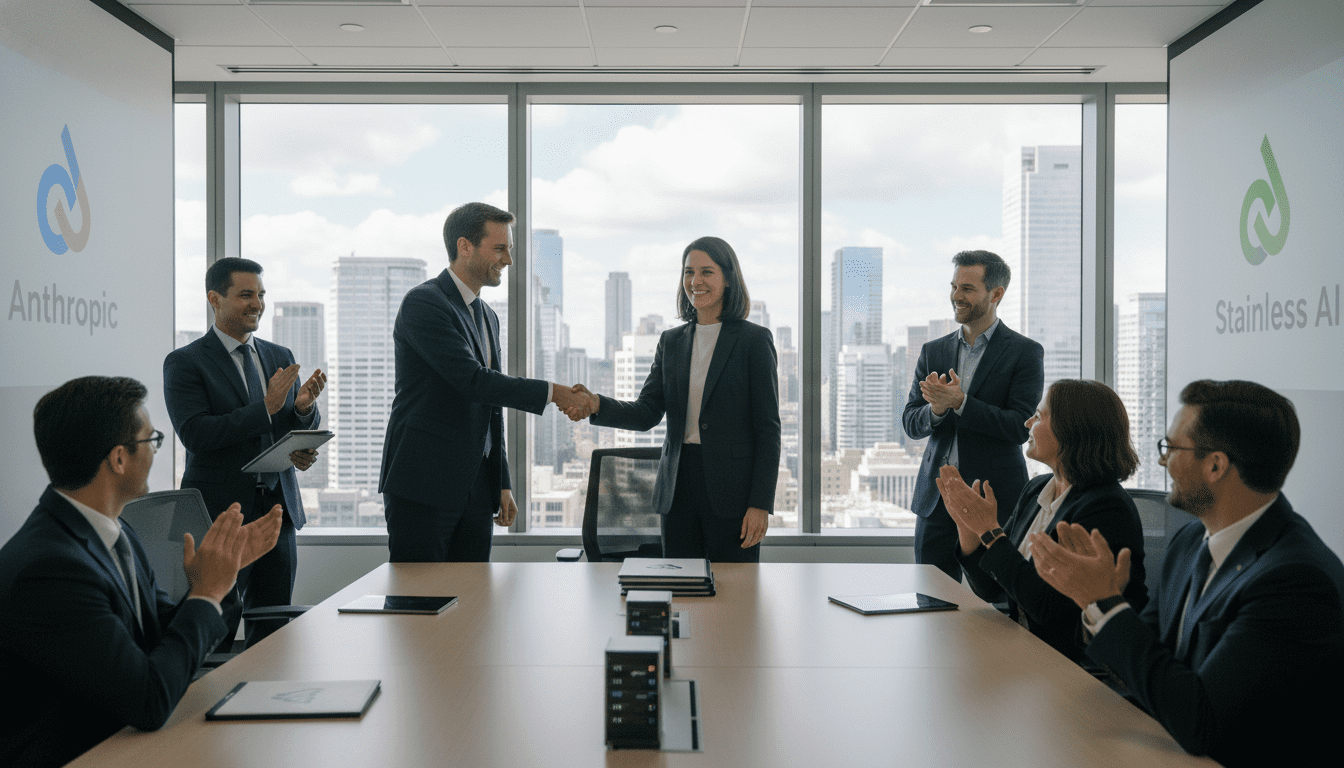
Anthropic acquires Stainless in deal that shifts critical SDK infrastructure to Claude-maker
Anthropic acquires Stainless, a startup that built widely used SDK-generation tools, potentially reshaping AI infrastructure and developer access. (155 characters)
Anthropic acquires Stainless, a developer-tools startup whose SDK automation software has been widely used across the AI sector, marking a major consolidation in foundational AI infrastructure. The company announced on Monday that it has purchased Stainless, founded by former Stripe engineer Alex Rattray, and that the acquisition will remove a key third-party SDK provider from the broader market. The move immediately affects how AI platforms build and maintain API client libraries and could alter competitive dynamics among major AI labs.
Acquisition confirms Anthropic’s strategic bet on developer tooling
Anthropic said it has finalized the acquisition of Stainless but did not disclose financial terms of the transaction. Industry reports had earlier indicated talks valuing the deal at more than $300 million, though Anthropic declined to confirm that figure. Company statements make clear that Anthropic intends to integrate the Stainless team and technology into its developer infrastructure work.
Anthropic described Stainless as central to the creation of its official SDKs, saying the start-up’s software has powered every Anthropic SDK since the company launched its API. The acquisition signals Anthropic’s intent to internalize a component many AI providers had previously outsourced to independent tooling firms.
Stainless technology and its role in the AI ecosystem
Stainless built an automated system to convert API specifications into production-ready software development kits across multiple languages, including Python, TypeScript, Kotlin, Go, and Java. That automation reduced the manual burden of creating and maintaining client libraries and offered automatic updates when APIs changed, a capability valued by platform teams.
Because AI agents and application integrations rely on stable SDKs to interface with external services, Stainless’s tooling became widely adopted by companies building agent-based workflows. The technology’s appeal lay in both rapid generation and ongoing maintenance of libraries, which helped developers reliably connect models to external systems and services.
Customers affected and immediate product changes
Anthropic said it will wind down all hosted Stainless products after the acquisition, though it assured users that SDKs already generated by customers remain theirs to modify and extend. The announcement noted that customers retain full rights over SDKs they generated prior to the wind-down, but the hosted generation and update pipeline will be absorbed into Anthropic’s environment.
Stainless had counted multiple leading AI and infrastructure companies among its users, including several that compete directly with Anthropic. The product shutdown will require those customers to assess replacement tooling or to self-host generated SDKs going forward, altering their maintenance workflows.
Competitive and market implications for AI labs
By bringing Stainless’s tooling in-house, Anthropic removes a neutral supplier from the market that previously served competing labs. That shift reduces a common point of interoperability in the AI development stack and could create friction for organizations that relied on Stainless’s hosted services to maintain multi-vendor integrations.
Analysts and developers will watch whether Anthropic limits future access to Stainless-derived capabilities or opens equivalent tooling to partners under different terms. The acquisition raises questions about how proprietary control of developer infrastructure might influence the pace and cost of integration for smaller teams and rival platforms.
Founding team and statements from Alex Rattray
Alex Rattray, who launched Stainless after leaving Stripe, framed the move as a natural evolution for the team and technology. In Anthropic’s announcement, Rattray said the company had been closely watching developer work on Anthropic’s platform and that joining forces allowed his group to continue their work at greater scale.
Rattray emphasized that SDKs deserve careful maintenance and said the team will remain focused on building tooling for the platform. Anthropic characterized the hire as both a talent acquisition and a consolidation of capabilities that have been important to its own developer ecosystem from the earliest days of its API.
What developers and customers should expect next
Anthropic has told customers that SDKs already generated through Stainless remain owned by their creators, and that those assets can be modified as needed. The company also indicated its intent to integrate Stainless’s capabilities into its own developer offerings, though details about timelines and access policies remain sparse.
For teams that depended on Stainless’s hosted services, the immediate task will be to inventory generated SDKs, assess self-hosting options, and determine whether to migrate to Anthropic’s upcoming tooling or to alternative vendors. Enterprises with complex, multi-platform integrations may face short-term operational work as they transition away from the hosted product.
The acquisition of Stainless by Anthropic represents a notable consolidation in the tooling layer that supports API-driven AI development. As Anthropic integrates the team and technology, customers and competitors will be watching closely for changes in availability, licensing, and the long-term shape of SDK tooling within the AI ecosystem.
