
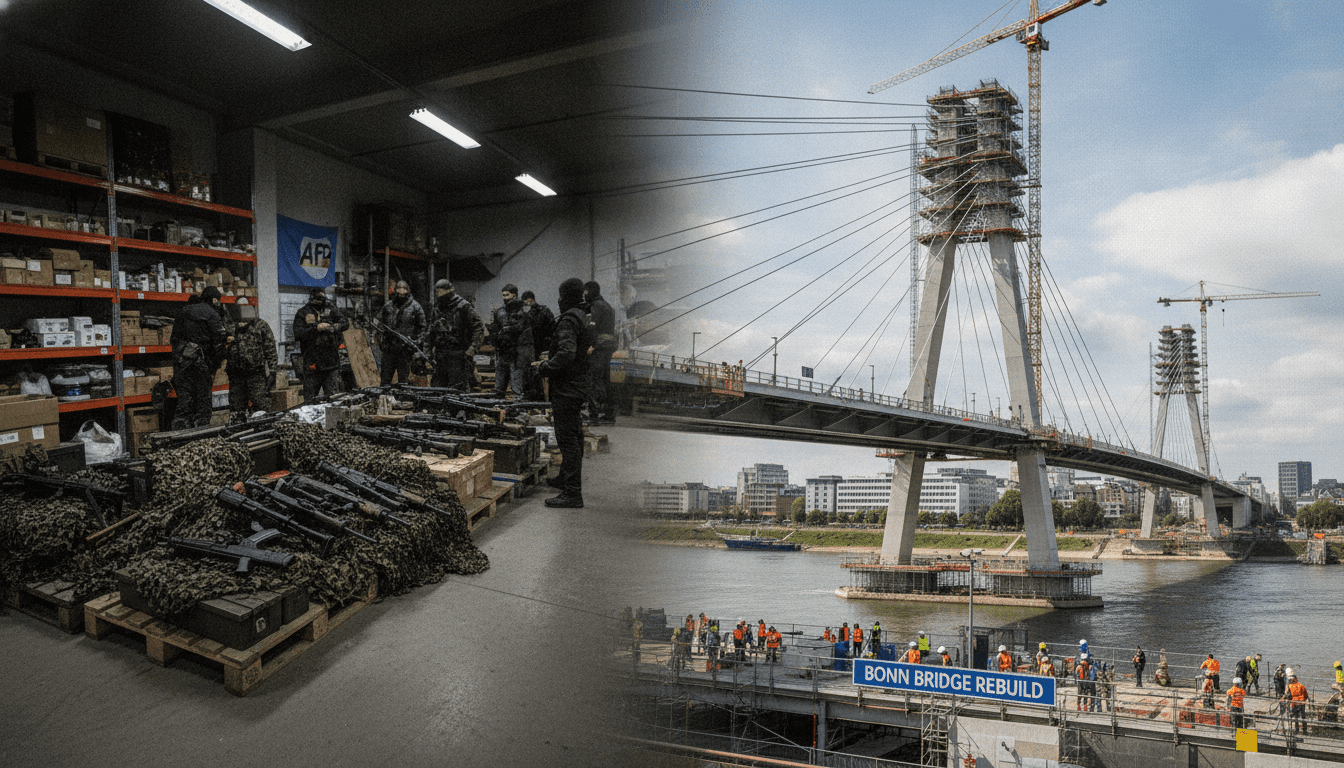
Bonn motorway bridge to be rebuilt amid AfD arms reports and World Cup cooling breaks
Bonn motorway bridge set for rebuild as Germany confronts armed AfD members in several states and World Cup cooling breaks reshape coaching influence.
The federal city of Bonn announced on Friday that a motorway bridge will be rebuilt after authorities determined the structure can no longer be maintained through repairs alone. The Bonn motorway bridge is the focal point of infrastructure concerns that officials say require full reconstruction rather than further patchwork fixes. At the same time, reports that members of the AfD have been hoarding weapons across several German states have prompted new political pressure, and the ongoing World Cup has drawn attention to how cooling breaks are changing coaching dynamics on the pitch.
Bonn motorway bridge ordered rebuilt
City engineers and transport authorities in Bonn concluded this week that the affected motorway bridge must be replaced due to persistent structural issues that, they say, pose long-term risks to traffic safety and reliability. Officials announced a timetable for a full rebuild and indicated that traffic diversions and phased closures will be necessary during construction.
Local and regional transport agencies are coordinating to reduce disruption, including rerouting heavy goods traffic and enhancing public-transport alternatives where possible. Residents and businesses near the site have been briefed on expected noise and access changes, and authorities pledged to publish detailed construction schedules soon.
Investigations reveal AfD members hoarding weapons across states
Law-enforcement sources and media reports say investigations in multiple German states have uncovered cases of AfD members accumulating firearms and other weapons, raising questions about party oversight and internal discipline. Prosecutors in at least some regions have opened inquiries into illegal possession and potential links to extremist networks, according to officials familiar with the probes.
Party leaders have faced calls from rival politicians and civil-society groups to clarify membership vetting and to cooperate fully with authorities. The reports have intensified debate in state parliaments about whether additional monitoring or new regulatory steps are required to prevent illicit arms stockpiling.
Federal and state officials respond to security concerns
Interior ministers at both state and federal levels convened meetings this week to review the findings and to assess whether current firearms controls and background-check mechanisms are sufficient. Officials emphasized that existing laws remain the primary tool for addressing illegal weapon possession, while acknowledging that targeted enforcement may be needed in specific cases tied to organized hoarding.
Some state governments said they would strengthen cooperation with police and intelligence services to trace the provenance of seized weapons and to identify any networks facilitating acquisition. Opposition lawmakers demanded rapid transparency and suggested parliamentary hearings to examine the extent of the problem.
World Cup cooling breaks alter coaching authority and tactics
On the sporting front, the World Cup’s mandated cooling breaks—introduced to protect players from extreme heat—have had the unintended effect of reshaping in-game power dynamics between coaches and referees. Teams are using the pauses not only for hydration and medical checks but also as tactical moments to convey instructions, alter formations, and reset mental focus.
Coaches have praised the breaks as useful windows to influence play when they otherwise could not, while some referees and federation officials have noted the shifts in pacing and strategy. The measure, intended primarily for player welfare, has therefore acquired a second role in tactical management.
Public reaction and political fallout across sectors
The confluence of an infrastructure emergency in Bonn, revelations about weapons among political party members, and the sporting debate over cooling breaks has prompted a wider public conversation about safety, accountability and institutional adaptability. Citizens in affected areas voiced frustration over prolonged repairs, while civil-rights advocates warned against politicizing law-enforcement responses.
Political parties have sought to capitalize on the different stories, with opposition groups urging tougher action on both infrastructure funding and internal party security. Meanwhile, sporting bodies have been asked to review whether temporary measures like cooling breaks require complementary rules to limit tactical exploitation.
The three developments underscore a broader challenge for German institutions: balancing immediate operational needs with long-term oversight and public trust. As Bonn prepares for a lengthy reconstruction project, law-enforcement agencies pursue investigations across several states, and sporting authorities monitor the effects of in-game breaks, officials say coordinated communication and transparent timelines will be critical to maintaining confidence and minimizing disruption.
