
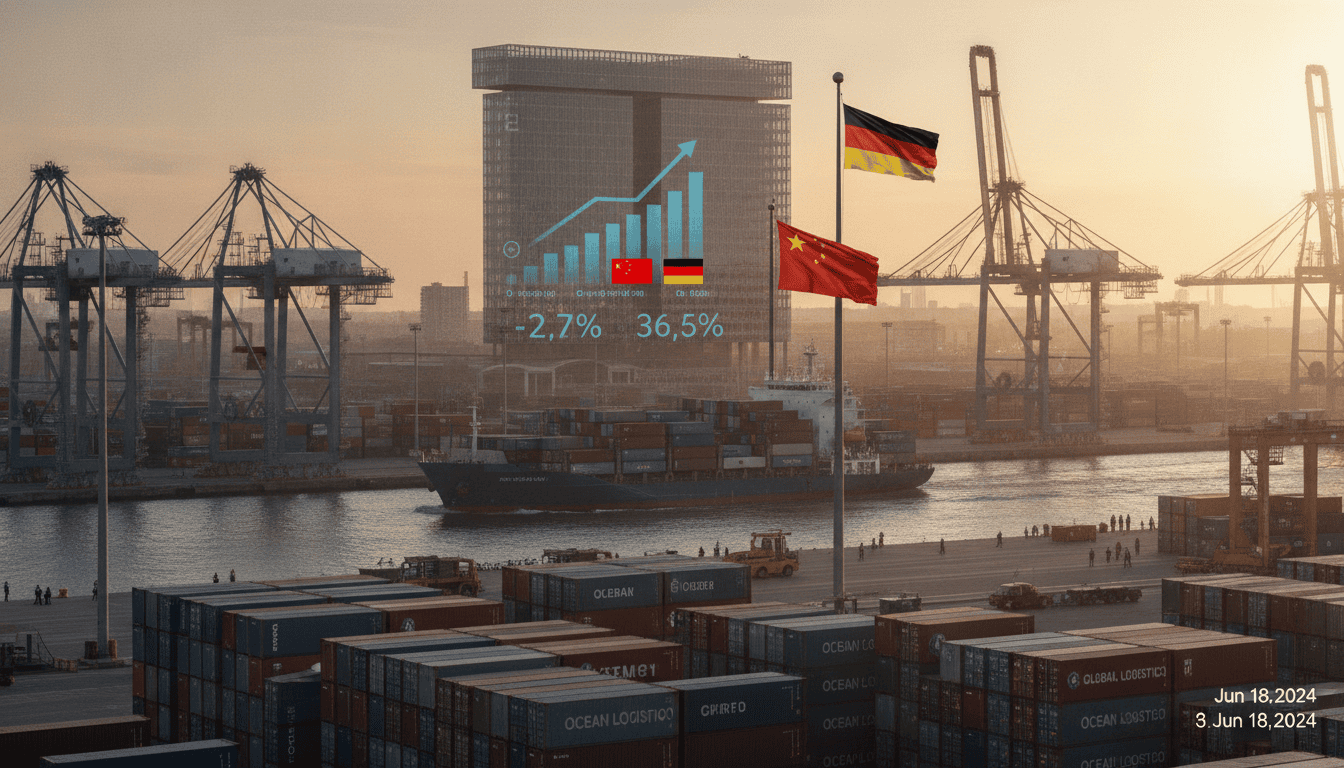
China exports to Germany surge in January–June 2026 as chip and auto shipments accelerate
Chinese exports to Germany rose 19% in Jan–Jun 2026 to $67.5 billion, while imports from Germany barely grew, widening the bilateral trade gap.
China exports to Germany surged in the first half of 2026, with shipments to the Bundesrepublik climbing 19% to $67.5 billion for January–June, according to data released by China’s customs authority. The import picture was markedly different: German deliveries rose only modestly to $45.1 billion, leaving a sharply higher Chinese surplus with Germany. The shift is part of a broader pattern in which Chinese sales to the EU and several trading partners have jumped, driven by semiconductors, automobiles and batteries.
China’s exports to Germany jump, surplus widens
China’s exports to Germany reached $67.5 billion for January–June 2026, up 19% from the same period in 2025, while German exports to China edged up to $45.1 billion. That asymmetric movement pushed China’s trade surplus with Germany from roughly $12.3 billion a year earlier to about $22.3 billion in the first half of 2026. Officials in Beijing reported the figures through the national customs authority, highlighting the growing tilt in bilateral merchandise flows.
EU trade imbalance with China grows by a quarter
At the EU level, China’s shipments rose 17% to $312 billion in the first half of 2026, while EU deliveries to China increased by about 9% to $135 billion. The resulting EU deficit with China widened to $176.7 billion, roughly $1 billion per day for the six-month span and about 24% higher than the $143 billion gap a year earlier. Analysts say the divergence reflects stronger global demand for Chinese manufactured goods and the rapid expansion of specific high-growth product categories.
Chips, cars and batteries fuel export growth
A concentrated portion of the export surge comes from machinery and electrical products, which account for nearly two-thirds of China’s outward shipments, according to customs figures. Semiconductor exports nearly doubled, rising from $90 billion to $177 billion, while vehicle exports climbed from $60 billion to $92 billion in the same comparative six-month window. Shipments of lithium batteries and wind turbines also recorded strong gains; China’s customs deputy chief, Wang Jun, said those rises were influenced in part by developments in the Middle East.
Automotive shipments point to record annual exports
Chinese carmakers exported 5.3 million vehicles worldwide in January–June 2026, up from 3.47 million in the first half of 2025, with June alone accounting for about 1.07 million units. That pace places the country on track to exceed 10 million vehicle exports for the full year if momentum continues into the second half. The increase is being driven by competitive pricing, expanded overseas dealer networks and surging demand for electric vehicles and affordable internal-combustion models in several regional markets.
South Korea benefits from semiconductor trade boom
Trade flows with South Korea show a contrasting dynamic: imports into China from South Korea rose by about 60%, driven largely by chips and components, while Chinese exports to South Korea grew roughly 30%. That imbalance has delivered an estimated South Korean surplus of around $46 billion in trade with China for the six-month period. The pattern underscores how the global semiconductor cycle and supply chains are reshaping regional trade balances across East Asia.
Overall balance: exports grow faster but surplus holds steady
For January–June 2026 as a whole, Chinese exports expanded 17.6% to $2,125 billion while imports climbed 26.6% to $1,549 billion, leaving an export surplus of $576 billion—about $10 billion lower than a year earlier. The customs authority emphasized the outsized contribution of machinery and electrical goods to the export increase, and singled out specific product lines such as chips, batteries and cars. While the headline surplus remains large, the narrowing year-on-year change suggests stronger import demand alongside persistent export strength.
China’s rapid export gains in key technology and automotive segments are reshaping trade patterns with major partners, prompting fresh attention from policymakers in Europe and East Asia. The scale and concentration of the flows — particularly in semiconductors and electric-vehicle components — will likely be central to trade discussions and industrial policy decisions in the months ahead.
