
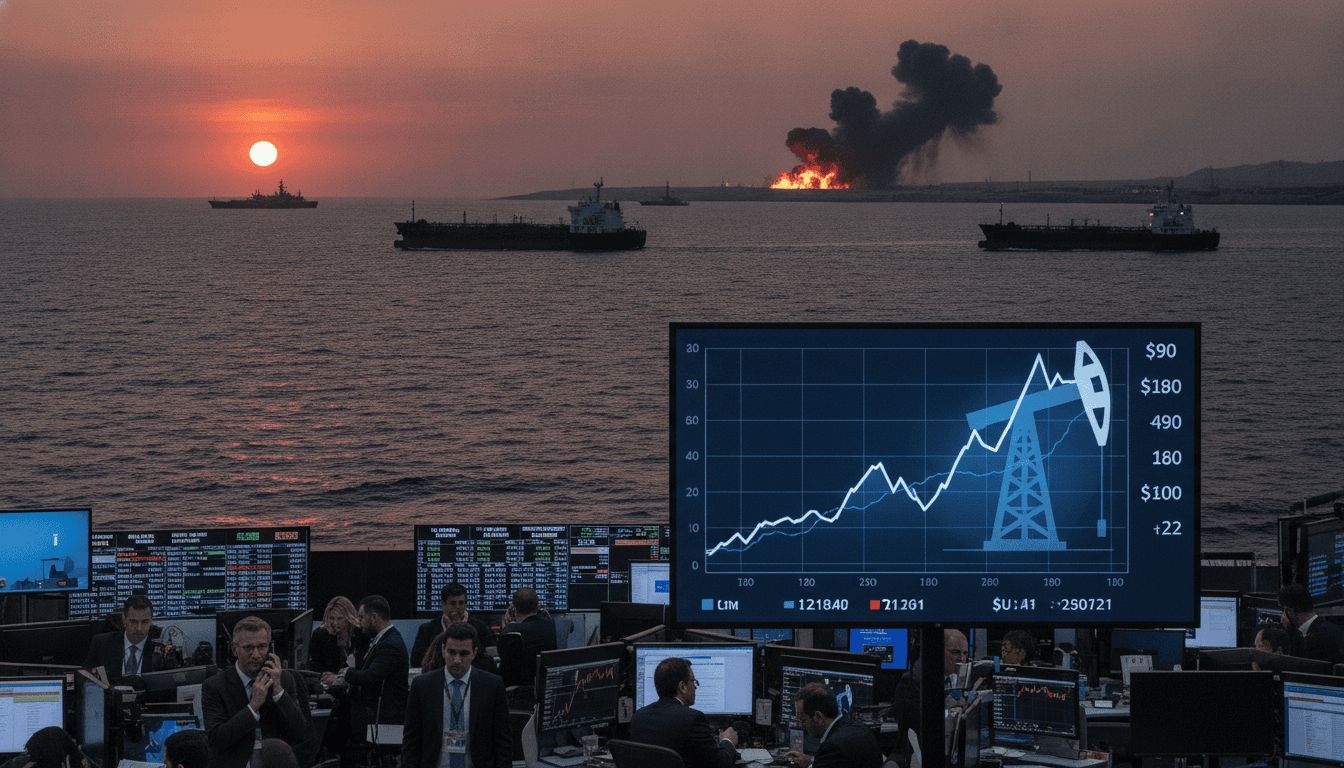
Oil price jumps as renewed US‑Iran strikes and Strait of Hormuz fears roil markets
Global oil price edges higher after US attacks on Iran and tensions around the Strait of Hormuz push traders to reprice risk.
Renewed military exchanges between the United States and Iran drove a notable rise in the oil price on Monday, with Brent crude up about 3.3% to $78.50 per barrel and U.S. West Texas Intermediate (WTI) rising roughly 3.4% to $73.83. The move reflects market concern that sustained confrontation could choke shipments through the Strait of Hormuz, a choke point that handles roughly one‑fifth of the world’s seaborne oil trade. Traders said the advance put benchmarks well above pre‑conflict levels recorded in late February, though short of the spikes seen earlier in the year when prices briefly climbed above $90 a barrel.
Markets react to military strikes and shipping disruptions
Financial markets reacted quickly after the U.S. reported fresh strikes on Iranian targets and Iran responded with attacks in the Gulf region. The immediate response was a jump in oil futures and heightened volatility as market participants reassessed supply risk and the potential for longer‑lasting disruption.
Shipping data deepened concern: maritime trackers recorded only six transits through the Strait of Hormuz on Sunday, the fewest in five weeks, signaling that some operators are delaying passage or rerouting. Reduced traffic through that narrow waterway is a direct signal for traders because any sustained blockage or interdiction there would significantly tighten global crude flows.
Details of the military exchanges cited by both sides
U.S. military officials said recent operations struck around 140 targets inside Iran in response to attacks on commercial vessels in the Gulf. Washington has framed the actions as retaliation for threats to merchant shipping and regional security.
Tehran rejected the characterization of its actions as offensive attacks and said Iranian measures were limited to warning shots in response to vessels straying from authorized routes. Iranian parliamentary speaker Mohammed Bagher Ghalibaf cited provisions in the June framework agreement allowing Tehran to take precautions to secure passage, and accused the United States of breaching the accord.
Regional claims of strikes on allied bases and official silence
Iran reported strikes on sites associated with U.S. forces in Kuwait, Bahrain and Jordan, describing them as retaliation for U.S. attacks. Those claims, circulated by Iranian state media, point to a widening pattern of exchanges beyond direct U.S.–Iran engagement.
U.S. Central Command (CENTCOM) did not immediately comment on the Iranian assertions, leaving aspects of the episode unconfirmed by independent military sources. The absence of rapid, corroborated statements from regional commands has amplified uncertainty among traders and policymakers.
Political shifts that complicate de‑escalation
The diplomatic backdrop has deteriorated: U.S. President Donald Trump recently declared the June framework agreement with Iran void, and Tehran has discussed measures to assert control over the Hormuz corridor, including levying transit fees. Those moves have eroded trust in existing mechanisms designed to keep maritime routes open.
Analysts say the political unravelling increases the risk that localized incidents could escalate into sustained disruption of shipping lanes or wider military engagement. With formal dispute‑resolution channels weakened, the market now prices in a higher likelihood that geopolitical frictions will persist.
Supply outlook and implications for consumers and producers
Although current benchmark levels remain below the peaks earlier in the conflict, the recent rise signals renewed upward pressure on fuel and energy costs if tensions continue. Refiners, traders and governments will be watching shipping patterns, insurance premiums and tanker layups closely for signs of longer‑term constriction.
A prolonged reduction in Strait of Hormuz throughput would force crude onto longer, costlier routes and could prompt inventory draws in consuming regions, tightening the supply cushion. Policy responses — from strategic reserve releases to naval escorts for tankers — are on the table but would likely take time to alter market perceptions.
Economic actors are also monitoring how quickly commercial shipping resumes normal transit and whether diplomatic channels can stabilize the situation. The combination of military action, political moves and fragile shipping flows has restored the Strait of Hormuz to the center of global oil market risk calculations.
The oil price remains sensitive to further developments in the Gulf, and traders will likely continue to price in a premium for disruption risk until there is clearer evidence of de‑escalation or concrete steps to guarantee unimpeded passage through the Strait of Hormuz.
