
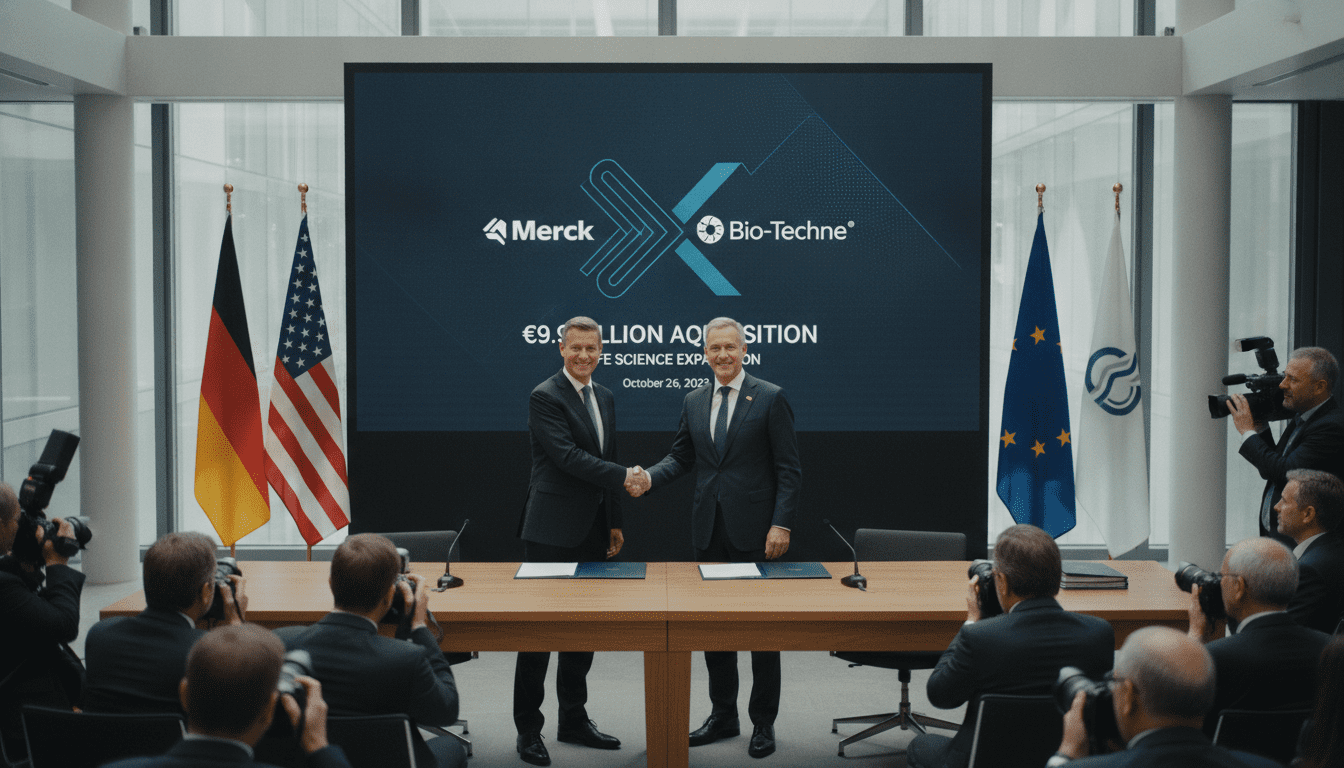
Merck buys Bio‑Techne for €9.9bn to expand life‑science tools in cell and gene therapy
Merck buys Bio‑Techne for €9.9bn, expanding life‑science tools for cell and gene therapy. Deal set to close late 2026–early 2027 with planned cost and revenue synergies.
Merck on Thursday announced it will acquire US lab supplier Bio‑Techne for about €9.9 billion, strengthening its life‑science business with technologies for cell and gene therapy and precision diagnostics. The acquisition — priced at $73 per share in cash and representing an enterprise value of roughly $11.3 billion — comes with a 24 percent premium to Bio‑Techne’s last close. Merck said the move will broaden its offering of reagents, instruments and services for pharmaceutical research and manufacturing.
Deal terms and timeline
The agreed purchase price values Bio‑Techne at roughly $11.3 billion including debt and comes with an all‑cash payment of $73 per share. Merck said the transaction is expected to be completed by the end of 2026 or in early 2027, subject to regulatory approvals and customary closing conditions.
Shares of Bio‑Techne jumped nearly 22 percent in premarket trading on the announcement, while Merck’s shares briefly rose to an annual high. Executives framed the price as a strategic investment in capabilities rather than a purely financial transaction.
Bio‑Techne’s product portfolio and footprint
Bio‑Techne brings a broad catalog of life‑science materials, including thousands of proteins and hundreds of thousands of antibodies, alongside instruments and related services. The Minneapolis‑based company operates 34 sites worldwide, with about 3,000 employees and 15 production facilities across North America, Europe and Asia.
Recent sales at Bio‑Techne exceeded $1.2 billion, a scale that complements Merck’s existing reagents and analytical technologies. Company executives highlighted how combining inventories and distribution networks will offer customers a more integrated supply of research‑grade and production‑ready materials.
Strategic rationale for Merck’s life‑science expansion
Merck’s management described the acquisition as a move to “buy innovation” and accelerate access to fast‑growing end markets such as cell and gene therapy and precision diagnostics. The combined portfolio is intended to serve the full development pathway from discovery to commercial manufacturing.
Life‑science already accounted for a significant share of Merck’s business in 2025 — about 42 percent of the company’s €21.1 billion revenue — and executives said Bio‑Techne’s technologies will add depth to that division. The deal aligns with a broader industry trend of vertical consolidation as drug developers seek integrated suppliers for complex biologic production.
Financial structure, expected savings and shareholder impact
Merck plans to fund the transaction with a mix of existing cash and new debt facilities, and expects the deal to be accretive to earnings per share from the third year after closing. Management is forecasting approximately €140 million of annual cost savings once integration is complete.
The firm’s finance chief emphasized a disciplined approach to mergers and acquisitions, arguing the timing and structure reflect strategic, not opportunistic, decision‑making. Investors will watch closely for the integration plan and how quickly the promised synergies materialize against the financing costs.
Management changes and US strategic focus
The acquisition is the first major strategic move under Merck’s new CEO, Kai Beckmann, who succeeded Belén Garijo in May after she moved to Sanofi. Beckmann framed the purchase as part of a deliberate push to strengthen Merck’s presence in the United States, where many high‑growth life‑science markets are concentrated.
Merck has continued to pursue US‑based targets in recent years, including last year’s purchase of Spring Works Therapeutics and earlier large acquisitions such as Millipore and Sigma‑Aldrich. Company leaders said the US remains an attractive market for advanced lab technologies and bioprocessing tools.
Company history of large life‑science acquisitions
The Bio‑Techne deal follows a string of sizable transactions that reshaped Merck’s laboratory and materials business over the last decade. Notable past purchases include Millipore in 2010, Sigma‑Aldrich in 2015 and Versum in 2019, each of which expanded Merck’s footprint in reagents, analytical equipment and materials for semiconductor and life‑science customers.
Analysts say the pattern shows Merck’s long‑term strategy to assemble a comprehensive suite of products that serve both early‑stage research and later‑stage pharmaceutical manufacturing. The latest acquisition extends that strategy into newer modalities where demand is growing rapidly.
The transaction will require regulatory sign‑off and careful operational integration, but Merck’s leadership says the combined capabilities will create a more compelling offering for customers developing advanced biologics and diagnostics.
