
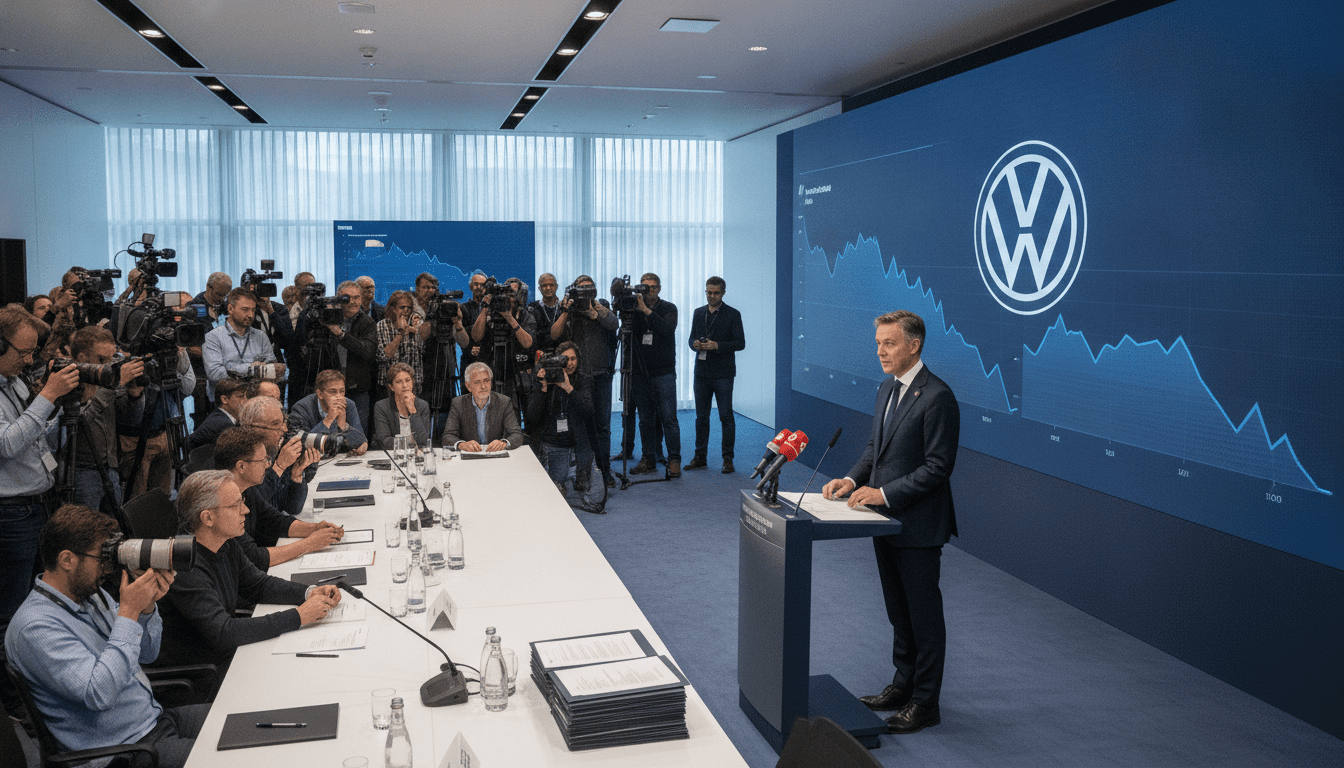
Volkswagen cost cuts escalate as Chinese rivals and politics squeeze German plants
Volkswagen cost cuts accelerate as the company prepares deeper savings measures amid slowing demand, rising competition from Chinese automakers, and mounting political resistance in Germany.
Volkswagen is preparing a new round of cost cuts as global demand stagnates and competitive pressure intensifies, company executives in Wolfsburg say. The move to deepen Volkswagen cost cuts comes after an earlier savings program that executives now view as insufficient to offset structural challenges and a changing market landscape. Management officials are framing the measures as necessary to preserve competitiveness as rivals from China and other regions expand into Europe.
Planned scale and objectives of the new measures
Volkswagen’s management has told staff the latest package will target broad efficiency gains across production, purchasing and overhead functions. The aim is to shrink structural costs to match slower growth expectations and a tougher margin environment across the auto sector. Company leaders have signaled that the scope could include plant consolidation, renewed procurement discipline and tighter controls on model-portfolio spending.
Executives emphasize that the objective is not short-term cost shaving alone but a longer-term reset of the company’s cost base to protect profitability. That recalibration is rooted in a strategic view that Europe’s traditional cost structures are unsustainable if rivals can produce at materially lower unit costs.
Chinese manufacturing expansion in Europe
A central driver of Volkswagen cost cuts is intensified competition from Chinese automakers, which have launched efficient, low-cost production facilities abroad. Several Chinese groups have moved to build factories in Southeastern and Eastern Europe to serve local markets with shorter supply chains and lower production costs. That strategy narrows the price and logistics advantages that once protected established manufacturers.
Automakers in Germany and across Europe have already reported market share losses in China and now face rivals that can mirror those advantages closer to home. For Volkswagen, that trend forces a strategic choice: match lower cost structures, shift product mixes, or cede segments to competitors.
Pressure on specific German plants and workforces
The new cost program heightens uncertainty at several legacy VW sites, including large-volume factories in Emden, Zwickau and Hannover, as well as the Audi plant in Neckarsulm. Management assessments highlight the particular vulnerability of older plants with legacy layouts and higher fixed costs. Industry analysts warn that without adaptation, these sites will face production downgrades or consolidation.
Company forecasts circulated internally mention significant global workforce adjustments could be required to achieve the savings targets. While exact figures remain under discussion, such projections have raised alarms among works councils and regional political leaders worried about employment impacts.
Union mobilization and legal-political pushback
Labor representatives and the IG Metall union have vowed to resist plant closures and mass layoffs, signaling readiness to use collective bargaining and industrial action to defend jobs. The union argues that deeper cost cuts must be paired with proposals to preserve employment through measures such as short-time work, redeployment and investment-linked guarantees.
At the same time, state stakeholders with ownership stakes in Volkswagen have publicly urged restraint. Their intervention complicates management efforts to enact rapid structural changes, contributing to protracted negotiations and a fraught industrial relations climate.
Regional political consequences ahead of elections
The timing of the restructuring stokes political tensions in regions where automotive suppliers and plants employ large numbers of people. In Saxony-Anhalt, where regional elections are scheduled in September, populist parties have sought to exploit local economic anxiety linked to supplier distress. That has intensified pressure on state governments to intervene on behalf of local employers and resist closures.
In Lower Saxony, a major shareholder in Volkswagen, the state government has already signaled it will act to protect its regional industrial base. Those political interventions could shape the final contours of any cost-saving program and slow or limit the most drastic measures.
Industry-wide inflection point and strategic choices
Executives and analysts describe the situation as a sectoral inflection point rather than a temporary downturn. Automakers face a simultaneous set of shocks: a deceleration in core market growth, fragmented politics that complicate supply chains and trade, and competitors whose cost structures undercut legacy manufacturing. For Volkswagen and peers, options include accelerated plant modernization, renegotiated labor frameworks, and more selective portfolio pruning.
Some industry observers say the long-term winners will be those that combine prudent cost management with targeted investment in automation and high-value electric models. Others caution that aggressive cost reduction alone could hollow out capabilities and weaken future competitiveness.
The coming weeks will test how effectively Volkswagen translates the strategic imperative for savings into concrete, socially acceptable actions while navigating union resistance and political intervention.
Volkswagen’s leadership faces a delicate balancing act: implement meaningful Volkswagen cost cuts to remain competitive while minimizing social fallout and preserving capacity to invest in the next generation of vehicles. The outcome will influence not only the company’s future but the trajectory of Germany’s automotive industry.
