
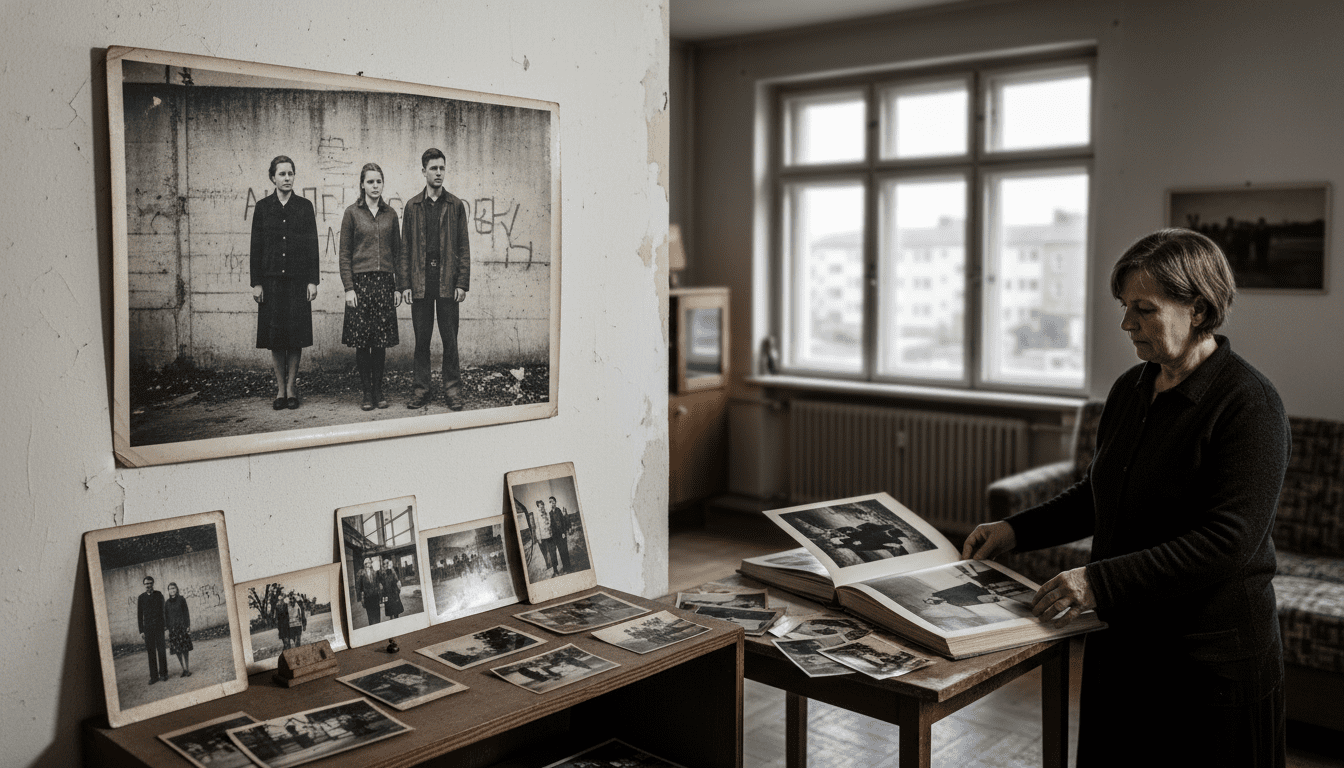
Mutterland: Photographer Michel Kekulé Chronicles Post‑1989 Eastern Germany Through Family Portraits
Mutterland traces the personal and regional aftermath of Germany’s post‑1989 transformation through intimate photographs and the story of one family. The project, created by 35‑year‑old photographer Michel Kekulé as his graduation work at the Ostkreuz School for Photography, centers on his mother Heike, 55, and the shrinking town they left behind. Kekulé’s Mutterland documents deindustrialization, migration and everyday markers of social fracture in eastern communities.
Photographer Michel Kekulé returns to hometown with Mutterland
Kekulé began Mutterland not to argue a single thesis but to observe how broad structural changes have altered private lives. He returned to Bad Salzungen and to the people who shaped his earliest years, using portraiture and domestic details to map continuities and ruptures. The project functions as both a family record and a visual study of the long tail of reunification-era upheaval.
Images emphasize domestic traces and infrastructural decline
The photographs often linger on small, telling objects: a mailbox with most flaps sealed, narrow corridors in prefabricated housing, and empty streets that recall former industry. These visual choices convert what is sometimes abstractly called the “transformation period” into concrete, legible evidence of loss and adaptation. By foregrounding ordinary settings, Kekulé connects intimate experience to broader demographic and economic trends.
Heike’s sealed mailbox as a symbol of displacement
One striking image follows the mailbox outside Heike’s Plattenbau apartment, where most slots have been taped over by the housing cooperative and residents face relocation. That sealed mailbox becomes an emblem for a household and a region in transit, signaling departures, administrative decisions, and lives disrupted. Kekulé’s portrait of his mother, paired with the mailbox detail, frames private vulnerability within institutional change.
Migration to Berlin and intergenerational distance
Michel himself lives in Berlin and reconnected with his mother through this photographic project, mirroring a larger pattern of east‑to‑west movement and urban draw. His work shows how migration reshapes family geographies: sons and daughters find opportunity in cities while older relatives remain in places marked by industrial decline. Mutterland uses these personal trajectories to illuminate a common story across many towns in eastern Germany.
Ostkreuz School context and the project’s reception
Presented as a graduation piece at the Ostkreuz School for Photography, Mutterland situates Kekulé within a generation of image makers probing recent German history. The school’s program has a reputation for documentary practice, and Kekulé’s approach — observational, fragmentary, and image‑led — fits that lineage. Early responses emphasize the project’s restraint and its capacity to make structural issues visible through quiet, carefully composed scenes.
Mutterland reframes transformation as a family archive
Rather than offering sweeping political analysis, the project reframes the post‑1989 transformation as a set of lived, sometimes contradictory memories. Kekulé’s photos register the slow persistence of ruptures: economic loss layered over routine care, the resilience of relationships under strain, and the endurance of places that no longer anchor prosperity. This framing invites viewers to consider reunification’s costs not only in macroeconomic terms but in day‑to‑day human consequences.
Mutterland also touches on contemporary visibility gaps in public discourse, where many residents of smaller eastern towns remain underrepresented. By making these lives the subject of sustained visual attention, Kekulé challenges simplified narratives and asks policymakers and the press to reckon with long‑term social effects. His images do not prescribe solutions, but they expand the record from statistics to people.
The project’s photographic language — light, composition and attention to texture — shapes its argument as much as caption text could. Close framing and quiet interiors encourage empathy without sentimentality, while the absence of overt commentary leaves space for viewers to draw connections between image and context. In this way, Mutterland functions as both art and social document.
Mutterland positions one family’s story amid regional shifts that continue to shape opportunities and identities in eastern Germany. Kekulé’s work underscores how structural change registers at the level of households and mailboxes, and how those traces merit sustained attention from cultural institutions and the wider public.
The photographs invite a longer conversation about memory, migration and the uneven effects of reunification on everyday life. By centering his mother’s experience, Michel Kekulé opens a path for other intimate, locally grounded investigations into the social consequences of historical transformations.
