
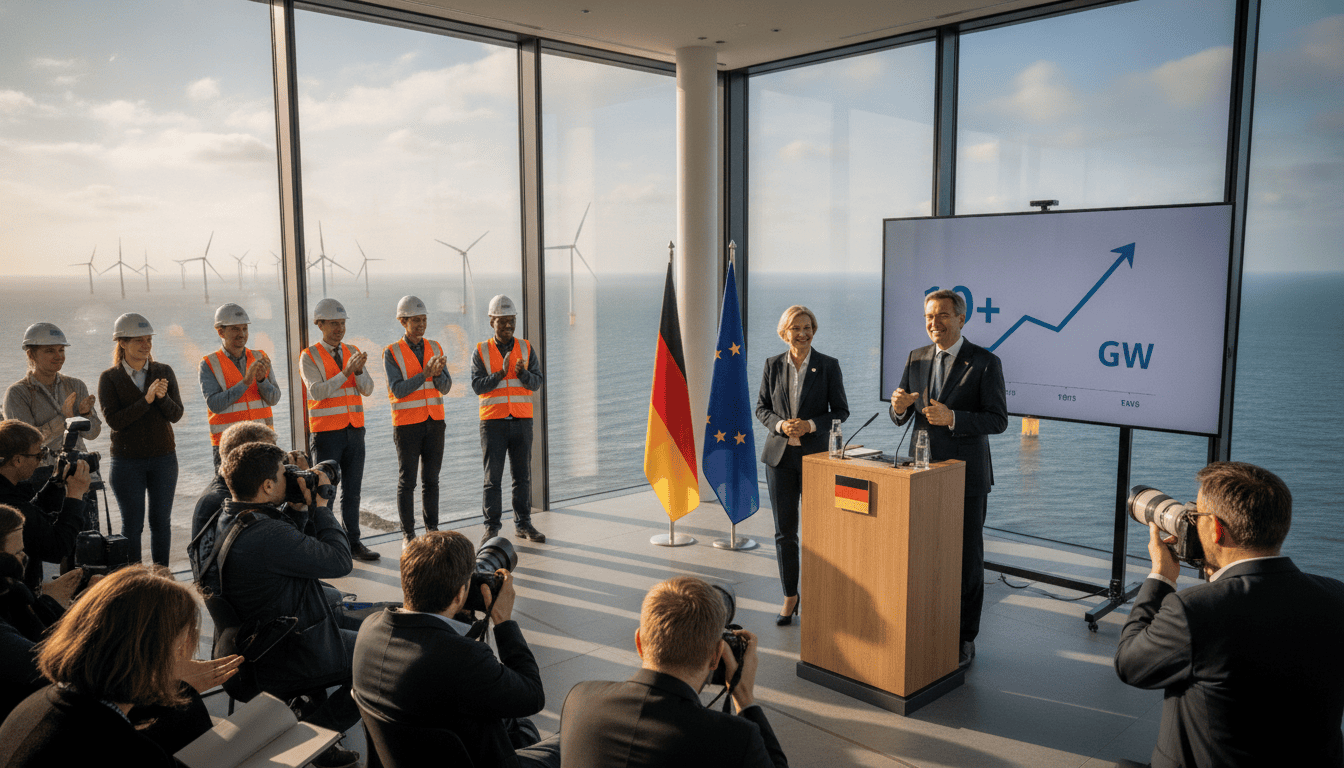
Offshore Wind Energy in Germany Surpasses 10 GW as Capacity Hits Record
Germany’s offshore wind energy surpasses 10 GW as of June 30, 2026, after strong H1 installations; 1,764 turbines set a new capacity and production record.
Germany has reached a new milestone in offshore wind energy, exceeding 10 gigawatts of installed capacity on June 30, 2026. The increase was driven by a particularly strong first half of the year, during which more than one gigawatt of new capacity was added. Industry groups say the development marks the fastest expansion of German offshore capacity to date.
Germany Tops 10.8 GW with 1,764 Turbines in Operation
As of June 30, 2026, German waters hosted 1,764 offshore wind turbines delivering a combined 10.8 GW of nameplate capacity. The offshore industry achieved a net addition of 1,077 megawatts in the first half of the year, the largest six-month increase on record. Officials said the threshold of 10 GW was crossed for the first time, reinforcing the sector’s central role in the country’s energy transition.
New Installations Still Await Commissioning
Alongside commissioned units, developers have installed further turbines that are not yet operational. Twenty-two newly erected turbines at sites including Borkum Riffgrund 3, He Dreiht and the North Sea cluster A account for about 323 megawatts. Grid connections and final commissioning processes remain underway for those machines before they begin feeding power into the system.
Investment Decisions Advance but Large Pipeline Remains
Project financing shows a mixed picture: final investment decisions (FIDs) have been taken for projects totalling roughly 2.6 GW, while about 17.5 GW of proposed offshore capacity has yet to reach the FID stage. Industry planning envisions the potential installation of up to 30 GW of offshore capacity in Germany by 2032 under current schedules. Analysts caution that reaching that target will require steady permitting, streamlined grid build-out and continued investor confidence.
Offshore Turbines Deliver Higher Full-Load Hours Than Onshore
Operators and energy associations report that offshore turbines in Germany typically achieve markedly higher full-load hours than their onshore counterparts. Offshore machines average between 3,500 and 4,500 full-load hours annually, compared with 2,000 to 3,000 hours on land. Those higher utilization rates translate into stronger capacity factors and greater annual energy yields per megawatt installed.
2025 Generation Equivalent Met Millions of Households
In 2025 German offshore wind farms generated approximately 26.1 million megawatt-hours of electricity, according to industry data. That output is equivalent to the estimated annual consumption of about 8.7 million households, assuming a 3,000 kilowatt-hour household usage. The generation figure underscores the growing contribution of offshore wind to national electricity supply and to decarbonization targets.
The record capacity milestone reflects accelerated installation activity but also highlights the remaining tasks: connecting new turbines to the grid, securing final investment for a substantial project pipeline and scaling port and logistics infrastructure. Policymakers and industry officials say continued regulatory clarity and investment support will be needed to sustain growth and realize the projected build-out through 2032.
