
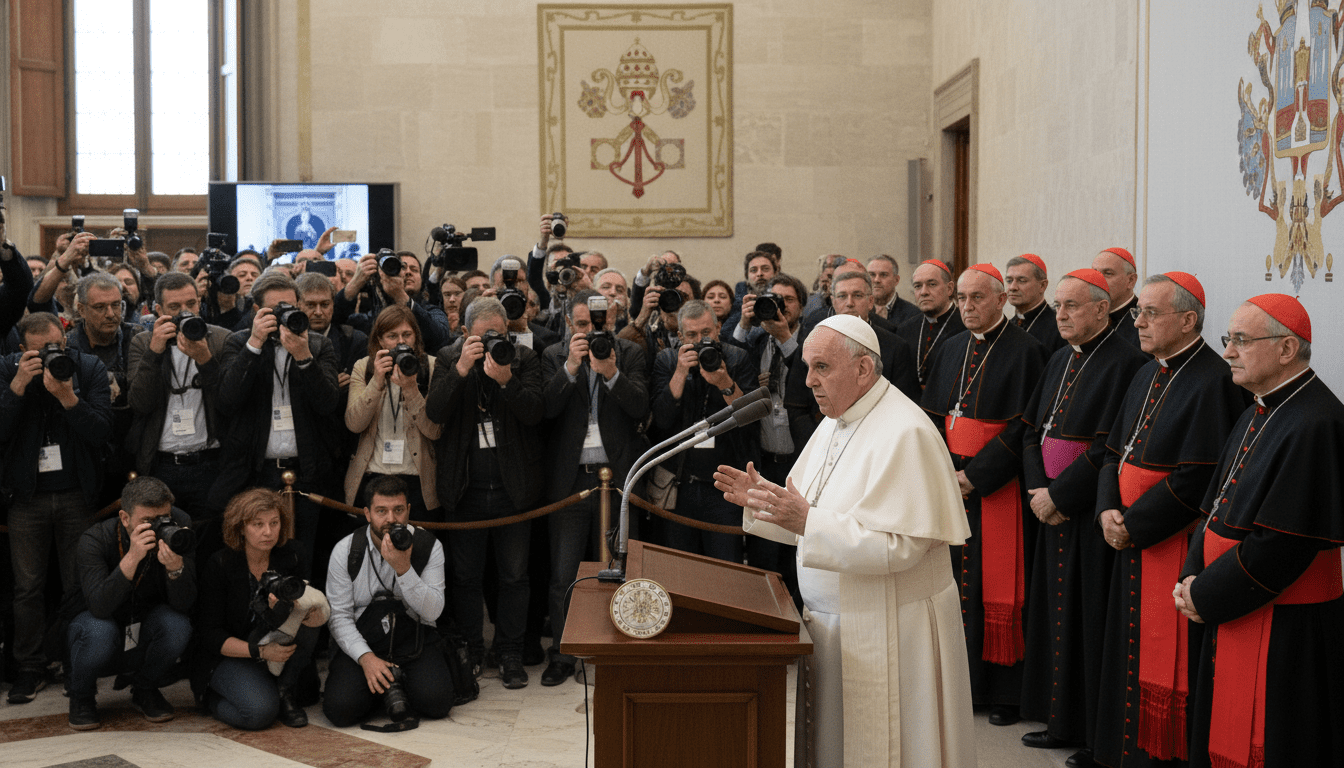
Pope Leo XIV Questions Just War Doctrine in New Encyclical “Magnifica humanitas”
Pope Leo XIV’s Magnifica humanitas calls for overcoming the just war doctrine while acknowledging a narrow right to self‑defense, igniting theological debate.
Pope Leo XIV’s first encyclical, Magnifica humanitas, includes a concise but consequential passage challenging the traditional doctrine of the just war and explicitly reaffirming only a narrow right of legitimate self‑defense. The statement arrives amid renewed political controversy after the U.S. vice president publicly accused the pope of misunderstanding the centuries‑old theory. The encyclical’s language has already prompted close readings by theologians, Vatican officials and international observers seeking to map its pastoral and political implications.
Pope’s Statement in Magnifica humanitas
The encyclical’s fifth and final chapter, devoted to questions of war and peace, contains the clearest papal remark to date on when the use of military force can be morally justified. Leo writes that “today it is — without prejudice to the right of legitimate defense, to be understood in the narrowest sense — more important than ever to reaffirm the overcoming of the theory of the ‘just war’.” That formulation both preserves a limited right to resist aggression and signals a desire to move beyond the classical categories that have guided Catholic moral teaching for centuries.
The wording is notable for its brevity and lack of technical qualification; the pope does not enumerate specific conditions under which force might be permissible. Instead, the encyclical situates the passage within a broader argument about the “culture of power” and a “civilization of love,” framing the rejection of expansive just war reasoning as part of a pastoral push toward conflict prevention and human dignity.
What the Catechism Says About Just War
The contemporary framework for the just war doctrine is laid out in the 1992 Catechism of the Catholic Church, which limits the concept to cases of military self‑defense and sets four principal conditions. Those conditions require that the harm inflicted by an aggressor be certain, grave and lasting; that all nonviolent remedies have been exhausted; that there be a reasonable chance of success; and that the use of force not produce evils or disorders worse than the harm being resisted.
Catechetical teaching also emphasizes proportionality, a clause that many commentators now view as difficult to satisfy given the destructive capacity of modern weaponry. Leo’s encyclical echoes that concern implicitly by calling for overcoming the doctrine, even as it acknowledges a tightly circumscribed right of defense, leaving open interpretive questions about how the conditions will be applied in practice.
Two Main Interpretations Among Theologians
Scholars and Vatican-watchers have coalesced around two principal readings of the pope’s sentence. One interpretation holds that Leo aims primarily to curb the doctrine’s misuse — a corrective intended to prevent just war language from being stretched into a rationale for preventive or aggressive interventions. Under this view, the pope seeks a more restrictive application of just war principles while leaving the core teaching intact.
The alternative reading is that Leo regards the doctrine itself as obsolete and worth superseding, not merely tightening. If taken this way, the encyclical would mark a doctrinal shift that follows the trajectory of prior papal remarks advocating for rethinking the moral logic of armed conflict. Both readings point to an intentional ambiguity in the text that has allowed different Catholic voices to project divergent expectations onto the pope’s statement.
Historical and Vatican Context
The just war tradition traces its intellectual origins to Augustine and was systematized over centuries of theological reflection. In recent decades, popes and Vatican bodies have repeatedly interrogated the doctrine in light of technological change and changing norms of international law. Pope Francis, for example, urged a reexamination of the teaching and highlighted proportionality concerns in the era of mass‑destructive armaments.
The Vatican hosted an international conference on the doctrine in 2016 at which over a hundred participants urged moving away from just war formulations. That conclusion did not produce an immediate change to the Catechism, and previous papal statements stopped short of offering a full replacement framework. Leo’s encyclical now places this longstanding debate back at the center of Catholic moral discourse.
Vatican Process and Possible Reasons for Ambiguity
Observers note that papal encyclicals are often the product of consultation and editorial synthesis, and the measured phrasing in Magnifica humanitas may reflect an attempt to balance competing currents within the Church. Some analysts suggest Leo deliberately avoided technical detail to prevent his words from being instrumentalized by political actors seeking moral cover for military action.
Others argue that the pope likely oversaw the final wording precisely because the passage touches on urgent global realities; if so, the restraint may indicate a tactical decision to nudge Catholic teaching in a new direction without precipitating immediate doctrinal rupture. Whatever the internal dynamics, the encyclical’s language invites further authoritative clarification from the Holy See.
Political Reactions and International Implications
The encyclical’s release follows a public exchange in which a U.S. official accused the pope of not understanding the just war tradition after the pope warned that God does not listen to the prayers of those who wage war. That controversy, and its association with current geopolitical tensions, has amplified the diplomatic sensitivity of Leo’s words. National leaders, military ethicists and Catholic institutions will be watching for follow‑up statements that translate the encyclical’s general posture into concrete guidance.
Beyond immediate political fallouts, the document could shape how Catholic chaplains, theologians and policymakers frame moral assessments of intervention, deterrence and arms development. By foregrounding the limits of just war reasoning, the pope may be seeking to reorient public and ecclesial conversations toward prevention, diplomacy and stricter moral scrutiny of the decision to resort to force.
The brief passage in Magnifica humanitas is likely to generate prolonged discussion inside and outside the Church, prompting requests for clarifying documents from Vatican congregations and independent Catholic scholars who will press for practical criteria to accompany the pope’s broad formulation.
