
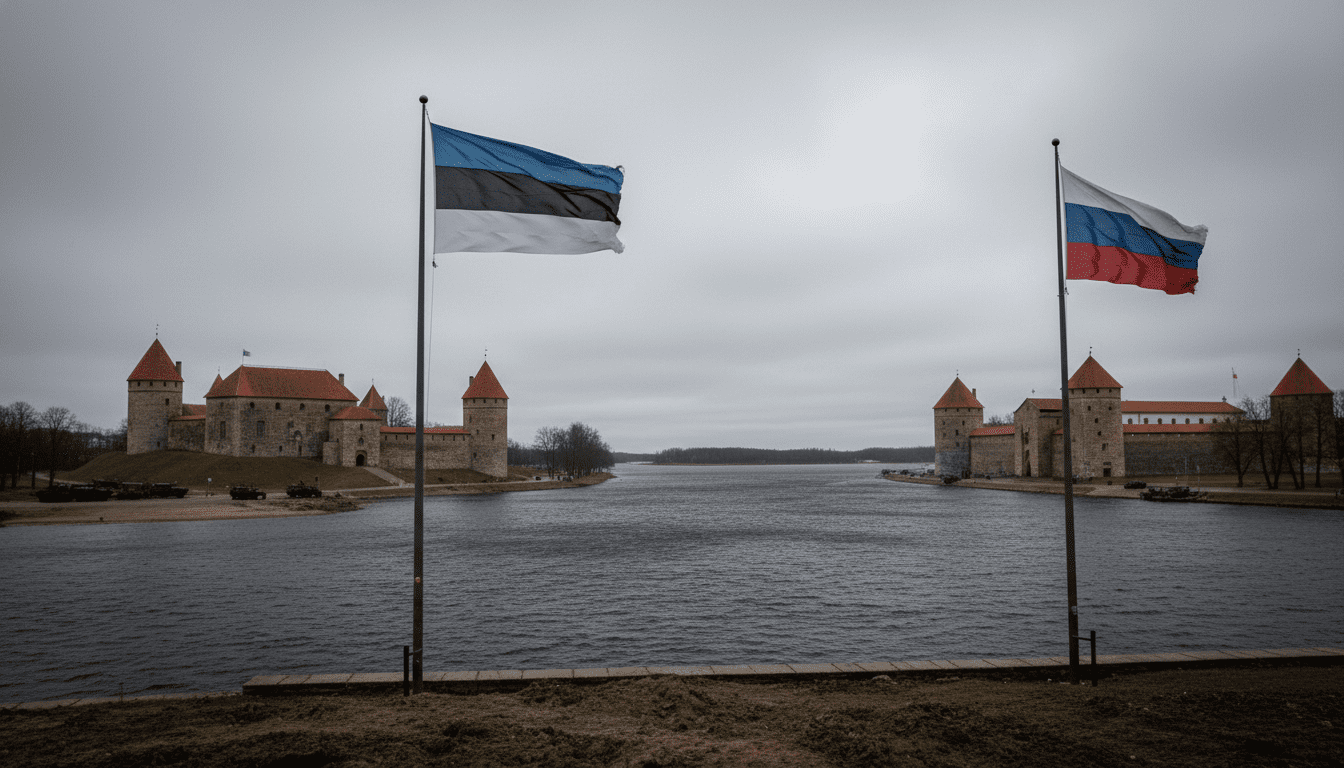
Narva scenario raises alarm over NATO vulnerabilities on Estonia’s Russian border
Experts warn of the Narva scenario: a possible Russian strike on Estonia’s border city Narva, exposing NATO vulnerabilities and local demographic tensions.
Narva, the Estonian border city facing Russia across the Narva River and a nearby reservoir, has become the focal point of a recurring strategic concern known as the “Narva scenario.” Analysts say the scenario imagines a rapid Russian operation targeting the city, exploiting geography and the fact that roughly 85 percent of Narva’s population speaks Russian. Voices in regional security circles, including Minna Ålander of the Swedish Institute for International Affairs and Marek Kohv of the Estonian ICDS, have repeatedly noted the scenario’s plausibility and its growing presence in public debate.
Narva’s strategic position on the Russian frontier
Narva sits at a narrow seam between Estonia and the Russian Federation, where the river forms a direct natural boundary. The adjacent reservoir and a limited number of crossings constrain movement and make the urban area a distinct tactical objective for any force operating from the east.
The city’s location gives it outsized significance for planners: control of Narva would offer a staging ground and a symbolic breach of NATO territory. That combination of practical access and political symbolism helps explain why the scenario has attracted persistent attention among analysts and in open-source discussions.
Demographics and the local context
Narva’s population is predominantly Russian-speaking, a legacy of Soviet-era migration and postwar settlement patterns. That demographic composition shapes both local politics and the information environment, with community ties and media consumption patterns that differ from much of Estonia.
Security experts caution that a Russian operation could seek to exploit these social networks and communicative channels, using propaganda, coercion, or staged incidents to justify intervention. Observers emphasize, however, that the presence of a Russian-speaking majority does not equate to automatic support for external military action.
How the ‘Narva scenario’ is framed by analysts
The “Narva scenario” typically describes a relatively swift cross-border incursion or a hybrid campaign aimed at seizing or destabilizing the city. Analysts sketch variations that range from overt military assaults to covert special-operations activity accompanied by cyberattacks and disinformation.
Those who study the scenario stress its function as a planning tool: it structures contingency thinking about NATO’s eastern flank, helping militaries and policymakers test responses to sudden, escalatory events. The scenario’s wide circulation—where it has become a named hypothetical—reflects its utility in rehearsing worst-case outcomes.
NATO posture and Estonia’s defensive measures
NATO has reinforced its presence in the Baltics since 2014, rotating multinational battlegroups and enhancing allied interoperability to raise the costs of aggression. Estonia has also invested in territorial defence, civil preparedness, and rapid response capabilities designed to complicate any attempt to seize urban centers quickly.
Despite these measures, planners note persistent challenges: the proximity of Russian forces, the complexity of urban combat, and the political dilemma that would confront alliance leaders if a battle unfolded in a densely populated, ethnically mixed city. Exercises and intelligence-sharing are intended to mitigate those risks, but analysts say no defence posture is invulnerable.
Information operations and legal complexities
Beyond kinetic risks, the Narva scenario highlights the role of information operations and legal pretexts in modern conflict. Hybrid tactics—ranging from orchestrated protests to fabricated incidents—could be used to manufacture justification for intervention or to confuse both local populations and allied decision-makers.
Legal questions also loom large. An attack on Narva would pose immediate Article 5 considerations for NATO, but the alliance would face complex judgments about the nature of the threat, attribution, and the threshold for collective response. That ambiguity itself is a leverage point in hybrid strategies.
Regional ripple effects and diplomatic stakes
A crisis centered on Narva would have consequences well beyond Estonia’s borders, testing Baltic cohesion and transatlantic resolve. Neighbouring states watch any escalation closely, aware that the handling of a single border city could set precedents for containment, deterrence, and alliance unity.
Diplomatically, the scenario would likely trigger intense international engagement, including emergency consultations within NATO, appeals to international bodies, and efforts to de-escalate while preserving credible defensive options. For smaller states in the region, the stakes combine territorial sovereignty with wider questions about the credibility of collective defence.
The Narva scenario has become more than a theoretical exercise; it now shapes training, intelligence assessments, and public debate about the limits of deterrence along NATO’s eastern flank. Policymakers stress that preparedness—military, informational, and legal—remains essential to prevent a localized incident from spiralling into a broader conflict.
