
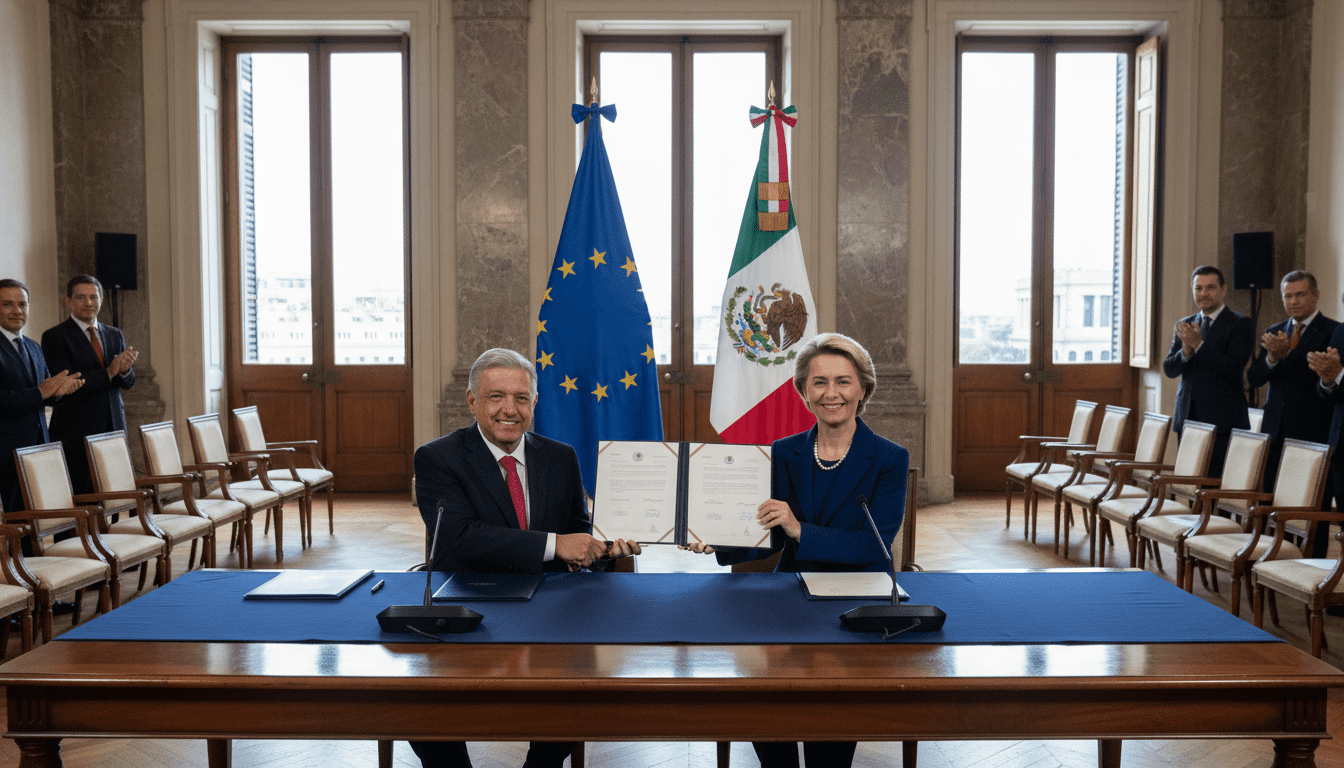
EU-Mexico trade agreement opens markets as Mexico to lift most tariffs
EU-Mexico trade agreement signed in Mexico City after decade-long talks, ending most Mexican tariffs on EU goods and securing €5bn in EU investment now.
The EU-Mexico trade agreement was formally signed in Mexico City after ten years of negotiations, marking a major upgrade in economic and political ties between the European Union and Mexico. The accord, signed by senior EU and Mexican leaders, aims to remove almost all Mexican tariffs on EU imports while opening new avenues for public procurement and digital commerce. EU Council President António Costa said the partnership is “more important than ever” in the current geopolitical climate.
Agreement signed after a decade of negotiations
The signing brought together EU Commission President Ursula von der Leyen, EU Council President António Costa and Mexican President Claudia Sheinbaum in Mexico City for the first full EU–Mexico summit in a decade. Delegations described the deal as a modernised replacement for the previous framework, reflecting new trade priorities such as digital trade, sustainability and human rights.
An interim trade agreement was also initialed to allow parts of the pact to enter into force while the full text undergoes ratification across EU member states. Officials said the interim arrangement will be followed by a “global” agreement once the EU’s internal ratification processes are complete.
Tariff eliminations and market access provisions
Under the new agreement, Mexico will phase out the vast majority of tariffs on EU exports, covering sectors from machinery to agri-food products. European officials outlined measures designed to streamline customs procedures and remove bureaucratic barriers that previously impeded cross-border trade.
Reports from trade promotion bodies indicate that roughly 95 percent of Mexican duties on EU agricultural exports will be removed, expanding market access for products such as dairy and processed foods. The pact also contains provisions aimed at facilitating EU companies’ participation in Mexican public procurement tenders.
EU investment package and strategic diversification
As part of the deal, the European Commission pledged a package of roughly €5 billion in support for Mexican infrastructure and development projects. EU leaders framed the investment as a means to deepen economic ties and to support resilient supply chains in the face of shifting global trade dynamics.
European and Mexican officials said the agreement is also a strategic move to diversify trade relationships beyond traditional partners. In official remarks, the EU highlighted a desire to build a more balanced transatlantic and transpacific trade architecture amid geopolitical uncertainty.
Protection of EU geographical indications and critical supplies
A significant element of the agreement secures protection for European geographical indications, covering names such as Parma ham, certain Bavarian beers and other regional food specialties. Trade authorities said this gives EU producers legal safeguards in the Mexican market and clarifies labelling rules for consumers.
The text also includes commitments on access to critical raw materials and regulatory cooperation on digital trade. These clauses are intended to support industrial supply chains and give businesses clearer rules for cross-border data flows and e-commerce.
Industry praise and civil society concerns
German and European industry representatives welcomed the pact as a boost to legal certainty and market predictability. Wolfgang Niedermark of the Federation of German Industries said the modernised framework enhances planning for companies operating in Mexico and strengthens bilateral economic relations.
European Parliament trade chair Bernd Lange (SPD) described the deal as a vote for open and fair trade, arguing it will help European exporters. At the same time, more than 70 NGOs from Latin America and the EU voiced strong criticisms, with Bettina Müller of PowerShift warning that the agreement risks expanding investor privileges and undermining environmental and social safeguards.
Next steps and ratification timeline
The interim agreement is expected to take effect once the necessary administrative steps are completed, but full implementation will depend on ratification by EU member states and the European Parliament. Officials cautioned that timelines may vary, and some chapters — notably those involving procurement and regulatory cooperation — could be phased in after parliamentary approval.
Mexico, with a population of around 130 million and positioned as Latin America’s second-largest economy, was presented by negotiators as a strategic partner for European manufacturing and trade. Its proximity to the United States and participation in the USMCA make Mexico an important node for European companies seeking diversified production and market access.
The EU-Mexico trade agreement sets out a comprehensive agenda spanning tariffs, investment, digital trade and standards, but its long-term impact will depend on the pace of ratification and how implementation addresses the concerns raised by civil society.
