
Ernst Thälmann Park: Prenzlauer Berg’s Monument, the Gasworks Legacy and a Divided Memory
Ernst Thälmann Park in Prenzlauer Berg stands at the intersection of industrial transformation, GDR political mythmaking and ongoing debates over public memory, making it one of Berlin’s most contested urban landmarks.
Opening summary
Ernst Thälmann Park sits on the hill where a nineteenth‑century gasworks once dominated the Prenzlauer Berg skyline, and today the estate, planetarium and colossal bronze monument attract visitors who encounter a dense, contested history. The name Ernst Thälmann Park is inseparable from both the life of the Hamburg communist leader and the GDR’s campaign to enshrine him as an antifascist martyr. The site also tells a second story: the conversion of heavy industrial land into large‑scale housing, public amenities and green space during the late socialist era. As the park passes its third decade since inauguration, debates about conservation, symbolism and local identity remain very much alive.
Hamburg uprising of October 1923 and its aftermath
The Hamburg events of October 23, 1923, were a violent episode in a wider plan for a national communist insurrection that ultimately failed across Germany. Around 1,300 armed insurgents seized multiple police stations in Hamburg, Altona and neighboring districts, only to be confronted by reinforced police units and armored vehicles the following morning. The operation ended in a rout with well over a hundred people killed, most of them civilians, and the episode became a decisive moment in the KPD’s shift away from immediate attempts to seize power by force.
That unsuccessful uprising hardened internal disputes within the German communist movement and led to leadership changes in the mid‑1920s. Responsibility for the fiasco was directed at the KPD’s then‑leader, prompting reorganization and fresh leaders to emerge across the party. One of the local commanders in Hamburg who later rose through party ranks was Ernst Thälmann, a working‑class activist whose wartime service and early political work in Hamburg shaped his public profile.
Ernst Thälmann’s working‑class origins and political formation
Ernst Thälmann was born in Hamburg in 1886 into a modest family whose livelihood came from a small grocery and haulage business. Leaving formal schooling early, he worked in the docks and shipyards and briefly traveled to the United States as a stoker and farm labourer, experiences that grounded his identity as a proletarian activist. He joined the Social Democratic movement in the first decade of the twentieth century and became active in union organizing among transport and carriage workers.
Thälmann’s political trajectory moved leftward after the First World War, as he aligned with anti‑war socialists and ultimately with the newly consolidated Communist Party of Germany. He held a seat in the Hamburg parliament from 1919 to 1933 and developed a reputation as a streetwise organiser who could both mobilise industrial workers and survive violent attacks by right‑wing opponents. Those qualities later made him an appealing candidate for Soviet‑aligned leaders across the Comintern.
From KPD leader to Stalin’s protégé
By the mid‑1920s Thälmann had risen to national prominence, winning a Reichstag mandate and drawing closer to Soviet organisers after Lenin’s death in 1924. With repeated visits to Moscow and a seat on Comintern committees, he became a reliable interpreter of Moscow’s line in German politics and was appointed KPD leader in 1925 with explicit Soviet support. Under Thälmann the KPD grew electorally in the late Weimar years, but its strategy of treating the Social Democrats as the primary adversary fractured potential anti‑Nazi cooperation.
Thälmann’s leadership also brought increasing internal discipline and purges of anti‑Stalinist opposition within the party, consolidating a top‑down organisational culture that matched Soviet preferences. Elections in the late 1920s and early 1930s reflected a growing KPD vote share, even as the party’s enmity with the SPD deepened and the democratic centre proved unable to marshal a unified defence against National Socialism.
Imprisonment, isolation and death under the Nazi regime
When the Nazi government outlawed the Communist Party in 1933, Thälmann was arrested and held for years in a sequence of prisons under harsh conditions. He endured lengthy solitary confinement, repeated interrogation and physical mistreatment while imprisoned in facilities including Moabit, Hanover and Bautzen. Despite offers or pressure to renounce his beliefs, he refused to make any public recantation and continued to hope that international communist networks might secure his release.
After the signing of the Molotov‑Ribbentrop Pact in August 1939 and the changing diplomatic calculations that followed, Thälmann’s fate grew bleaker. In the final chapters of the Third Reich, the regime selected several high‑profile political prisoners for execution; Thälmann was murdered on August 17, 1944, at Buchenwald, a death that transformed him into a martyr figure for the postwar East German state.
GDR mythmaking and the creation of a Thälmann cult
The Socialist Unity Party of East Germany (SED) moved quickly after 1945 to incorporate Thälmann into the new state’s founding mythology, presenting him as a heroic antifascist who symbolised working‑class resistance. State propaganda repurposed his writings and final letters, produced films and school curricula, and created organisations for children and youth that bore his name. Across the GDR, streets, squares and institutions were renamed to anchor the personality cult in civic life.
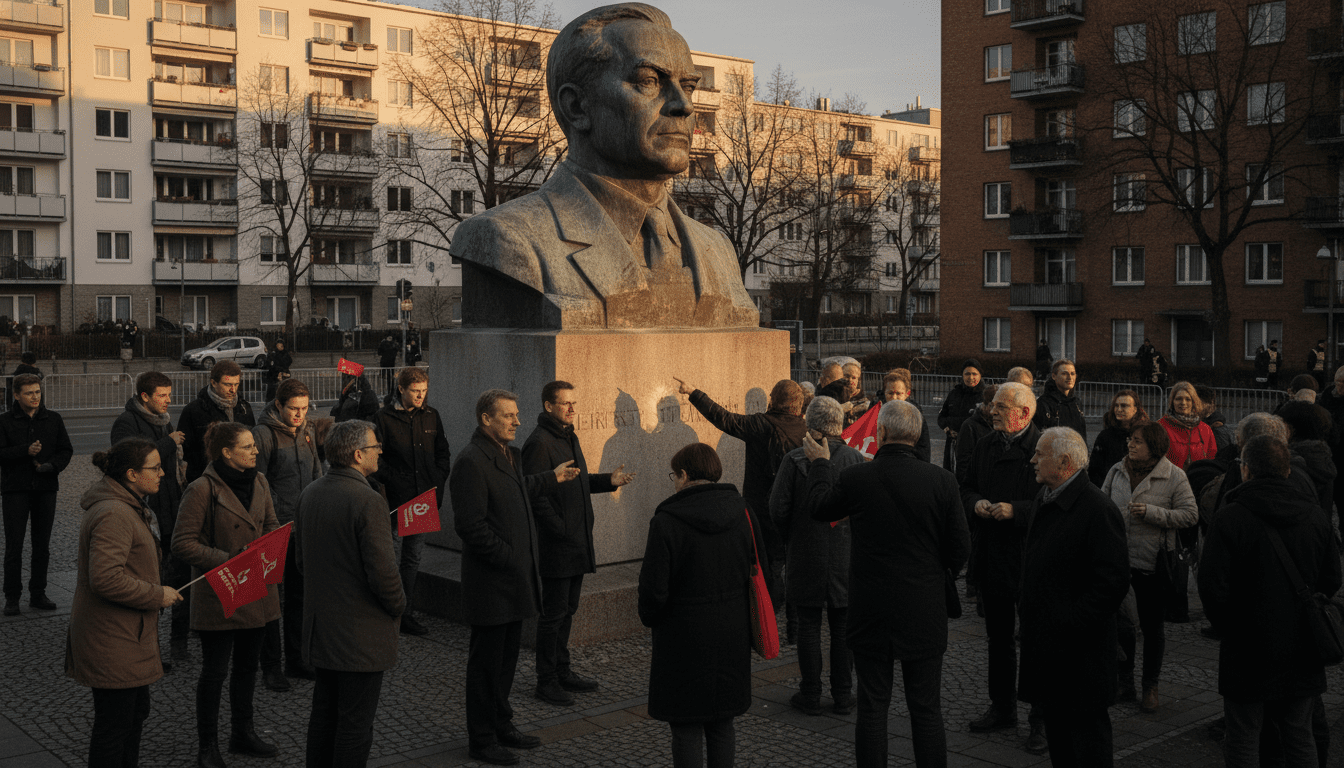
This deliberate elevation reached its architectural and visual apex with plans for a monumental memorial in Prenzlauer Berg. The Thälmann monument—an enormous bronze bust set on a parade square—was commissioned in the 1980s as a prominent statement of state remembrance. Designed and executed by a Soviet sculptor, it rapidly became a focal point for ceremonies, school visits and curated representations of heroism in the East German public realm.
From Gaswerk IV to a large‑scale housing estate
The terrain on which Ernst Thälmann Park now sits was for a century dominated by Berlin’s industrial infrastructure, beginning with Gaswerk IV established in 1872. The gasworks expanded during the late nineteenth and early twentieth centuries to serve growing suburbs and became a major local employer and landmark, with towering cylindrical towers and coking ovens visible across the neighbourhood. Working conditions were harsh in the plant and the site played a significant role in local labour organising and industrial disputes.
Wartime damage and postwar reconstruction altered the complex, but the site continued in East German service as a key producer of gas and coke for decades. By the late 1970s, shifts in energy supply and the adoption of imported natural gas rendered the plant obsolete, and production ceased in May 1981. That closure reopened long‑standing municipal plans to convert the brownfield into green space and housing, a project that the GDR advanced with political urgency in the 1980s.
Design, construction and community life in the new estate
Plans for the redevelopment combined housing, social infrastructure and cultural facilities into a single, self‑contained estate aimed at both practical needs and symbolic display. Architects employed new prefabricated housing types in fan‑shaped arrangements to frame the proposed monument, while community amenities included a public indoor pool, a planetarium, a school, shops and childcare provision. The scheme delivered roughly 1,300 apartments intended to house around 4,000 residents and incorporated public squares, gardens and playgrounds intended to foster neighbourhood life.
Builders sought to reference the industrial past through material choices and site planning, and the estate’s layout avoided the denser, mechanistic forms of earlier Plattenbau developments. Planting plans and recreational spaces were emphasised, and a long‑planned park was reintroduced into the redevelopment narrative. Inaugurated on April 16, 1986—Thälmann’s hundredth birthday—the complex opened amid ceremonial attention and state celebrations.
Demolition, protest and environmental legacies
Not all of the old gasworks was preserved; the three brick gasometers that had dominated the skyline were declared structurally unsound and demolished amid public protest. Residents, artists and civic groups mobilised against the loss of familiar landmarks, while state authorities moved to remove structures they regarded as obsolete. The demolition was tightly controlled and even photographed under restriction, and the event left a visible gap in the urban silhouette.
Beyond the physical removal of buildings, the site carried an environmental legacy. Soil and groundwater contamination with cyanides, phenols and coal tar required excavation and bioremediation work after reunification, and remediation has remained an ongoing task to secure the area for residential use. Authorities have stated that cleanup measures eliminated significant risks to residents and drinking water, but the contamination history continues to frame discussions about health, redevelopment and postindustrial stewardship.
Monumental art, Soviet authorship and local controversy
The Thälmann sculpture that anchors the park was created by a Soviet artist and installed as the symbolic centrepiece of the ensemble, a decision that provoked debate even within the GDR. The massive bronze work—measured in tonnes and several metres in scale—occupies a parade square and was intended to be visible from the official route leading to party residences beyond Berlin. For the SED leadership, the monument served to project antifascist legitimacy and to connect the young GDR with an older narrative of resistance.
After German reunification the monument’s presence became a subject of renewed controversy as many Berliners reappraised the politics embedded in the cityscape. Questions were raised about whether a large, ideologically charged sculpture should remain in public space, and municipal authorities considered demolition or removal in the early 1990s. Funding constraints, legal protections and divided public opinion complicated any straightforward decision to dismantle the memorial.
Post‑1990 conflicts, preservation and local opinion
The years after reunification saw the monument and park become sites of political contestation and irregular appropriation. The square around the monument was repeatedly targeted by graffiti and provocations, and in 1992 a neo‑Nazi demonstration took place on May 1 directly in front of the memorial, provoking clashes with counter‑demonstrators. In 1993 the Berlin Senate voted to remove the memorial, but the plan was stalled by lack of funds and subsequent legal developments.
A change in local sentiment followed a popular survey in 1997 in which a majority of residents favoured retaining the park’s name, and in 1995 officials placed the memorial under preservation listing. Later, in 2014, the entire park received official heritage protection, recognising both its architectural ensemble and its layered historical significance. These formal protections have turned the site into an urban palimpsest where competing memories are intentionally preserved rather than erased.
Visiting today and reading the layers of history
Ernst Thälmann Park now functions as a residential quarter, a recreational destination and a locus for critical reflection on twentieth‑century German history. Visitors can reach the park on local transit and encounter everyday life—playgrounds, cafés and the planetarium—alongside the vast bronze head that still commands the parade square. Informational plaques and local guides provide concise biographical context, but the monument itself remains ambiguous: a memorial to a man murdered by the Nazis, and simultaneously a relic of a propagandistic past that shaped the GDR’s identity.
The site invites a particular kind of urban reading: industrial archaeology visible in street patterns and material choices, GDR urban design in building typologies, and the politics of remembrance expressed through sculpture and placenames. For those interested in labour history, the Weimar-era uprisings and the fraught political currents that preceded the Nazi seizure of power, the park offers tangible points of departure for further exploration across the city.
What the monument and park tell us about public memory
Ernst Thälmann Park demonstrates how public spaces can become vessels for competing historical narratives rather than straightforward commemorations. The monument embodies both legitimate claims to antifascist resistance and the GDR’s instrumental use of memory to secure political legitimacy. Its continued presence prompts questions about whether some memorials should be removed, recontextualised or retained as testimonies to the complexities of the past.
Local decisions—referenda, preservation listings and municipal stewardship—have turned the park into a negotiated landscape where community identity, heritage law and political sentiment intersect. The park’s evolution suggests that urban memory is not only about monuments themselves, but also about the civic processes that determine which pasts are publicly visible and which are relegated to archives.
A short walk across the lawn, around the pond and up the paths that once carried coal to the ovens offers a condensed history lesson in Berlin’s industrial growth, interwar turbulence and the Cold War’s imprint on urban life. The site remains a productive place to reflect on how cities transform contested ground into liveable neighbourhoods while still carrying visible reminders of complex and sometimes uncomfortable histories.
